Organic poultry farming (BIO) — where to start
Organic production is not just ‘chemical-free’. It is a strict set of requirements from European Union rules on organic farming: constant access to an outdoor range, lower stocking density, organic feed, restrictions on treatment and mandatory inspection by a certification body. We explain simply what you must meet, how to get certified and when you may use the EU organic logo.
verifiedFrom the team that has organised work on poultry farms for years.
What organic poultry farming is
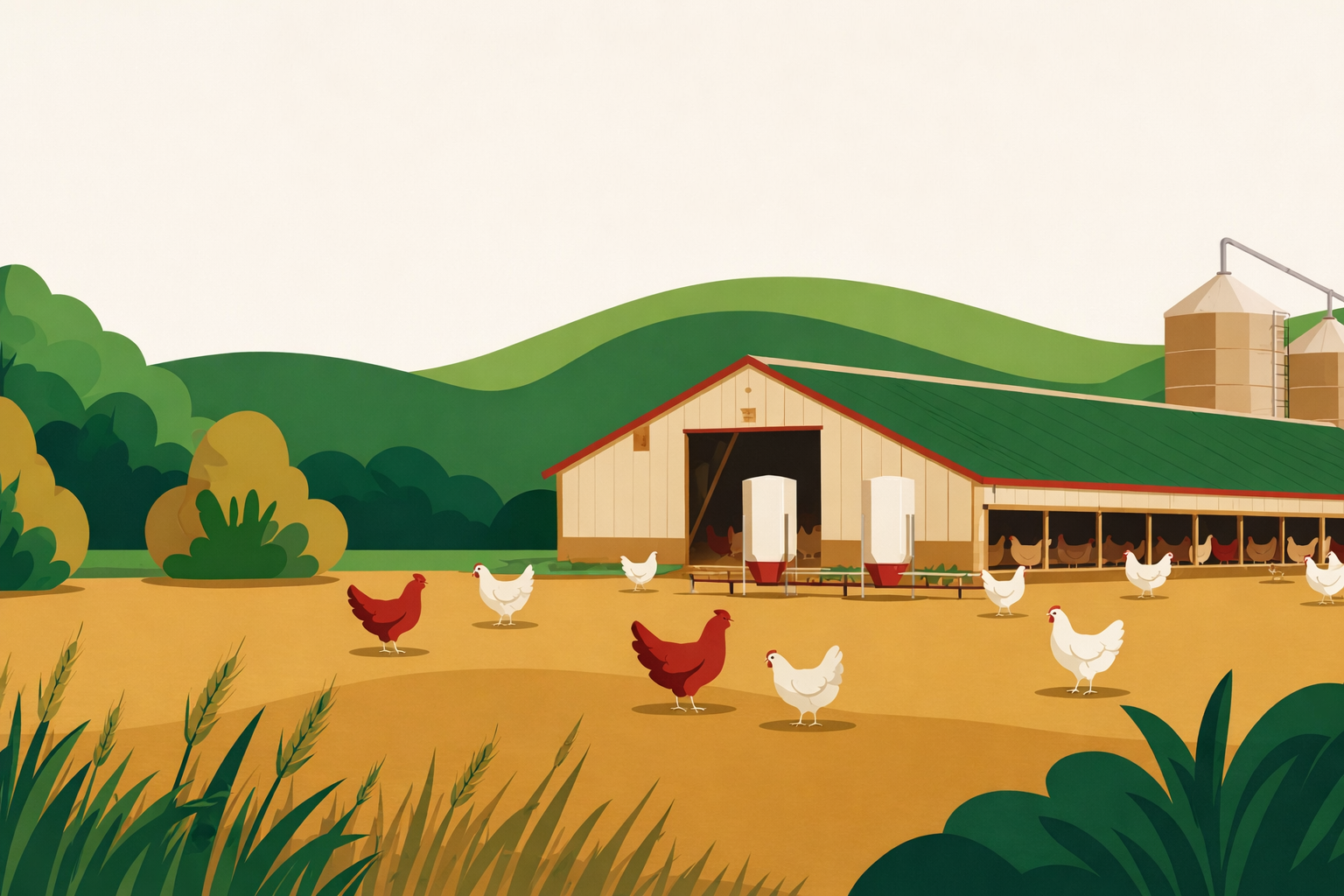
Organic farming (labelled ‘bio’ or ‘eco’) is a way of keeping poultry in line with European Union rules on organic farming. Birds have constant access to an outdoor range, are fed organic feed, kept at a lower density, and chemical treatment is heavily restricted. Most importantly: you may call a product ‘organic’ only after passing inspection and obtaining a certificate from an authorised certification body. This is a completely different model from large-scale farming geared towards maximum intensity.
Range, density and space — the foundation of the system
In the organic system birds must have access to an open, vegetated range for most of the day, and the stocking density — both in the building and on the range — is lower than in intensive farming. Lower density and outdoor movement improve welfare, but they increase the area needed per bird and the workload. These requirements are set out numerically in EU rules, so always check the specific figures in the current regulation and with your certification body. We expand on welfare in the guide on poultry welfare and payments.
Organic feed and treatment restrictions
Organic poultry is fed feed from certified organic production, without synthetic additives that the rules do not allow. Routine, preventive use of antibiotics is forbidden — a medicine may be used only to treat a specific illness, under veterinary supervision, and the withdrawal period (the time after which the product may again be sold as food) is extended compared with conventional farming. You must record every treatment. The treatment and withdrawal records and knowing how to calculate the withdrawal period for poultry will help.
Organic certificate and EU logo — no ‘bio’ without it
The words ‘organic’, ‘bio’ and ‘eco’ are legally protected. You may use them only once the holding is under the control of a certification body and holds a valid certificate — before that there is a conversion (transition) period. An organic product is labelled with the EU logo (the green ‘Euro-leaf’), the certification body’s number and information on the origin of the raw materials. This requires solid documentation and records, which you can conveniently keep in the poultry farm management software, and DlaFerm.pl can file your flock records in IRZplus for you — automatically, if you want.
The road to an organic certificate
Certification is a process, not a one-off formality. Here are six stages — from the decision to the first sale of a product bearing the organic logo.
1. Learn the requirements and do the maths
Before you change anything, read the EU organic-farming requirements for poultry: range, density, feed, treatment. Estimate whether your house and plot will meet them and what it will cost. It is worth turning to the Agricultural Advisory Centre (ODR) for knowledge and support. This is the ‘do I go organic at all’ decision stage.
2. Choose a certification body
The certificate is issued by an authorised certification body — it inspects the holding and confirms compliance with the rules. You pick one of the bodies supervised by the Agricultural and Food Quality Inspection (IJHARS) and notify it of your intention to produce organically. That notification starts the whole process.
3. Go through the conversion (transition) period
After the notification a transition period begins — a time when the holding already produces according to organic rules, but the product may not yet be sold as organic. The length of conversion depends on the type of production and follows from the rules — you will settle the exact time with the certification body.
4. Adapt the house, range and feed
During conversion you set up the holding to meet the requirements: you provide access to a range, lower the density, switch to organic feed and arrange disease prevention without routine antibiotics. Well-planned feeding and a choice of feed mixes in a certified organic version help here.
5. Inspection and issuing of the certificate
The certification body carries out an inspection of the holding — it checks the conditions, documents, the origin of feed and chicks, and the treatment records. If everything is compliant, it issues a certificate of conformity. Only with a valid certificate may you name and label the product as organic.
6. Label, sell and renew
With the certificate you place the product on the market with the EU organic logo, the body’s number and information on origin. Inspection recurs periodically and the certificate must be renewed — keeping the organic status is ongoing work. We cover sales channels in poultry farming for sale and in on-farm sales (RHD).
Requirements, costs and pitfalls of organic production
Before you go for certification, count the costs and learn the limits. Here are six areas that most often surprise beginners.
Density and range
The organic system requires a lower density of birds in the building and constant access to a vegetated range for a large part of the day. This means more space and land per bird than in intensive farming. The exact limits are in EU rules — check them in the current regulation and with the certification body before you work out how many birds will fit.
Organic feed
You feed only feed from certified organic production, often more expensive and harder to source than conventional feed. Some raw materials may come from your own holding if it is in the organic system. The origin of every feed batch must be documented — it is one of the main inspection points and a real production cost.
Veterinary care and treatment
Routine, preventive use of antibiotics is forbidden. You use a medicine only to treat a sick flock, under veterinary supervision, and the withdrawal period is longer than in conventional farming. A sick animal must always be treated — you may not refuse treatment to ‘save’ the organic status. Record every procedure in the records.
Certification and documentation
A certificate is not a one-off paper but ongoing supervision: notification, transition period, inspections, renewal. You must keep reliable records — the origin of chicks and feed, treatment, sales, the range. Gaps in documentation are the most common reason for remarks during inspection. You will organise it in the farm management software.
Registering the holding
Regardless of ‘organic’, the usual requirements apply to you: registering the poultry activity, a veterinary number, reporting the flock. We cover this in registering a poultry farm and in the farm veterinary number. Organic certification sits ‘on top of’ these basic duties, not instead of them.
Costs and profitability
Organic production is more expensive: lower density, costlier feed, more work, the cost of certification. In return you sell the product at a higher price and reach a customer looking for organic food. Work out profitability realistically for your scale and market — it is a niche, premium model, not a mass one. Look for support and calculations at the ODR.
Frequently asked questions about organic poultry farming
Can I call eggs or poultry ‘organic’ without a certificate?add
No. The words ‘organic’, ‘bio’ and ‘eco’ are legally protected and you may use them only when the holding has a valid certificate issued by a certification body. Before that, during the transition period, you sell the product as conventional. Using the term ‘organic’ without a certificate misleads the consumer.
What is the conversion (transition) period?add
It is the time after notifying the certification body during which you already produce according to organic rules, but the product may not yet be sold as organic. This is meant to give assurance that the holding really operates in line with the rules before it receives a certificate. The length of conversion follows from EU rules and you will settle it with the certification body.
Are antibiotics allowed in organic farming?add
Routine, preventive use of antibiotics is forbidden. A medicine may be used only to treat a specific illness, under veterinary supervision, and an extended withdrawal period then applies. A sick animal must always be treated — welfare is more important than keeping the organic status. You record every treatment in the records.
What feed is allowed in organic farming?add
Organic poultry is fed feed from certified organic production, without prohibited synthetic additives. Some raw materials may come from your own organic holding. The origin of every feed batch must be documented, because it is one of the key inspection points of the certification body.
Who issues the organic certificate and how do you get it?add
The certificate is issued by an authorised certification body, supervised in Poland by IJHARS. You notify it of your intention to produce organically, go through the transition period and an inspection of the holding, and once compliance is confirmed you receive a certificate. The specific requirements and prices differ between bodies, so it is worth comparing several.
Is organic farming profitable?add
It depends on the scale, costs and market. Organic production is more expensive than conventional (lower density, costlier feed, more work, the cost of certification), but you sell the product at a higher price to a customer looking for organic food. It is a niche, premium model — work out profitability realistically for your holding and turn to the ODR for support.
Run your organic poultry farm in one place with DlaFerm.pl
Organic certification means a lot of documentation: the origin of feed and chicks, treatment, withdrawal periods, the range, sales. DlaFerm.pl helps you keep the Flock Card, treatment records and flock records in IRZplus — all ready for inspection. Create a free farm account.
Phone
+48 796 258 151