Crooked legs in turkeys — tibial dyschondroplasia (TD) and leg deformities
Lameness and crooked legs are one of the biggest welfare problems in fast-growing turkeys. We explain in plain language what tibial dyschondroplasia is, what leg deformities look like, and what you can do on the farm to reduce the problem.
verifiedFrom the team that has organised work on poultry farms for years.
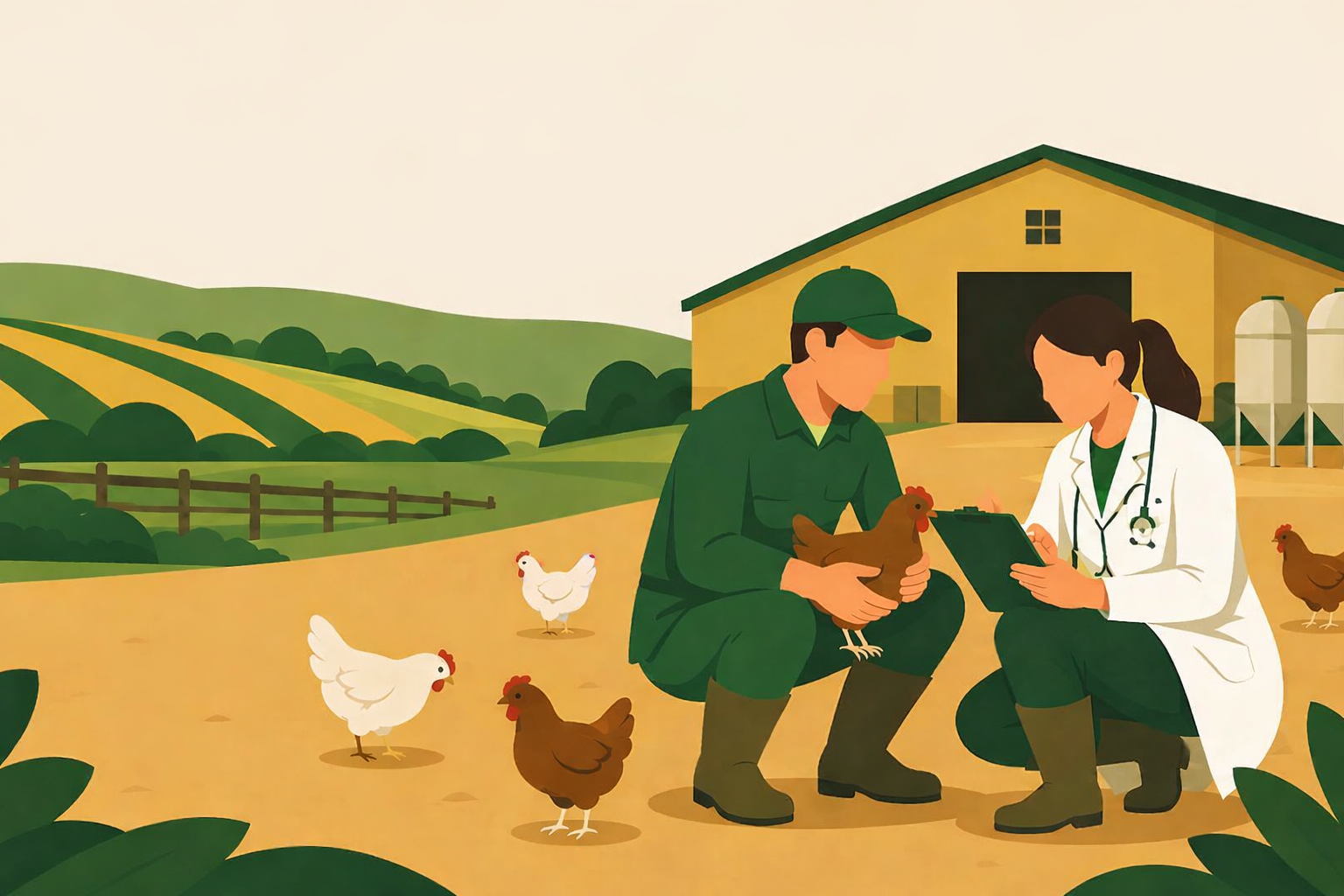
Fast-growing turkeys — especially heavy tom turkeys — are prone to leg problems. A lame bird eats less, grows more slowly, and is more likely to be culled (removed from the flock). That is a loss for the farmer and a welfare problem for the birds. This guide is part of the turkey cluster — the full picture of turkey production is in the guide on turkey farming.
What is tibial dyschondroplasia (TD)?
Tibial dyschondroplasia (TD) is a bone growth defect: the cartilage growing in the tibial bone (the long leg bone) does not turn into strong bone properly — a soft, unossified plug remains that cannot bear the bird's body weight. The leg hurts, the bird limps or cannot walk at all. It most often affects heavy tom turkeys in the final stage of the rearing cycle, but can occur in any bird growing too fast.
What are valgus and varus deformities?
Leg deformities are visible to the naked eye: the leg bends at the hock joint (the joint just above the toes in a bird) — either outward or inward. Valgus — the leg bends outward, birds stand in an X shape. Varus — the leg bends inward, birds stand in an O shape. With severe deformity the bird limps or cannot move at all and must be humanely culled.
Dyschondroplasia, valgus and varus — how to recognise them
The three main leg problems in turkeys differ in cause and symptoms, but share a common outcome: lameness, reduced welfare, increased mortality, and culling.
Tibial dyschondroplasia (TD)
A bone growth defect: cartilage in the tibial bone does not turn into strong bone — a soft, unossified plug remains in the tibia. The leg cannot bear the bird's body weight, the bird limps or sits and does not rise. There is no visible external deformity — lameness without obvious bending is a reason to suspect TD. Confirmation requires a post-mortem or X-ray. Most common in fast-growing, heavy tom turkeys in the second half of the rearing cycle.
Valgus — leg bends outward (X shape)
The hock joint (just above the toes) bends outward — birds stand with their legs in an X shape. With mild valgus the bird still walks but is lame. With severe valgus it cannot walk and must be humanely culled as quickly as possible. Assess by looking at the bird from the front: are both legs straight, or do they bow outward?
Varus — leg bends inward (O shape)
The hock joint bends inward — birds stand with crossed or close-together feet in an O shape. Varus is less common than valgus, but restricts movement and welfare just as much. Assess by looking from the front and the side: are the tibia and foot in a straight line?
Lameness without visible deformity
The bird is clearly lame, but the legs look straight from the outside. This could be TD, tendon pain, or another structural problem. Monitor the bird: if it does not improve within 1–2 days, it should be culled. If the problem is widespread in the flock, consult a vet and your poult supplier.
Why legs deform — and what you can do about it
Most leg problems in turkeys have several contributing causes. The good news: several of them can be reduced with good feed, a proper lighting programme, and attention to litter quality.
Too-fast growth rate and genetics
Heavy, fast-growing turkey lines are more prone to TD and leg deformities — the bones cannot keep up with the increase in body weight. This is a genetic trait that cannot be fully eliminated, but it can be reduced. Monitor growth rate by comparing weekly bird weights with the breeder's growth curve. If the flock is growing too fast, consider adjusting the lighting programme — more darkness slows feed intake and growth rate.
Nutritional errors — calcium, phosphorus, vitamin D3, manganese, zinc
Bones grow properly only when the feed contains the right amounts of minerals. Too little calcium or phosphorus (or a poor ratio between them) weakens bones. Vitamin D3 deficiency impairs calcium absorption — even a good diet "does not reach" the bones without D3. Manganese and zinc are needed for proper cartilage formation. Detailed turkey norms are in the guide on turkey nutrition — norms. If the problem is serious, have the feed analysed and compare with IZ-PIB norms.
Lighting programme — insufficient darkness
Turkeys without a dark period eat almost around the clock and grow too fast. Bones do not have time to strengthen. A proper lighting programme — with darkness at night — slows growth and reduces the risk of TD and deformities. Details are in the guide on the lighting programme for turkeys. The rule is simple: no darkness = too-fast growth = weaker legs.
Poor litter — wet or too hard
Wet litter is slippery and causes leg injuries. Hard, compacted litter does not cushion the steps of a heavy tom turkey — joints and bones are placed under greater stress. Good litter is dry, springy, and encourages the birds to move. The path from drinker to feeder should be as short as possible and always dry. A comparison of limb and foot problems in poultry is also in the guide on pododermatitis — foot pad quality in broilers.
Lack of movement and overcrowding
A bird that does not walk has weaker muscles and tendons — legs deform more easily. Overcrowding limits movement and increases competition for feed and water. Weaker birds go lame faster because they stand in one place. The correct stocking density is described in the guide on turkey stocking density.
Prompt, humane culling of severely lame birds
A bird that cannot walk is suffering — and suffers more with each passing day. Culling (humanely removing from the flock) is not a failure for the farmer but a welfare obligation. If a serious number of lame birds appear in the flock, consult a vet — they can determine whether the problem is genetic, nutritional, or environmental.
Frequently asked questions about leg problems in turkeys
What is tibial dyschondroplasia (TD) in turkeys?add
It is a bone growth defect: the cartilage growing in the tibia (the long leg bone) does not turn into strong bone properly — a soft, unossified plug remains. The leg cannot bear the bird's body weight, and the turkey limps or sits and cannot rise. Most common in heavy, fast-growing tom turkeys in the final stage of the rearing cycle.
What is valgus and varus in turkeys?add
Valgus — the leg bends outward at the hock joint, birds stand in an X shape. Varus — the leg bends inward, birds stand in an O shape. With mild deformity the bird is lame; with severe deformity it cannot walk and must be humanely culled. Assess by looking at the bird from the front.
Why do tom turkeys have more leg problems than hens?add
Tom turkeys grow faster and are heavier than hens — their bones and joints are placed under greater stress. Rapid body weight gain is the main reason for their susceptibility to dyschondroplasia and leg deformities. That is why leg problems appear more often and earlier in toms.
What minerals in the feed help prevent crooked legs?add
The most important are calcium and phosphorus (in the right ratio), vitamin D3 (without it calcium is not absorbed), manganese, and zinc. A deficiency of any of these minerals can impair proper bone and cartilage formation in growing turkeys. Detailed turkey norms are given by IZ-PIB in the Poultry Nutrition Standards.
How does the lighting programme affect turkey leg health?add
Turkeys without a dark period eat almost around the clock and grow too fast — bones cannot keep up with body weight gain. A proper lighting programme with a nightly dark period slows growth and reduces the risk of dyschondroplasia and leg deformities. The rule is simple: no darkness = too-fast growth = weaker legs.
When should I consult a vet about turkey leg problems?add
If more than 1–2% of the flock is lame, or if you see birds that cannot rise at all — consult a vet and your poult supplier. A vet can assess whether the problem is nutritional, genetic, or environmental and recommend further action.
Manage your turkey flock in DlaFerm.pl
Want to record lameness, mortality, and culling in one place? Create a free farm account or write to us.
Phone
+48 796 258 151