Poultry farm veterinary number: step-by-step registration with the district vet
Every poultry farm must be registered or approved by the district veterinary officer (PLW) and receive a veterinary identification number before it starts operating. Find out who is obliged, how the procedure works and what the consequences of skipping it are.
verifiedFrom the team that has organised work on poultry farms for years.
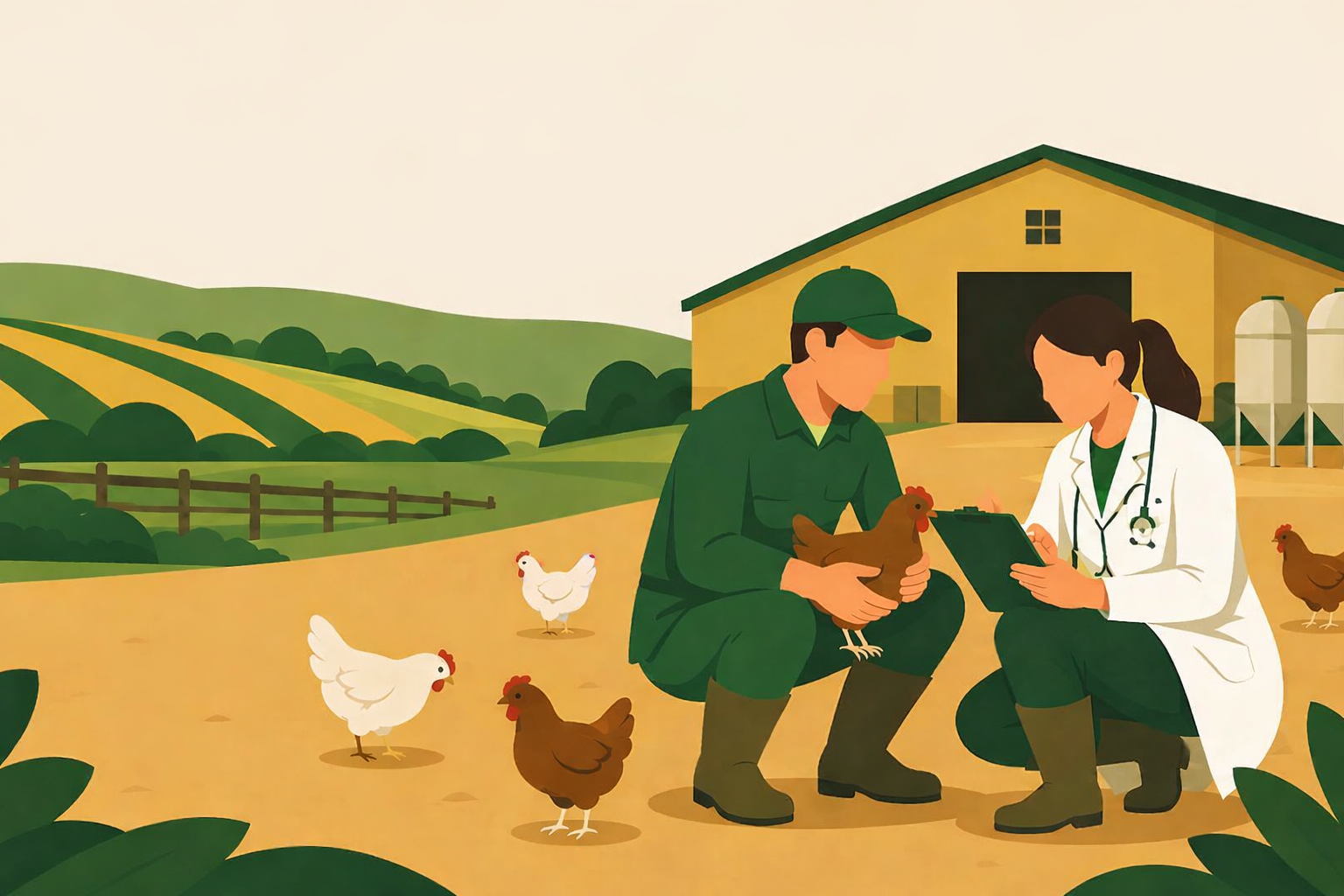
Who is required to register a poultry farm?
Anyone who keeps poultry — regardless of scale — is required to notify the district veterinary officer (PLW) competent for the location of the holding. The obligation stems from the Animal Health Protection Act and from EU Regulation 2016/429 (the Animal Health Law). It applies to large industrial farms and backyard flocks alike, above a set size threshold. Notification must take place before the first batch of birds arrives on the farm.
Registration vs. approval — what is the difference?
EU Regulation 2016/429 distinguishes two procedures: registration (for smaller or lower-risk operators) and approval (for farms presenting higher risk due to species, scale or production purpose). Farms keeping breeding birds or parent flocks require approval, not just registration. The PLW will indicate the correct procedure based on the description of your activities submitted with the application.
What is a veterinary identification number?
Once the application is approved, the PLW enters the farm in the register and assigns a veterinary identification number. This unique code identifies the farm in veterinary surveillance systems and is required when trading birds, issuing health certificates, registering in IRZplus and on documents accompanying live animals. The veterinary number must be quoted in dealings with the Inspection, the slaughterhouse and integrators.
Link to ARiMR, IRZplus and the producer number
The veterinary identification number does not replace the producer number from ARiMR. A poultry farmer must separately register with the Agency for Restructuring and Modernisation of Agriculture (ARiMR) to obtain a producer number, and then keep flock records in the IRZplus system. Both registers — veterinary and ARiMR — are interlinked: a change of farm location or closing down the farm requires updates in both. More about IRZplus: Flock records in IRZplus.
How to register a poultry farm and obtain a veterinary number — 6 steps
- 1
Establish whether you need registration, approval, or both
Before submitting any application, check which procedure applies to your operation. Farms keeping commercial poultry (e.g. broilers, laying hens for table eggs) are usually subject to registration. Farms with breeding birds, parent flocks or hatchling sales require approval. The PLW for your district will clarify — call or write before submitting your application.
- 2
Prepare details of the holding and farm buildings
For the application you will need: the exact address and cadastral plot number, a description of the buildings (number, type and capacity of livestock houses), the species and production direction of the poultry, the estimated maximum stocking density, the details of the owner or farm manager, and the planned start date. Also prepare a site plan or map with the buildings marked. Make sure you have biosecurity documentation — the PLW may require it for an approval. More: Poultry farm biosecurity.
- 3
Submit the application to the district veterinary officer (before starting operations)
The application for registration or approval is submitted to the PLW competent for the farm’s location. Most district veterinary inspectorates publish application forms on their websites or at their offices. Applications can be submitted in person, by post or via ePUAP. The law requires the application to be filed before the farm starts operating — breach of this deadline may result in an administrative penalty.
- 4
Inspection and decision on the veterinary number
For an approval, the PLW carries out an on-site inspection to verify that veterinary and biosecurity requirements are met. Following a positive assessment, the PLW issues an administrative decision and assigns the veterinary identification number. For standard registration, the number may be assigned without a site visit, after document verification. The statutory deadline is usually 30 days from the date of receipt of a complete application.
- 5
Register with ARiMR and enrol the flock in IRZplus
Once you have the veterinary number, visit the local ARiMR district office to obtain a producer number (if you don’t already have one). Then register the holding in the IRZplus system — this system is used for electronic records of animal movements (placements, slaughter, mortality, transfers). The deadlines for reporting changes to the flock are set by law — most commonly 7 days from the event. In DlaFerm.pl, if you want, we’ll send these reports to IRZplus for you, so you don’t have to retype the data in the ARiMR portal. More: Flock records in IRZplus.
- 6
Maintain required records and keep data up to date
After registration, the farm is subject to veterinary supervision. Keep the following up to date: flock records (IRZplus), treatment and drug withdrawal documentation, the farm entry log, and disinfection records. Changes to operations (species change, extension, change of ownership, farm closure) must be reported promptly to the PLW and updated with ARiMR. More on treatment records: HACCP and QAFP on a poultry farm.
Frequently asked questions about poultry farm registration and veterinary numbers
Does every poultry farm need a veterinary number?add
Yes. Every operator keeping poultry is required to register or obtain approval from the district veterinary officer and receive a veterinary identification number. The obligation arises from the Animal Health Protection Act and EU Regulation 2016/429. A farm without a veterinary number cannot legally sell birds or poultry products.
What is the difference between registration and approval of a farm?add
Registration is a simplified procedure for smaller or lower-risk operators. Approval is required for farms with breeding birds, parent flocks or hatchling sales — the PLW then inspects the farm and issues a decision following a positive outcome. The correct procedure is determined by the PLW based on the description of activities.
When must the application for farm registration be submitted?add
The application must be submitted before starting operations, meaning before the first batch of birds arrives on the farm. Submitting the application after the fact is a breach of the regulations and may result in an administrative sanction.
Is the veterinary number the same as the ARiMR producer number?add
No. These are two separate numbers from two different registers. The veterinary identification number is assigned by the PLW and is used for veterinary surveillance. The producer number is assigned by ARiMR and is required for, among other things, direct payments and notifications in IRZplus. Both are mandatory for a poultry farm.
What must be reported in IRZplus and by when?add
IRZplus requires notification of: bird placement (flock intake), slaughter, collective mortality and transfers. Reporting deadlines are usually 7 days from the date of the event, though the details are set out in implementing regulations. Failure to report may result in correction or blocking of ARiMR payments. If you want, DlaFerm.pl will prepare and send these reports to IRZplus for you — or you report yourself, whichever you prefer.
What happens when ownership changes or the farm closes?add
A change of owner, address, scope of activities or closure of the farm must be reported promptly to the PLW to update the veterinary register, and to the ARiMR district office. An unreported change may cause a mismatch between registers and make it difficult to trade animals or obtain veterinary certificates.
Sources & resources
- linkChief Veterinary Inspectorate — registration and approval of operators
- linkGov.pl — ARiMR: agricultural producer registration and animal records
- linkGov.pl — Animal Health Protection Act and control of infectious animal diseases
- linkEUR-Lex — EU Regulation 2016/429 (Animal Health Law)
- linkIRZplus — animal movement records system (ARiMR)
Manage your farm records in DlaFerm.pl
Need help with flock records, the entry log or treatment documentation? Write to us — we’ll show you how DlaFerm.pl organises the paperwork on a farm, and if you want, it will send your IRZplus reports for you.
Phone
+48 796 258 151