Crop fill assessment in chicks — broiler and turkey
The crop (a food pouch at the base of the bird's neck) filling up in the first hours after placement is the simplest way to check that chicks have found feed and water. We explain how to do it, what different crop types mean, and what the thresholds are for broilers and turkey poults.
verifiedFrom the team that has organised work on poultry farms for years.
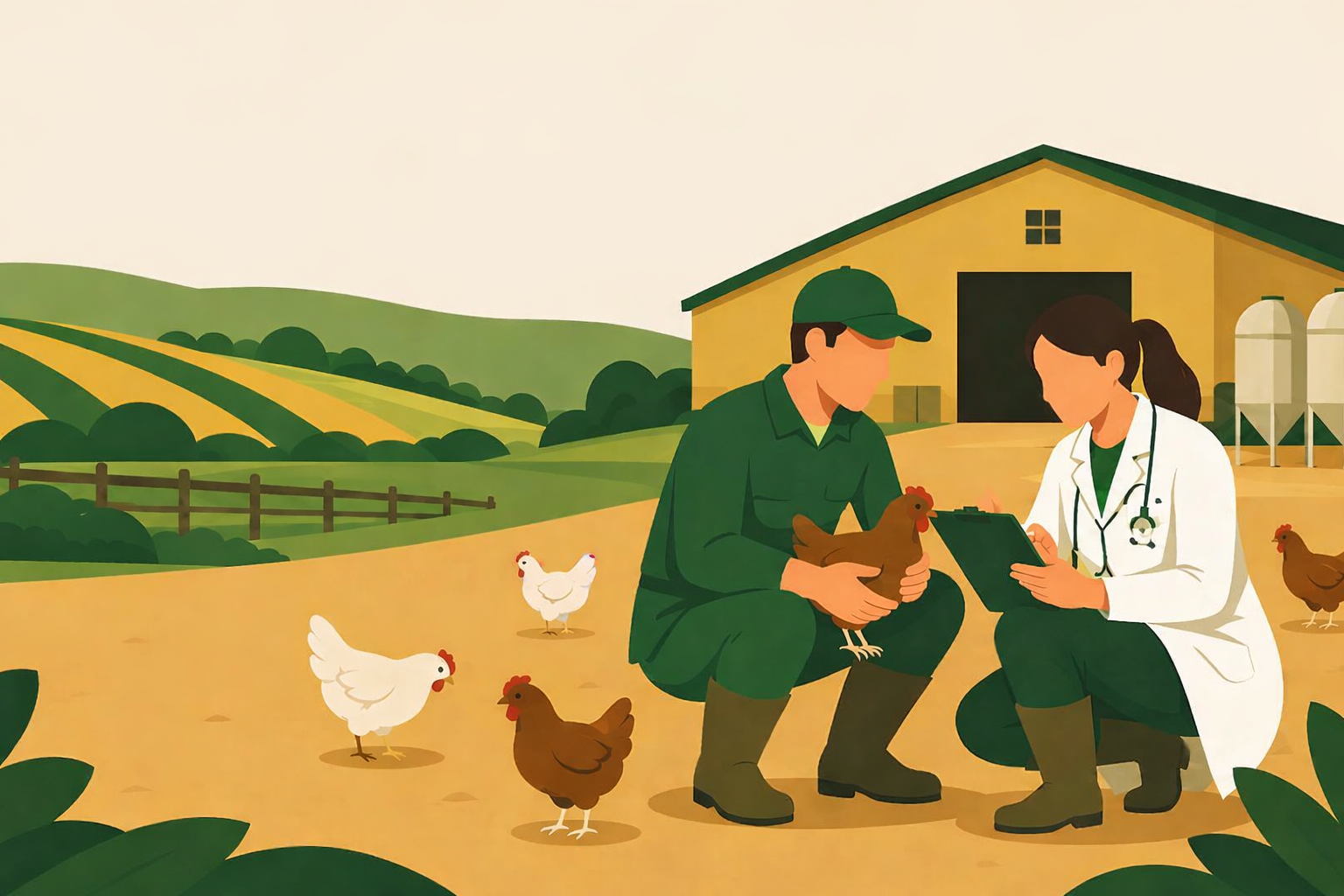
The first hours after placement decide the start of the whole production cycle. A chick that does not find feed and water in time falls behind and never fully catches up — it grows more slowly, flock uniformity suffers and mortality rises. Crop fill assessment is a quick, hands-on check that any farmer can do without any equipment.
What is the crop and why does it matter?
The crop is a small food pouch at the base of the bird's neck, just below the beak. When a chick eats and drinks, the crop fills up and feels soft. When it does not eat or drink, the crop stays empty. That is why crop fill is the best signal of feeding activity — you can assess it in seconds by gently feeling the crop with a fingertip. Details on broiler start management are in the guide on broiler chick rearing — the first week, and for turkeys in turkey rearing — the first days.
Where do the numbers in this guide come from?
The broiler threshold (about 95% of chicks with full crops at 24 hours) comes from the Ross 308 Broiler Management Guide (Aviagen). The turkey poult threshold (about 85% at 5–8 hours) comes from Aviagen Turkeys — Crop Fill (BR31). These are indicative values for commercial poultry lines and may differ between poult suppliers and farm conditions. Treat them as reference points.
How to assess crop fill — step by step
- 1
Select a random sample of chicks
Do not pick birds that happen to be near you — draw from different parts of the house (under the brooder, at the edge, near feeders and away from feeders). Typically about 50–100 birds per flock are checked. The larger the flock, the more important it is that the sample is genuinely random, because chicks gathered in one spot can give a misleading result.
- 2
Gently feel the crop
The crop is a soft pouch just below the beak, on the underside of the neck. Hold the chick gently and feel the area with your thumb or index finger. There is no need to squeeze or probe inside — the feel and fill under your fingertip is enough.
- 3
Assess consistency and record the result
Three crop types: (1) full and soft — the chick is eating and drinking, correct result; (2) hard or dry — the chick is eating feed but drinking too little water; (3) balloon-like and soft, fluid-filled — the chick is drinking but eating too little feed. For each chick, note which category it falls into and calculate percentages at the end.
- 4
Compare with the threshold for your species
Broiler: at 24 hours from placement about 95% of chicks should have full, soft crops. You can check earlier (e.g. at 8 and 12 hours) to catch problems sooner. Turkey poult: at 5–8 hours from placement about 85% should have full, soft crops. Turkey poults start more slowly than broilers — this is normal.
- 5
If the result is too low — act and re-check
Improve conditions and re-check crops after 1–2 hours. What to fix: add more feeders and lower them (the chick must see feed without effort), spread more feed on paper or trays, check water temperature (warmer water encourages drinking), increase light intensity (bright light stimulates foraging). Acting promptly after detecting the problem translates directly into better final flock results.
Crop fill in broilers — when to check and what to expect
Broilers start more quickly than turkey poults. Below are indicative thresholds for commercial broiler lines (e.g. Ross 308) from Aviagen.
At 8 hours
An early check at 8 hours is worthwhile — it lets you catch problems before they affect the whole start. At this stage the large majority of chicks should already have full crops, though not all lines specify a firm threshold at this hour. If the result concerns you — act immediately.
At 12 hours
A check at 12 hours gives chicks more time to start and is a useful mid-point. If the result is clearly below expectations — correct conditions and recheck before the 24-hour mark.
At 24 hours (key measurement)
This is the most important checkpoint for broilers. Indicatively, at least about 95% of chicks should have full, soft crops. A result below this threshold signals a poor feeding start and warrants investigating the cause (temperature, access to feed and water, lighting). More on managing the first week in the guide on broiler farming.
Crop fill in turkey poults — when to check and what to expect
Turkey poults are weaker "finders" than chicks and start more slowly. Below are indicative thresholds from Aviagen Turkeys (BUT/Nicholas).
At 5–8 hours (key measurement)
The main crop check for turkey poults. At 5–8 hours from placement at least about 85% of poults should have full, soft crops. Turkey poults start more slowly than broilers — hence the lower threshold and the earlier measurement window. If the result is lower, improve conditions (more light, lower feeders, warmer water, feed on paper) and re-check.
What does it mean that a poult is a weak finder?
Turkey poults naturally search less actively for feed and water than chicks. That is why everything at the start must be literally under the beak: feed on paper and trays, drinkers and feeders close to the heat source, and strong lighting. More on start management in the guides on turkey farming and turkey rearing — the first days.
Balloon-like crop in a turkey poult
A balloon-like, soft, fluid-filled crop appears more often in turkey poults than in broilers — the poult has been drinking but not eating. Check that feed is accessible and visible, that feeders are low enough and close to the heat source, and that lighting is adequate.
The most common mistakes when assessing crop fill
A few things that cause the check result to be misleading or incorrectly interpreted.
Non-representative sample
Checking only the chicks lying near the feeders gives a falsely high result — those birds have already found feed. Draw chicks from different parts of the house, including spots away from feeders and drinkers.
Confusing a hard crop with a full one
A hard, dry crop is a completely different problem from a full, soft crop — the chick is eating but not drinking. You assess both fill and consistency. Full + soft = good. Full + hard = insufficient water. Balloon-like + soft = insufficient feed.
No correction after a poor result
The check alone is not enough — if the result is too low, you must improve conditions immediately and re-check. Recording a poor result without acting on it achieves nothing. The faster you act, the smaller the impact on final flock results.
Checking too late
Assessing crop fill at 48 hours is too late — a chick that has not eaten or drunk for the first 24 hours is already in poor condition and this is very difficult to recover. The first check should be at 8–12 hours for broilers and at 5–8 hours for turkey poults.
Frequently asked questions about crop fill
What is the crop in a bird?add
The crop is a small food pouch at the base of the bird's neck, just below the beak. When a chick eats and drinks, the crop fills up and feels soft to the touch. When it does not forage, the crop stays empty or flat. That is why crop fill is a simple and reliable indicator of feeding activity in the first hours after placement.
How many hours after placement should I check crop fill in broilers?add
It is worth checking at 8, 12 and 24 hours from placement. The most important measurement is at 24 hours — at that point indicatively about 95% of broiler chicks should have full, soft crops. Earlier checks (at 8 and 12 hours) let you catch the problem sooner and act before it affects the whole start of the flock.
How many hours after placement should I check crop fill in turkey poults?add
For turkey poults the key check is at 5–8 hours from placement. At that point at least about 85% of poults should have full, soft crops. Turkey poults start more slowly than broilers — they are weaker "finders" and need feed and water literally under their beak in a well-lit house.
What does a hard crop mean in a chick?add
A hard, dry crop means the chick has been eating feed but drinking too little water. This is a different situation from a balloon-like crop (drinking but not eating enough) and a full, soft crop (eating and drinking — correct). With a hard crop, check that drinkers are well positioned, water is warm enough and chicks have easy access to it.
What does a balloon-like crop mean in a chick?add
A balloon-like, soft crop — filled like an inflated balloon with no firm lumps of feed — signals the chick has been drinking but eating too little feed. Check that feeders are low enough and close to the heat source, that feed is on paper or trays clearly visible to the chicks, and that lighting is adequate.
What should I do if the crop fill result is too low?add
Act immediately: add more feeders and lower them, spread more feed on paper or trays, use warmer water, increase light intensity. Then re-check crops after 1–2 hours to see whether the improvement has had an effect. The faster you respond, the smaller the impact on final flock results — mortality, uniformity and final weights.
Record crop checks and mortality in DlaFerm.pl
Want to keep crop fill results, mortality and first-hour conditions in one place? Create a free farm account or write to us.
Phone
+48 796 258 151