Broiler farming — from chick to slaughter
The broiler is a meat chicken that grows from 40 g to 2.5–3 kg in under six weeks. We walk through the whole cycle — from house preparation, through brooding and fattening, to live-bird collection — and show what to control at each stage so the flock grows healthy and profitably.
verifiedFrom the team that has organised work on poultry farms for years.
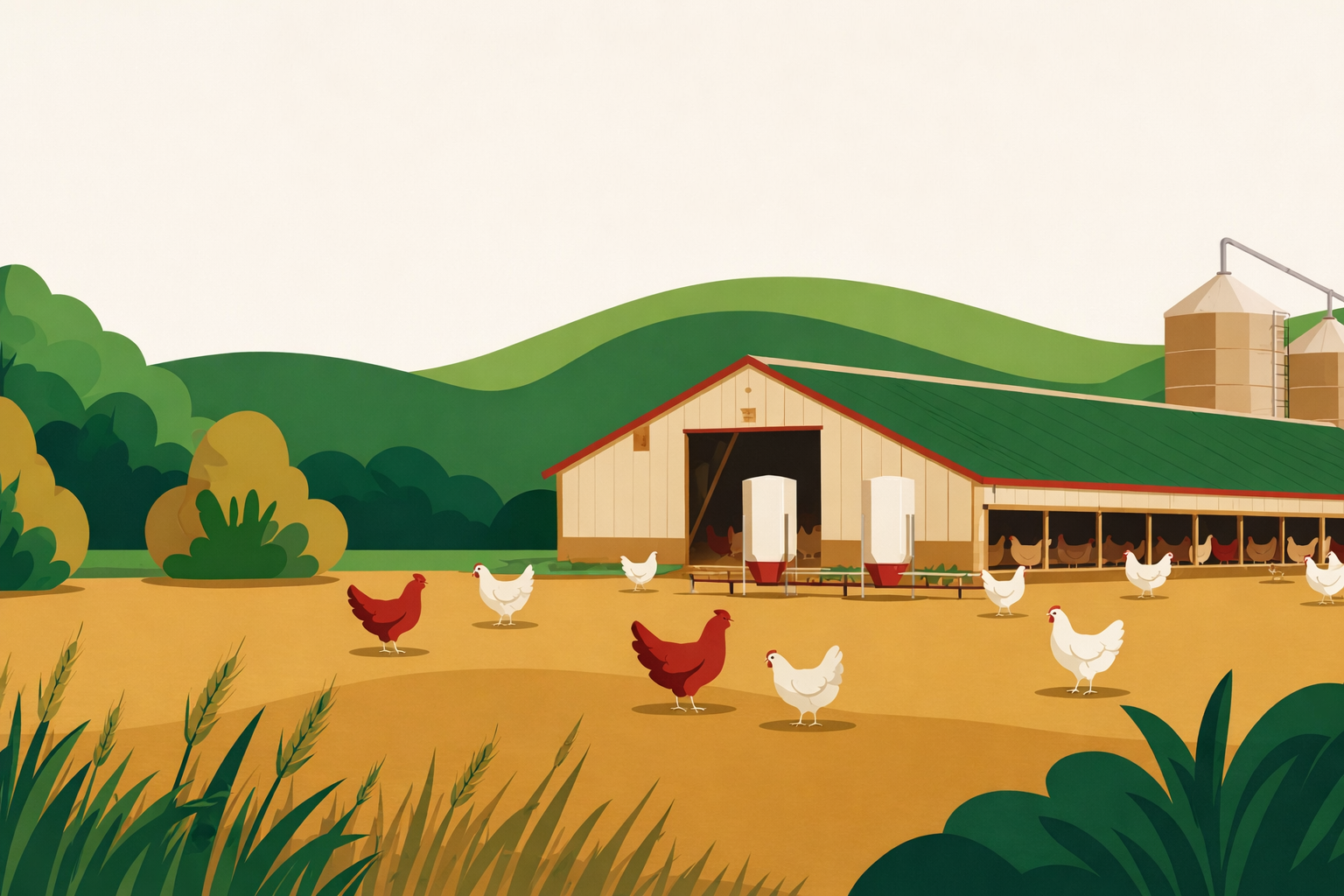
The broiler — a fast-growing meat chicken
The broiler is a meat chicken — a fast-growing bird raised solely to lay down as much meat as possible in a short time. The most popular genetic lines are Ross 308 and Cobb 500, selected over decades for body-mass gain and feed efficiency. This is a completely different production model from a layer farm — here what counts is pace, intensity and precise control of conditions in the house.
A cycle of about 42 days and 5–6 batches a year
One fattening cycle usually lasts about 35–42 days from placing the chicks to collecting the live birds. In that time a 40 g chick reaches a slaughter weight of 2.5–3 kg. Such a short cycle allows 5–6 batches a year in the same house — with a downtime period for cleaning and disinfection between placements. We describe the whole sequence in the guide on the broiler production cycle step by step.
FCR and stocking density — what drives the result
Profitability comes down to two key indicators. The first is FCR (feed conversion ratio) — how many kilograms of feed are needed for 1 kg of gain. A good result for a broiler is about 1.5; the lower it is, the cheaper you produce. The second is stocking density — the maximum is 33 kg/m², while with higher welfare and better ventilation 39 or even 42 kg/m² is allowed. Both parameters depend directly on microclimate, litter quality and flock health.
Everything in one place with DlaFerm.pl
Broiler farming means dozens of tasks and duties — from setting the heating, through weighings and medications, to records and the withdrawal period before slaughter. DlaFerm.pl brings them together in one poultry farm management software: you keep a digital broiler Flock Card, DlaFerm.pl can file your flock records in IRZplus for you — automatically, if you want — and you stay ready for an inspection at any time.
The broiler production cycle step by step
From an empty, cleaned house to loading the live birds — every stage has its standards and checkpoints. Here are the four main phases of fattening.
House preparation
After the downtime, the house must be cleaned, disinfected, lined with fresh litter and warmed up. You check the heating, ventilation, feed and drinking lines. Details in the guide on house preparation before placement, and we cover heating costs in house heating costs.
Brooding (days 1–10)
The first days decide the whole cycle. Chicks need a high temperature (about 33–34°C under the brooder in the first week), easy access to feed and water, and the right lighting. Key are temperature and humidity in the house and a well-set lighting programme.
Main fattening
In the fattening phase the flock grows intensively and the demand for air and cooling rises sharply. A refined broiler house ventilation and dry, well-managed litter protect against ammonia and leg problems. We cover litter in litter management in the house.
Live-bird collection
At the end of the cycle you plan the catching and transport to the slaughterhouse. Before loading, feed withdrawal before slaughter is applied to limit carcass contamination. How to carry out this stage smoothly is described in the guide on broiler live-bird collection.
What to control on a broiler farm
A batch’s financial result is the sum of daily decisions. Here are six areas that most affect flock health and FCR.
Microclimate
Temperature, humidity and air exchange must keep up with the growing flock. A stable microclimate means fewer losses and better gain. Control temperature and humidity and house ventilation throughout the cycle.
Feeding and phases
The broiler is fed high-energy, high-protein feed delivered in phases (starter, grower, finisher) matched to age. Good feeding directly affects FCR and growth rate — it is one of the largest production costs.
Flock health
The most common threats are coccidiosis (protozoa in the gut) and colibacillosis (E. coli infections). Early signs — diarrhoea, lethargy, reduced appetite — must be caught fast, because losses grow rapidly.
Welfare and leg quality
Dry litter and good ventilation protect against pododermatitis (footpad dermatitis), which lowers welfare and carcass value. Caring for conditions is also a route to welfare payments.
Flock records
Every flock must be reported and recorded in IRZplus, with treatment and withdrawal records kept — conveniently done through a digital broiler Flock Card. This is the basis for settlements and inspection readiness.
Biosecurity
Protecting the farm against the introduction of diseases — especially avian influenza — is absolutely fundamental. Disinfection mats, a hygiene barrier, entry control and work clothing are required at every placement. Details in poultry farm biosecurity.
Frequently asked questions about broiler farming
How long is a broiler production cycle?add
A single broiler fattening cycle usually lasts about 35–42 days from placing the chicks to collecting the live birds. In that time the chicken reaches a slaughter weight of 2.5–3 kg. After each batch a downtime period is needed for cleaning and disinfection, which allows 5–6 batches a year in the same house.
What FCR is a good result for a broiler?add
FCR (feed conversion ratio) tells you how many kilograms of feed are needed for 1 kg of body-mass gain. A good result for a broiler is an FCR of about 1.5 — the lower the value, the cheaper you produce meat. FCR depends on genetics, feed quality, microclimate and flock health, so keeping an eye on it is one of the most important tasks on the farm.
How many broilers can be kept per 1 m²?add
The maximum broiler stocking density is 33 kg/m² of body mass. At a higher welfare level and with better ventilation, regulations allow 39 kg/m², and in exceptional cases even 42 kg/m². Exceeding the density worsens the microclimate, litter quality and leg condition, so density must be controlled throughout the cycle.
How many broiler batches can you run in a year?add
With a cycle of about 42 days and a downtime period for cleaning and disinfection, a single house usually runs 5–6 batches a year. The exact number depends on the cycle length, the time needed for house preparation and the organisation of live-bird collection.
What diseases are most common in broilers?add
The most common health problems are coccidiosis (caused by Eimeria protozoa that damage the gut) and colibacillosis (E. coli infections). Avian influenza is also a threat, which is why biosecurity is so important. Catching the symptoms early — diarrhoea, lethargy, falling appetite — helps limit losses.
What temperature should there be in the first week of brooding?add
In the first week chicks need a high temperature — about 33–34°C in the zone under the brooder (where the chicks stay), gradually lowered over the following days. Too low a temperature slows growth and favours disease, while too high a temperature dehydrates the chicks. Proper humidity and even heating of the whole floor are equally important.
Run your broiler farm in one place with DlaFerm.pl
Want the cycle, records and flock documentation under control? We will show you how DlaFerm.pl simplifies daily work on a broiler farm. Write to us.
Phone
+48 796 258 151