Poultry farm biosecurity: the rules that protect your flock
Biosecurity is a set of daily procedures that shield your flock from disease. Learn what you must do on your poultry farm and how to automate the entry log.
verifiedFrom the team that has organised work on poultry farms for years.
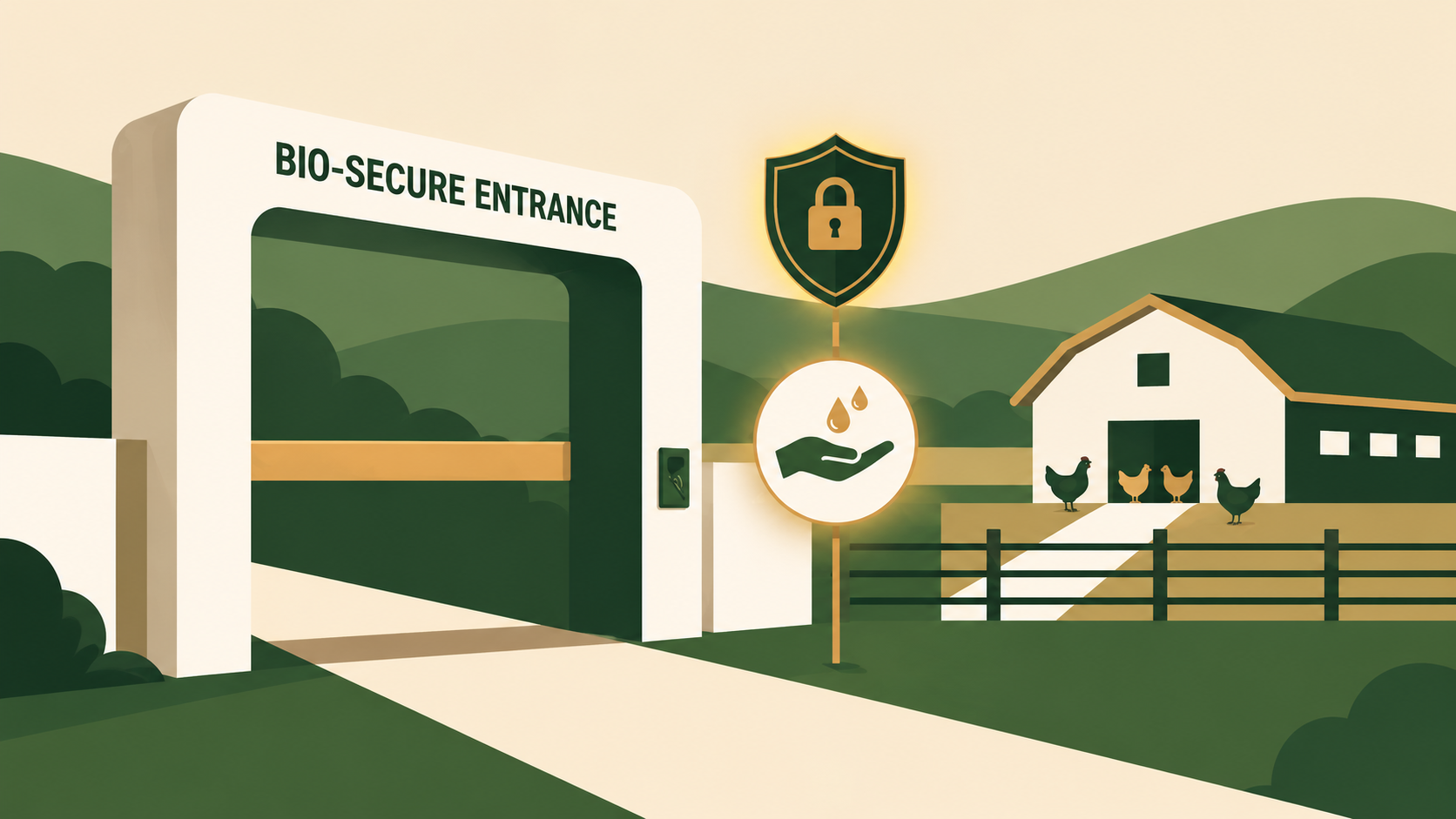
What is poultry farm biosecurity?
Biosecurity is everything you do to prevent pathogens — viruses, bacteria and parasites — from reaching your farm and entering the poultry houses. It covers access management for people and vehicles, disinfection, protective clothing, rodent and wild-bird control, and quarantine of new birds. In Poland, poultry farms are subject to national veterinary regulations and EU requirements monitored by the Veterinary Inspection service.
Why is biosecurity so important?
Highly pathogenic avian influenza (HPAI) and other infectious diseases can wipe out a flock of tens of thousands of birds within days. The consequences for a farmer include not only production losses but also mandatory culling of the entire flock, prolonged downtime and severe trade restrictions across the region. A well-implemented biosecurity programme is the cheapest insurance against those costs.
Clean zone and dirty zone — the basis of farm organisation
The key concept in biosecurity is dividing the farm into a clean zone (poultry houses and their immediate surroundings) and a dirty zone (access roads, loading ramps, feed delivery areas). The boundary between zones must be clearly marked, and no one should cross it without changing clothes and disinfecting footwear. Every farm, regardless of scale, should have this boundary physically defined — by a fence, signs or a sanitary lock.
Who enters the farm? The role of the entry log
Every person entering a poultry farm should be recorded: name, date and time, purpose of visit. A traditional paper log is hard to maintain and easy to skip. DlaFerm.pl provides a digital entry log with a QR code — visitors scan the code at the gate on their phone, enter their details, and appear on your list in the app. The complete list is available on demand during a veterinary inspection. Read more: QR Entry Log.
Biosecurity and the law — what do the regulations say?
Polish veterinary law and EU regulations (including Regulation EU 2016/429 on transmissible animal diseases — the Animal Health Law) impose specific biosecurity obligations on farmers. The Veterinary Inspection service oversees compliance and may carry out unannounced inspections. When an HPAI outbreak is confirmed, requirements become significantly stricter and farms in restriction zones must implement additional measures ordered by the district veterinary officer.
6 biosecurity rules every poultry farm must implement
Each rule addresses a specific risk of introducing a pathogen to the farm.
Clean zone and dirty zone
Define a physical boundary between the poultry house area and the vehicle access area. No one crosses from one side to the other without changing clothes and disinfecting footwear.
Disinfection mats and dip baths
Place a disinfectant-soaked mat at every poultry house entrance. At the lorry entrance, install a wheel dip bath. Check the effectiveness of the disinfectant regularly.
Protective clothing and footwear
Visitors and workers must change footwear and put on protective overalls before entering the clean zone. Clothing should be washed and disinfected after each visit to the poultry house.
Rodent and wild-bird control
Rodents and wild birds are the main disease vectors. Secure ventilation openings with mesh, carry out regular rodent control, and do not store feed where sparrows and pigeons can reach it.
Quarantine of new birds
Every new batch of birds should be quarantined in a separate building, or kept isolated for at least 21 days after delivery before joining the main flock. This also applies to birds returning from shows or markets.
Entry control and registration
Keep an entry log for all visitors: name, date, company, purpose. With DlaFerm.pl, a visitor registers via a QR code at the gate — the entry appears in your app automatically, with no paperwork.
How to prepare a biosecurity plan for your poultry farm
A biosecurity plan is a written document describing the procedures that apply specifically to your farm.
Assess the risks on your farm
Start with a list of entry points: gates, poultry house entrances, feed delivery points, lorry manoeuvring areas. For each, note who has access and how often.
Document procedures step by step
For each risk, write down a specific procedure: what the worker does, what a visitor does, how a vehicle is disinfected. The plan must be simple enough for everyone to follow without supervision.
Set a schedule for checks and disinfection
Write into the plan how often the disinfection mat is changed, when rodent control takes place, and who is responsible for topping up the disinfectants. A schedule keeps procedures alive, not just described.
Train workers and partners
The plan is useless if workers do not know about it. Every new person working on the farm should read the rules before entering a poultry house for the first time.
Frequently asked questions about poultry farm biosecurity
What is poultry farm biosecurity?add
Poultry farm biosecurity is a set of procedures and measures to prevent infectious diseases — such as avian influenza (HPAI) or Newcastle disease — from reaching the farm and its flocks. It covers entry control, disinfection, protective clothing, and rodent and wild-bird control.
What are the basic biosecurity rules for a poultry farm?add
The basics are: dividing the farm into clean and dirty zones, using disinfection mats and wheel dip baths, mandatory clothing and footwear changes before entering poultry houses, rodent and wild-bird control, quarantine of new birds, and maintaining an entry log for all visitors.
Is keeping an entry log compulsory for a poultry farm?add
Yes. Poultry farmers are required to record everyone entering the farm. The Veterinary Inspection service can request this list during an inspection. DlaFerm.pl makes it easy with a QR code entry log — simpler than paper registration.
How often should the disinfection mat fluid be changed?add
Frequency depends on traffic volume and the type of disinfectant. As a rule, in an active season the mat should be replaced every 2–3 days or more often if visibly soiled. Always check the manufacturer’s instructions for the specific product.
What should I do if I suspect disease on my farm?add
If you suspect an infectious disease — especially HPAI — contact your district veterinary officer immediately. In the meantime, stop all movement of people and vehicles to and from the farm, isolate the flock, and do not remove dead birds until the Inspection has arrived.
How does DlaFerm.pl support poultry farm biosecurity?add
DlaFerm.pl offers a digital QR entry log — visitors scan the code at the gate and register without installing an app. The full entry list is available in the farmer’s app and ready to show during an inspection. The app also displays a map of active HPAI outbreaks so you know when risk in your area is rising.
Implement biosecurity together with DlaFerm.pl
Want to see the QR entry log live or have a question about the app? Write to us.
Phone
+48 796 258 151