Feed silos — a feed buffer between delivery and the house
A silo is a feed store the feeders draw from throughout a batch. The most common sizing mistake: capacity given in cubic metres is volume, not mass. We explain how to convert m³ to tonnes, how to choose the shape and material and how to keep an eye on the feed level.
verifiedFrom the team that has organised work on poultry farms for years.
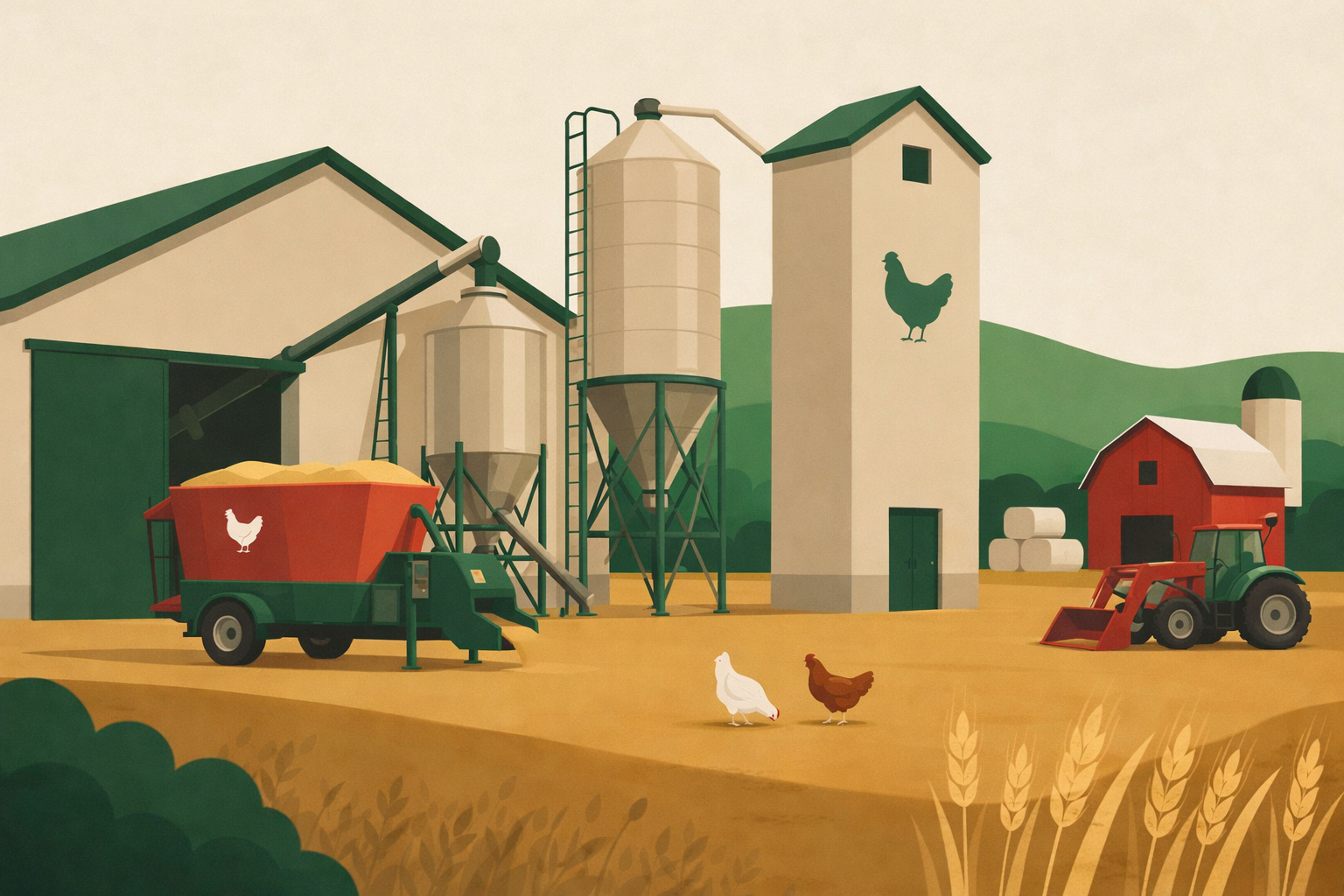
A feed silo is a vertical tank that stands next to the house and holds feed delivered in bulk. From the silo the feed drops into a conveyor that distributes it to the feeding lines inside. A well-sized silo is a buffer: it holds a few days’ stock so the farm doesn’t depend on a single delivery, yet it isn’t so large that the feed sits in it for weeks and loses freshness.
Capacity in m³ is not mass in tonnes — why?
Manufacturers give silo capacity in cubic metres, that is in volume. But you buy and account for feed in tonnes, that is in mass. The two figures are linked by bulk density: mass = volume × density. Complete poultry feed weighs roughly 0.6–0.7 tonnes per cubic metre, so a 20 m³ silo holds about 12–14 tonnes of feed, not 20 tonnes. If you confuse volume with mass, you miscalculate the stock and set the level alarms wrong.
What a silo is built from and what to watch inside it
The choice depends on the type of feed, the size of the flock and how you want to track the stock.
Galvanised steel silos
The most common choice. Steel sheets coated with zinc are cheap, durable and widely available. The walls are corrugated, which stiffens the structure, but with moist feed the folds make caking easier. They work well with regular feed rotation.
Polyester and laminate silos
A tank of glass-fibre reinforced plastic has smooth inner walls down which feed slides more evenly and bridges less. It doesn’t corrode and doesn’t conduct heat like steel, so less moisture condenses inside. Usually more expensive than steel.
Discharge cone shape and angle
The bottom of the silo narrows into a cone that feeds slide down to the outlet. The cone angle must be steeper than the feed’s angle of repose, otherwise the feed hangs on the walls and forms a bridge over an empty space. Free-flowing feed slides easily; finely ground or moist feed flows worse, so it needs a steeper cone.
Volume capacity vs mass capacity
The silo plate gives the volume in m³. To know how many tonnes of feed it holds, multiply the volume by the bulk density (roughly 0.65 t/m³ for poultry feed). Pellets and crumble have different densities, so the same silo body holds a different mass of different feeds.
Feed level monitoring
The level can be measured in several ways. Load cells (strain gauges) under the silo legs weigh the whole contents and give the mass directly in tonnes — the most accurate method. Radar and ultrasonic sensors measure the distance to the feed surface from the top, that is a height, which has to be converted to volume and mass.
Conveyor and feed transport to the house
From the silo outlet the feed travels to the feeding line by a conveyor. An auger (screw conveyor) is simple and cheap but breaks pellets up more. A chain-and-disc conveyor is gentler on the feed and handles longer runs. The choice depends on the silo-to-house distance and the type of feed.
A feed silo step by step
- 1
Calculate daily and weekly feed use
Start with the flock: how many birds, at what rearing stage and how much feed they eat per day. From that you work out the weekly use. This is the basis, because a silo is sized to the flock’s real appetite at peak, not to the floor area of the house.
- 2
Size the capacity in TONNES, not m³
Decide how many days of stock you want as a buffer and convert that to tonnes of feed. Only then convert the tonnes back to volume by the bulk density (tonnes ÷ ~0.65 = the m³ needed). That way you choose a silo that really holds the planned mass of stock, not just one that adds up “on the metres”.
- 3
Choose material and cone angle for the feed
For free-flowing pellets a typical galvanised silo is enough. For finely ground feed, mash or feed prone to moisture, smooth polyester and a steeper cone work better so the feed doesn’t hang. The material and geometry are there to protect the feed from caking and from getting stuck inside.
- 4
Set the silo on a hard, level base
A full feed silo weighs over a dozen tonnes, so the foundation must carry it and stand level so the structure doesn’t tilt. Level setting is also a condition for load cells to work — a silo standing crooked distorts the mass reading.
- 5
Fit level monitoring or a scale
The handiest is a load-cell scale giving mass directly in tonnes, connected to a system that warns before the stock runs out. If you use a radar or ultrasonic sensor, remember it measures a height — to get tonnes, the system must know the silo geometry and the feed density.
- 6
Clean and air the silo between batches
Between batches empty the silo completely and check the walls and cone. Leftover old feed, caking, moisture and mould spoil the fresh batch and risk clogging the outlet. A short airing and an inspection inside at every flock change is the cheapest way to protect feed quality.
Frequently asked questions about feed silos
How many tonnes of feed does a silo of, say, 20 m³ hold?add
Multiply the volume by the feed’s bulk density. For typical poultry feed that is roughly 0.6–0.7 tonnes per cubic metre, so a 20 m³ silo holds about 12–14 tonnes, not 20 tonnes. The exact figure depends on the type of feed (pellets, crumble, mash), as each has a slightly different density.
Why doesn’t the feed mass equal the silo capacity?add
Because they are two different quantities. Capacity in m³ tells you how much space there is in the silo (volume), while tonnes tell you how much the feed weighs (mass). Bulk density links them: mass = volume × density. Feed is lighter than a cubic metre of water, which is why the number of tonnes always comes out smaller than the number of cubic metres.
How is it best to monitor the feed level in a silo?add
The most accurate are load cells under the silo legs — they weigh the whole contents and give the mass directly in tonnes. Radar and ultrasonic sensors measure the distance to the feed surface, that is a height, which has to be converted to mass via the silo geometry and feed density. Whatever the method, it pays to connect a low-level alarm so you can order a delivery in advance.
Why does feed bridge or hang in the silo and how do you prevent it?add
Feed hangs when it sticks to the walls or cone and forms an arch over an empty space — the outlet is then blocked even though the silo looks full. Moisture, finely ground feed and too flat a cone all encourage it. You prevent it with smooth walls (polyester), a suitably steep cone angle, dry feed and regular emptying and cleaning of the silo.
Describe your building’s equipment in DlaFerm.pl
In DlaFerm.pl, in the “Technical equipment of the building” step, you record what silos you have and their capacity — all in one place. Create a free account or write to us.
Phone
+48 796 258 151