Gait score — poultry gait assessment (0–3 scale)
Gait score is a numerical assessment of how a bird moves — on a scale from 0 to 3. It is a quick, equipment-free method of checking leg health and overall flock welfare. We explain the scale, how to carry out the assessment, and when to take action.
verifiedFrom the team that has organised work on poultry farms for years.
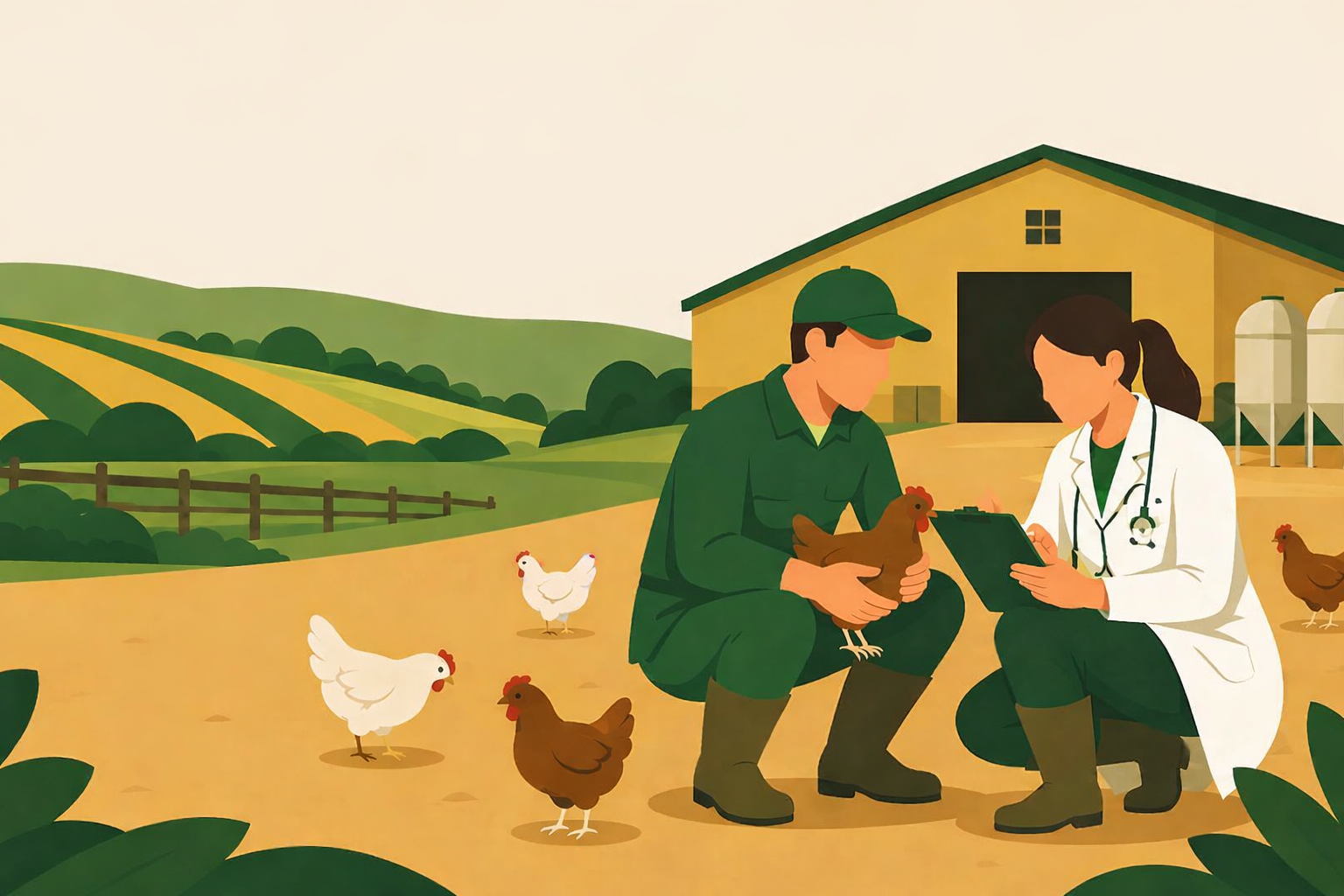
Healthy legs are fundamental to bird welfare. A bird that struggles to walk cannot reach feed and water, loses weight, and is exposed to pain and stress. In broiler flocks, leg problems are one of the most common causes of poor production results and the need to cull birds on welfare grounds. Gait scoring is one of the methods that allows this problem to be detected early and its scale tracked over time.
Where does this method come from?
Poultry gait scoring originates from scientific research into broiler welfare — notably the Bristol Gait Scoring Scale developed by researchers at the University of Bristol. The full scientific version of the scale describes 6 grades (0–5). For everyday use on the farm, a simplified 4-grade version (0–3) is sufficient — it is faster and easier to apply without specialist training. This is the version described in this guide. More on welfare requirements in the guide poultry welfare — payments and requirements.
When is gait assessment particularly important?
Gait assessment is useful throughout the rearing period, but is especially important in the second half of the production cycle, when birds are growing fastest and the risk of leg problems is highest. Carry it out regularly (e.g. once every one to two weeks) and compare results over time — the trend matters more than any single result. A rising proportion of scores 2 and 3 signals that something is happening and the cause needs to be found.
How to carry out a gait assessment — step by step
- 1
Designate the sample and observation points
Randomly select at least 25–50 birds from different parts of the house — near feeders, in the middle, along the wall, in resting areas. Do not just pick birds that happen to be in your path, as you may end up with a group whose gait is better or worse than the rest of the flock. The larger and more genuinely random the sample, the more reliable the result.
- 2
Encourage birds to walk
Walk slowly and calmly behind or alongside a group of birds to prompt them to take a few steps forward. Do not chase or startle them — you want natural gait, not stress-affected movement. Observe each bird for several steps before assigning a score.
- 3
Observe gait and assign a score of 0–3
Watch how the bird places its steps, whether it crouches, whether it rises with difficulty, whether it moves unsteadily. Assign a score using the scale: 0 — normal gait; 1 — slight abnormality, hard to detect; 2 — clear abnormality, bird can still reach feed; 3 — severe abnormality, bird crouches and walks with great difficulty. Full details of each grade appear below in the "Scoring scale" section.
- 4
Count the score distribution and record the result
After scoring the whole sample, count how many birds received each score (0, 1, 2, 3) and express these as percentages. Record the date, flock age, number of birds assessed, and the score distribution. This record is your baseline for future assessments.
- 5
Compare with previous results and act when score 2–3 proportion rises
A single result is a data point. A series of results over time is a picture of the situation. If the proportion of birds scoring 2 or 3 is rising, look for the cause: litter condition (wet litter), genetics (growth rate), nutritional deficiencies, lighting (too little movement), leg disease (pododermatitis, TD/crooked legs). Record results also in the context of welfare requirements — see poultry welfare indicators.
- 6
Repeat regularly — the trend matters more than a one-off result
Carry out gait assessment at regular intervals — e.g. every 7–14 days from the mid-point of the production cycle. One poor result may be coincidental. Two or three poor results in a row indicate a growing problem that requires action. Regular observation also lets you judge whether corrective measures are working.
What each gait score means (0–3)
A simplified 4-grade scale based on the scale used in broiler welfare assessment. Each grade corresponds to a different level of the bird's mobility.
Score 0 — normal gait
The bird moves confidently and smoothly. It takes even steps with no visible difficulty, rises without effort, and walks freely around the house. No balance problems or lameness are visible. This is the result you aim for across the whole flock.
Score 1 — slight abnormality
The bird walks, but a slight unevenness or wobble is visible — minor, hard to catch unless you are watching carefully. The bird functions normally and has access to feed and water, but something departs slightly from the normal pattern. Score 1 on its own is not alarming, but a rising proportion in the flock is worth monitoring.
Score 2 — clear abnormality
The bird walks awkwardly and it is clearly visible that something is hindering its movement — it may limp slightly, move slowly, or place uneven weight on its legs. It is still able to rise and reach feed and water. A clear rise in the proportion of score 2 birds is a warning signal that warrants investigating the cause — litter, nutrition, leg disease.
Score 3 — severe abnormality
The bird walks with great difficulty, crouches, or is reluctant to rise. Access to feed and water is clearly impaired — the bird may be unable to reach them. Birds scoring 3 require an immediate response: individual inspection, possible separation into a hospital pen, or humane culling if suffering is evident. A high proportion of score 3 birds is a serious flock welfare problem.
Why assess gait and what affects gait quality
Gait scoring is not just a formality — it is a practical tool for detecting problems early and managing flock health. Here are the three main reasons to use it, and the factors that most commonly affect bird gait.
Early detection of leg problems
Leg problems develop gradually. Regular gait scoring lets you notice a rising proportion of score 2–3 birds before the situation becomes serious. The earlier you identify the cause (wet litter, vitamin and mineral deficiency, genetics, disease), the easier it is to address and the smaller the impact on flock results — final weights, mortality, uniformity.
Welfare requirements and documentation
Gait assessment is a component of poultry welfare assessment systems (e.g. Welfare Quality) used in certification and audits. An increasing number of retail chains and subsidy schemes require regular monitoring of welfare indicators including gait. Recorded results constitute documentation that may be inspected. More on requirements in the guides poultry welfare indicators and poultry welfare — payments and requirements.
Factors affecting gait — what to check when results are poor
The most common causes of poor gait in poultry: (1) wet and caked litter — causes pododermatitis and general leg problems (wet litter); (2) rapid genetic growth rate — body weight stresses joints and bones; (3) nutritional deficiencies — vitamin D3, calcium, phosphorus, biotin; (4) too little physical activity — darkness, stocking density; (5) leg diseases — pododermatitis, tibial dyschondroplasia (TD) and others.
The most common mistakes in gait assessment
A few things that cause the assessment result to be misleading or incorrectly interpreted.
Assessing only "convenient" birds
If you only score birds that happen to be near the house entrance or sitting by feeders, the result will be misleading. Birds with the worst gait often crouch in corners or along the wall and rarely approach feeders. Select birds randomly from different parts of the house — that is the only way to guarantee a reliable sample.
Startling birds instead of calm observation
A startled bird moves differently from a bird walking normally — it may conceal a slight lameness or conversely look worse than it really is. Assess gait calmly: enter the house slowly, wait a moment for the flock to settle, then gently encourage birds to take a few steps. Observe, do not chase.
Lack of regularity — one measurement is not enough
A one-off gait assessment only tells you the current state — not whether it is better or worse than last week. The value of gait scoring lies in regular repetition and tracking the trend. Once per cycle is better than nothing, but the ideal is every 1–2 weeks from the mid-point of the rearing period.
Ignoring birds scoring 3
Birds scoring 3 are not merely a statistic — they are individual animals that may be suffering and may have impaired access to feed and water. Every score 3 bird requires an individual decision: separation, treatment, or humane culling. Recording a score of 3 and taking no action is a welfare violation.
Frequently asked questions about poultry gait scoring
What is gait score in poultry?add
Gait score is a numerical assessment of how a bird moves, on a scale from 0 to 3. Score 0 means normal gait, score 3 means severe gait impairment — the bird walks with great difficulty or crouches and is reluctant to rise. It is a simple, equipment-free method of assessing leg health and flock welfare.
How often should gait be assessed in a flock?add
Gait should be assessed regularly in the second half of the production cycle, when the risk of leg problems is highest — for example every 7–14 days. Regularity matters because a single result tells you little — the trend is what counts. A rising proportion of score 2 or 3 birds between successive assessments is a signal that something is wrong.
How many birds should I assess at each measurement?add
As a rule, assess at least 25–50 birds per flock, selected randomly from different parts of the house. The larger the flock, the more important it is that the sample is genuinely random — do not just pick birds standing near feeders or within easy reach.
What proportion of score 2–3 birds is cause for concern?add
There is no single universal threshold — it depends on the certification scheme and the welfare requirements of the market in question. The general principle is: the lower the proportion of score 2 and 3 birds, the better. A high and rising proportion of scores 2–3 signals a growing problem. Birds scoring 3 require an immediate response regardless of their percentage.
What should I do when the proportion of score 2 and 3 birds is rising?add
Look for the cause: check litter condition (wet or caked?), assess stocking density and access to feed and water, review the feeding programme for deficiencies (vitamin D3, calcium, phosphorus, biotin), check lighting (birds need adequate physical activity). If in doubt, consult a veterinarian — leg problems may also have an infectious cause.
Does gait scoring apply only to broilers?add
No — gait assessment can be used for various poultry species: broiler chickens, turkeys, laying hens. However, the method is most commonly described and applied in broiler production, where leg problems arising from rapid growth rates are particularly prevalent. In turkeys, lameness and tibial dyschondroplasia are similarly important welfare concerns.
Monitor gait and flock welfare in DlaFerm.pl
Want to record gait assessment results, welfare indicators, and flock observations in one place? Create a free farm account or write to us.
Phone
+48 796 258 151