Vehicle entry and deliveries — biosecurity rules on a poultry farm
Vehicles entering the farm are one of the most important routes by which diseases can reach the poultry house — through wheels, mud, the undercarriage, and even the driver. We explain how to reduce this risk: wheel disinfection, a vehicle log, the feed delivery zone, and rules for livebird collection.
verifiedFrom the team that has organised work on poultry farms for years.
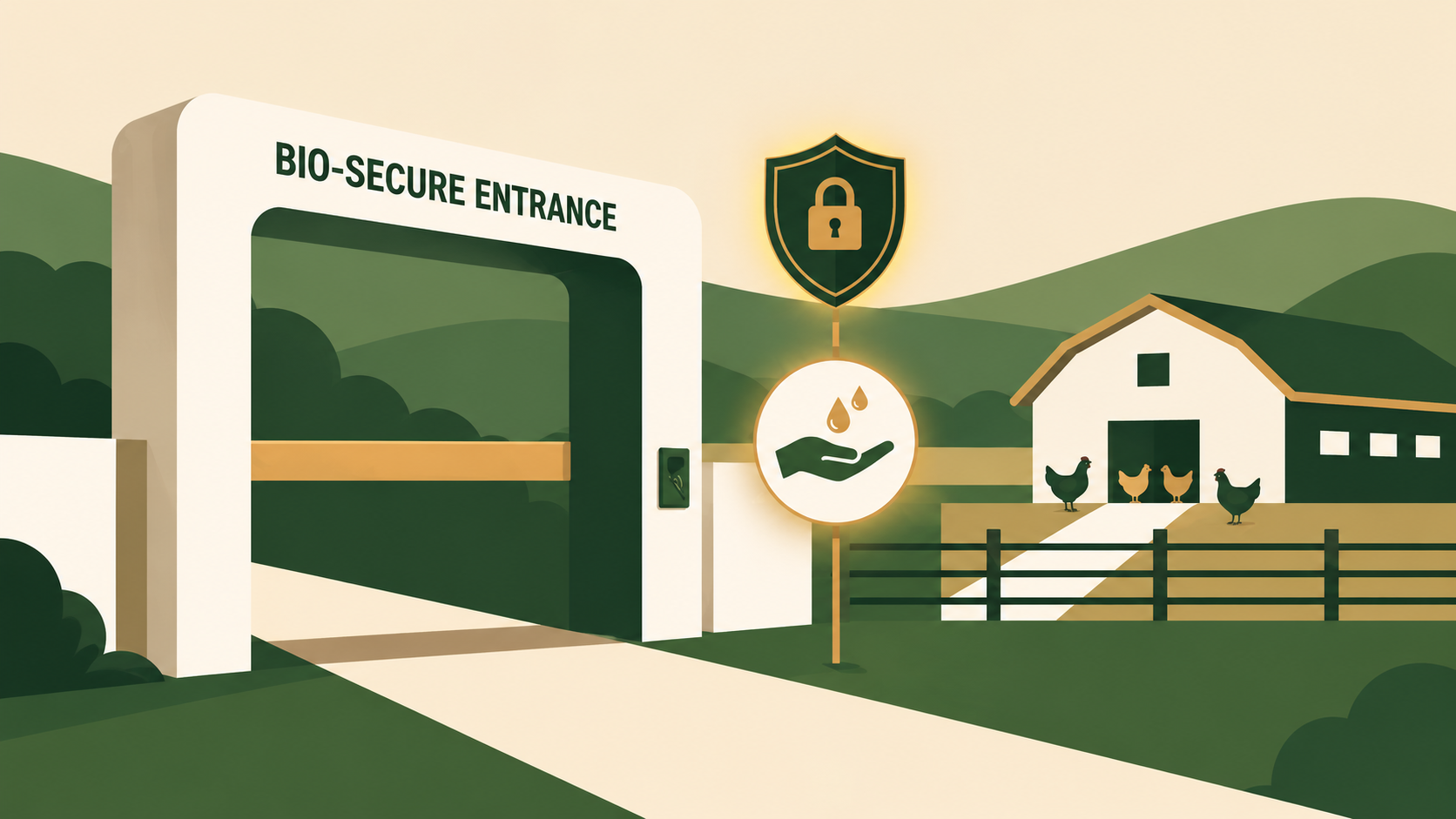
Every vehicle that enters the farm brings a little of the outside world with it — soil on tyres, mud on the undercarriage, and sometimes pathogens from another farm, a slaughterhouse or a carcass collection point. You cannot eliminate vehicle entries entirely, but you can keep them to a minimum and treat each one as a controlled risk. This is one of the foundations of biosecurity described in detail in the guide on poultry farm biosecurity.
Why are vehicles such an important threat?
Tyres and undercarriages can carry viruses (e.g. avian influenza), bacteria and fungi even when they look clean. Mud stuck to a tyre can survive outside the farm for many hours. Particularly dangerous are vehicles that visit several farms in a single day — slaughter lorries, rendering trucks, litter and equipment transporters. Each such vehicle is a potential link between farms.
The minimum-entry principle
The first rule is simple: do not let in any vehicle that does not need to enter. Feed can be delivered to a silo positioned at the fence — the feed truck does not need to drive between the houses. Carcasses can be collected from a designated, remote point at the farm boundary. Livebirds can be loaded from a ramp at the fence. Each such arrangement reduces the risk of disease introduction. The clean and dirty zones are covered in a separate guide on clean and dirty zones on a poultry farm.
Vehicle entry — step by step
- 1
Plan the vehicle route so it does not cross the clean zone
Before the vehicle arrives, plan its route and where it will stop. The route should run through the dirty zone and end at the gate, or reach a specific loading point or silo — without crossing the clean zone where workers enter the poultry houses. If the farm layout does not allow this, consider creating separate entry points for different vehicle types.
- 2
Stop the vehicle at the gate and check
Every vehicle stops at the entrance before going further. Check who is arriving, where from and why. If the vehicle has been to another farm that day, treat it as an elevated risk. External drivers do not enter the clean zone. If they must — only through the sanitary airlock with a change of clothing and footwear, as described in the guide on farm entry log.
- 3
Wheel disinfection mat or bath
Every vehicle that proceeds drives through a disinfection mat or bath. The bath is a shallow pool (approx. 15–20 cm deep) filled with disinfectant solution — tyres must pass through it, not around it. The solution loses effectiveness quickly: with dirty tyres (soil neutralises the product), in frost (most products lose activity below 5–10°C depending on type), and after several hours in strong sunlight. Change the solution regularly — every few hours on busy days or after every visibly dirty vehicle.
- 4
Record the vehicle in the entry log
Every entry goes into the vehicle log: date, time, vehicle type and plate number, company, reason for visit. The log is required by biosecurity regulations for commercial farms and is the basis for tracing how a disease reached the farm — if it does. Keep records for at least one year. More on maintaining the log in the guide on farm entry log.
- 5
Receive feed delivery into a silo at the farm boundary
The feed silo should be positioned at the fence or in the dirty zone so that the feed pipe reaches the silo without the feed truck having to drive between the houses. The truck stops at or beyond the fence and fills the silo without the driver entering the clean zone. This eliminates one of the most frequent vehicle entries on a farm. More on silos in the guide on feed silo monitoring.
- 6
Livebird and carcass collection — from designated points only
Livebird collection (catching crew and slaughter lorry) is one of the highest-risk events — these vehicles visit multiple farms in a single day. If possible, loading takes place from a ramp at the fence without the lorry driving into the farm. Carcasses are collected by a rendering company — designate a remote, separate point at the farm boundary, away from the houses. Never allow the rendering vehicle to drive up to a poultry house. Details on livebird collection in the guide on livebird collection — broilers.
Which vehicles carry the greatest risk
Not all vehicle entries are equally dangerous. Below are the vehicles that require the highest level of caution.
Slaughter lorries and livebird catching crews
These vehicles may visit several different farms in a single day. Drivers and catching crews have contact with live poultry from multiple flocks. Loading should take place at the fence without the lorry driving into the farm. The crew does not enter the clean zone — if they must, only through the airlock with a change of clothing.
Rendering company (carcass collection)
Rendering vehicles carry highly infectious material and travel between farms, slaughterhouses and other sites. Designate a permanent collection point at the farm boundary — as far from the houses as possible. Never allow a rendering vehicle into the farm interior. If a farm worker takes carcasses to the collection point, they must change footwear and wash hands on return.
Vehicles delivering or collecting litter or manure
Litter and manure can contain pathogens. Vehicles delivering fresh litter or collecting used litter/manure should not drive into the farm interior. Loading and unloading should take place at the farm boundary or at a designated point. After such a vehicle departs, check whether the road and yard need cleaning and disinfection.
What specifically to do to reduce risk
A set of practical measures that can be implemented on any farm without costly investment.
Hardened access road and yard at the gate
A hardened surface (concrete, asphalt, concrete slabs) is easier to clean and disinfect than muddy ground. Tyres pick up less soil and the disinfectant in the bath works more effectively on a smooth surface. If you do not have a hardened road, keep the yard at the gate and the area around the bath reasonably clean and drained.
Agree procedures with suppliers in advance
Tell your feed supplier, rendering company and slaughterhouse what the entry rules are on your farm. Standing, pre-agreed procedures work better than ad-hoc decisions at the gate. If the driver knows they must stop at the bath and sign the log, they will do it without delays.
Restricted access for private vehicles
Private cars belonging to staff and visitors should park outside the farm — if possible, in a car park before the gate. If staff need to drive closer to the houses, the same rules apply as for other vehicles: disinfection bath, log entry. Private cars are a frequently underestimated source of risk.
The most common mistakes in vehicle entry control
A few errors that make vehicle biosecurity procedures ineffective.
Disinfection bath filled with dirty, cold water
The mat and bath only work when the solution is clean and at the right concentration. Dirty water (soil, mud) neutralises the disinfectant. Most products lose effectiveness in frost. Change the solution regularly and check the temperature — in winter, heat the bath or use a product rated for low temperatures.
Skipping the vehicle log entry
A log filled in "later when there is time" or from memory after a few days is a fiction of protection. The log only has value when it is completed at every entry, in real time. A missing entry means there is no evidence that due diligence was applied at the gate.
Letting the driver into the clean zone
An external driver who walks between the poultry houses without going through the sanitary airlock negates virtually all the protection provided by wheel disinfection. A person's footwear and clothing carry as much risk as the vehicle itself. Clear rule: external drivers do not enter the clean zone. If they must — only through the airlock.
Feed truck driving between poultry houses
If the silo is located deep inside the farm and the feed truck must drive between the buildings, this is one of the most significant recurring risks — feed trucks visit many farms and can carry disease between them. Address this structurally: move the silo to the farm boundary, or install a separate silo at the fence to eliminate the need for the truck to enter.
Frequently asked questions about vehicle entry and biosecurity
Is a disinfection mat at the gate enough for wheel disinfection?add
A mat soaked in disinfectant is the minimum, but it is not as effective as a bath (a shallow pool of solution). The tyres must be submerged in solution, not just touch a mat. A bath about 15–20 cm deep and long enough for the wheel to complete a full rotation gives much better contact between the solution and the tyre. Both options lose effectiveness when the solution is dirty or too cold — change it regularly.
How often should the disinfection bath solution be changed?add
There is no single answer, as it depends on the number of entries and the condition of the tyres. A practical rule: change it after every visibly dirty vehicle (mud on tyres) and every few hours on busy days. In frost or strong sunlight — more often, as the product loses activity faster. Check the colour and turbidity visually: dark, cloudy water means it is time to change.
Does the feed truck have to enter the farm?add
No, if the silo is positioned at the fence or in the dirty zone. Feed pipes can reach from several to several dozen metres — the truck can stop at the fence and fill the silo without entering the farm interior. If the silo is in the wrong location, consider moving it or installing a new silo at the boundary — a one-off cost that eliminates a recurring risk.
Where should the carcass collection point be?add
As far from the poultry houses as possible and as close to the farm boundary as possible. Designate a permanent, marked point — ideally at the gate or with separate external access, so the rendering vehicle does not need to enter the farm at all. Rendering vehicles are one of the highest risks, as they travel between farms and slaughterhouses and can carry pathogens in any direction.
Can the feed truck driver enter the poultry house?add
As a rule, they should not enter the clean zone. If they absolutely must — only through the sanitary airlock: change of footwear (or overshoes), change of outer clothing, hand washing and disinfection. The same applies to any external driver, regardless of the type of delivery. A clear rule is better than case-by-case exceptions.
What should be recorded in the vehicle entry log?add
Date and time, vehicle make and plate number, company name or driver name, purpose of visit (feed delivery, livebird collection, service, inspection, etc.). If the vehicle was at another farm that day — note it. The log should be available for inspection by veterinary authorities and kept for at least one year. In DlaFerm.pl you can maintain this record electronically.
Keep your vehicle entry log in DlaFerm.pl
Want to record every vehicle entry, delivery and biosecurity check in one place? Create a free farm account or write to us.
Phone
+48 796 258 151