Poultry scales — flock weight under control every day
Body weight tells you more about a flock than almost anything else. A drop in gain is often the first sign of trouble with feed, water or health — before you can see it with the naked eye. We explain how automatic scales work, how to read uniformity and how to compare weight against the supplier’s breed curve.
verifiedFrom the team that has organised work on poultry farms for years.
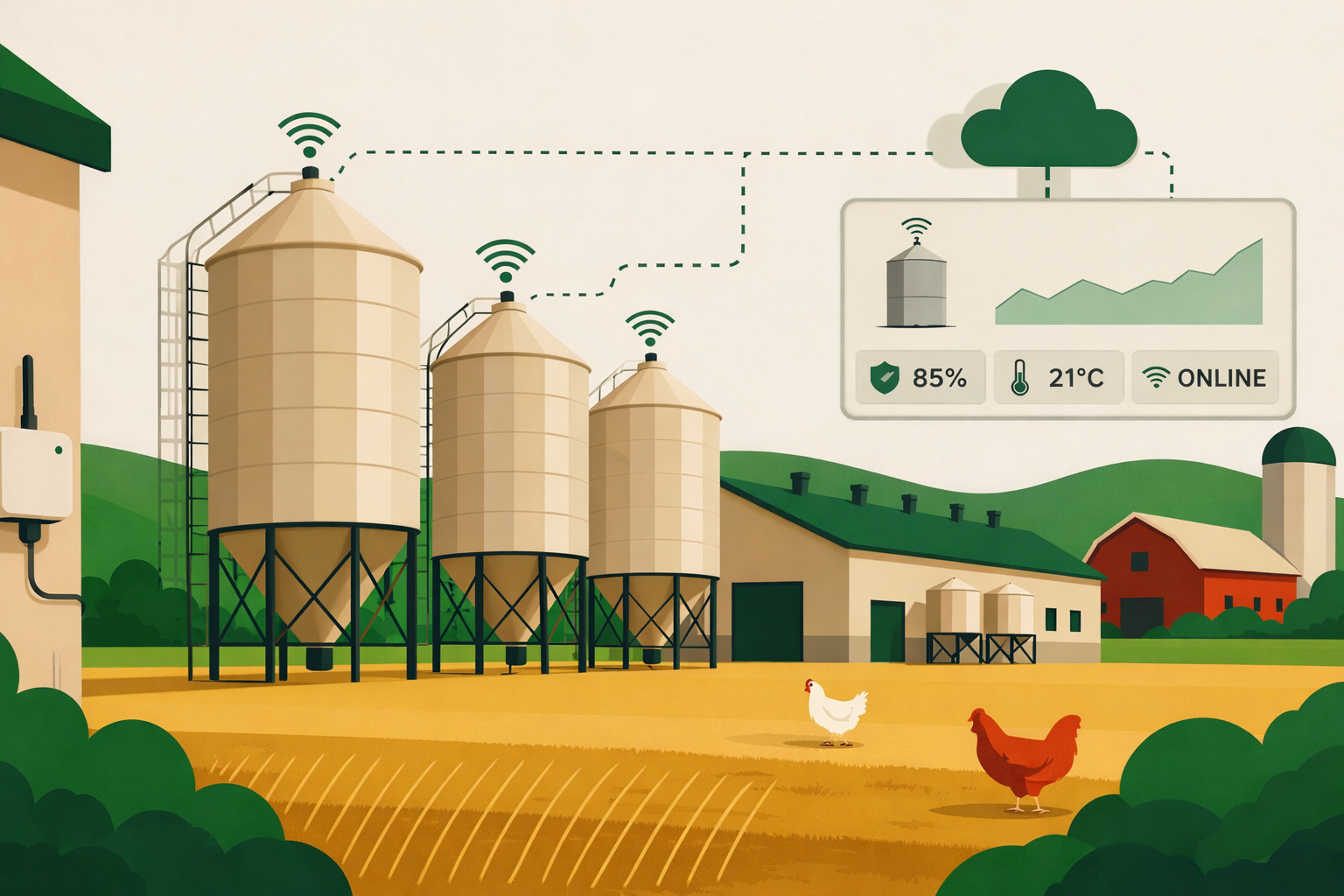
An automatic scale is a platform or a suspended element in the house that the bird steps onto by itself. With each step the scale records the weight, and the system averages hundreds or thousands of readings a day. That gives you a daily, objective average weight of the whole flock — without catching birds and without the stress of manual sample weighing.
Why an automatic scale if you can weigh by hand?
Manual sample weighing gives a picture from a single day and covers a few dozen birds — an automatic scale collects data non-stop, from a large number of steps, and shows the trend. The trend is what matters most: a sudden flattening of the growth curve or a divergence between scales in different parts of the house is an early alarm. Manual weighing still helps as a check and a calibration, but it is the automatic scale that delivers the continuity and the uniformity (CV%) you cannot compute by hand every day.
How poultry is weighed
The choice depends on the species, the birds’ age and whether you want continuous measurement or only a spot check.
Automatic platform scales
The most common choice for broilers on litter. The bird steps onto the scale plate by itself, and the sensor records the weight while filtering out faulty steps (two birds at once, a bird stepping off). The more steps, the more reliable the average. The scale is raised as the litter builds up, so it always sits at the level of the birds.
Suspended (hanging) scales
A platform hung on a load-cell sensor, popular with turkeys and in rearing. It hangs above the litter and keeps its own level, so there is no need to adjust it as the bedding builds up. It works well where the bird readily jumps onto a raised spot.
Manual control weighing of a sample
A classic hand or hook scale for periodically weighing a random sample of birds. It is used to verify the automatic scale and to check at catching. The sample must be representative — weigh birds from different parts of the house, not just those nearest the door.
Uniformity measurement (CV%)
The average weight alone is not enough — what also counts is how much the birds differ from one another. The coefficient of variation CV% shows the spread of weight in the flock: a low CV means an even flock, a high one signals a problem with access to feed or water, or an uneven house climate.
Growth curve and comparison to the standard
The system plots the average weight day by day and overlays it on the supplier’s breed curve (Ross, Cobb). You see at once whether the flock is on plan, ahead of it or behind. This is the basis for deciding the catching date and for feeding corrections.
Data integration with the controller
The scale gives the most when its data flows into the climate controller and the farm management system together with feed and water use. Then you set weight against FCR and the climate in one place, and deviations are easier to link to a cause.
Flock weighing step by step
- 1
Match the scale type to species and age
You pick a different scale for broilers on litter, another for turkeys, and yet another for rearing young birds. Check the weighing range and plate size — a chick and a finished broiler are two very different weights. Suppliers state which models suit a given species and age range.
- 2
Position the scales evenly in the house
One scale is a picture of one spot. Place them evenly across the house, away from drinkers, feeders, walls and air inlets — where birds spend time, neither crowding nor avoiding. A larger house needs several scales so the average covers the whole flock, not one corner.
- 3
Calibrate and tare the scale
Before placement set the zero (tare) and verify the reading with a reference weight. A platform scale on litter must be raised as the bedding builds up so it sits at the level of the birds. A tilted or soiled plate falsifies the measurement — check it regularly.
- 4
Set the supplier’s breed curve
Load into the system the growth curve for your bird line (Ross, Cobb) and sex, if you run them separately. It is this curve the system will compare the daily average weight against. Without a standard you have only numbers; with it you see at once whether the flock is on plan.
- 5
Read average weight and uniformity daily
Look not only at today’s figure but at the trend and at uniformity (CV%). A growing spread of weight or a flattening curve is a signal before any drop is visible in the house. Compare the scales with one another — a divergence between them shows something is wrong in one part of the house.
- 6
React to deviations from the standard
When the flock falls behind the curve, look for the cause in order: access to feed and water, their quality, temperature and ventilation, the birds’ health. Weight set against feed use (FCR) hints whether the problem is in feeding or elsewhere. Base the catching date on the curve too, not on the calendar alone.
Frequently asked questions about poultry weighing
Why an automatic scale if I can weigh by hand?add
Manual weighing gives a picture from one day and covers a small sample, while the automatic scale collects data non-stop from many steps and shows the trend. The trend catches a problem earliest — before you see it in the house. Manual weighing stays as a check and a calibration, but the daily average and uniformity come only from an automatic scale.
How many scales do I need per house?add
It depends on the size of the house and the species, but the rule is simple: one scale shows one spot, so a large house needs several, placed evenly. The point is for the average to cover the whole flock, not one corner. The exact number and spacing are best chosen with the equipment supplier for the specific building.
Why does the weight deviate from the breed curve?add
A Ross or Cobb standard is built under model conditions, so small differences are normal. A larger deviation downwards usually points to limited access to feed or water, their quality, the wrong temperature or a health issue. What matters is whether the deviation grows from day to day — then look for the cause, starting with feed, water and the house climate.
How are uniformity and flock CV calculated?add
Uniformity describes how much individual birds’ weights differ from the average. It is most often given as the coefficient of variation CV%, the spread of weight relative to the average — the lower it is, the more even the flock. The system computes it automatically from the scale readings. A high CV signals that some birds are growing worse and that access to feed, water and the climate are worth checking.
Describe your building’s equipment in DlaFerm.pl
In DlaFerm.pl, in the “Technical equipment of the building” step, you record which scales you weigh the flock with and what equipment you have — all in one place. Create a free account or write to us.
Phone
+48 796 258 151