Turkey farming for meat — from placement to slaughter
A turkey is a different world from a broiler: a longer rearing period, higher starting temperatures and a clear split between heavier toms and lighter hens. We explain in plain language how raising a meat turkey works, from the first day under the canopy to preparing the flock for slaughter.
verifiedFrom the team that has organised work on poultry farms for years.
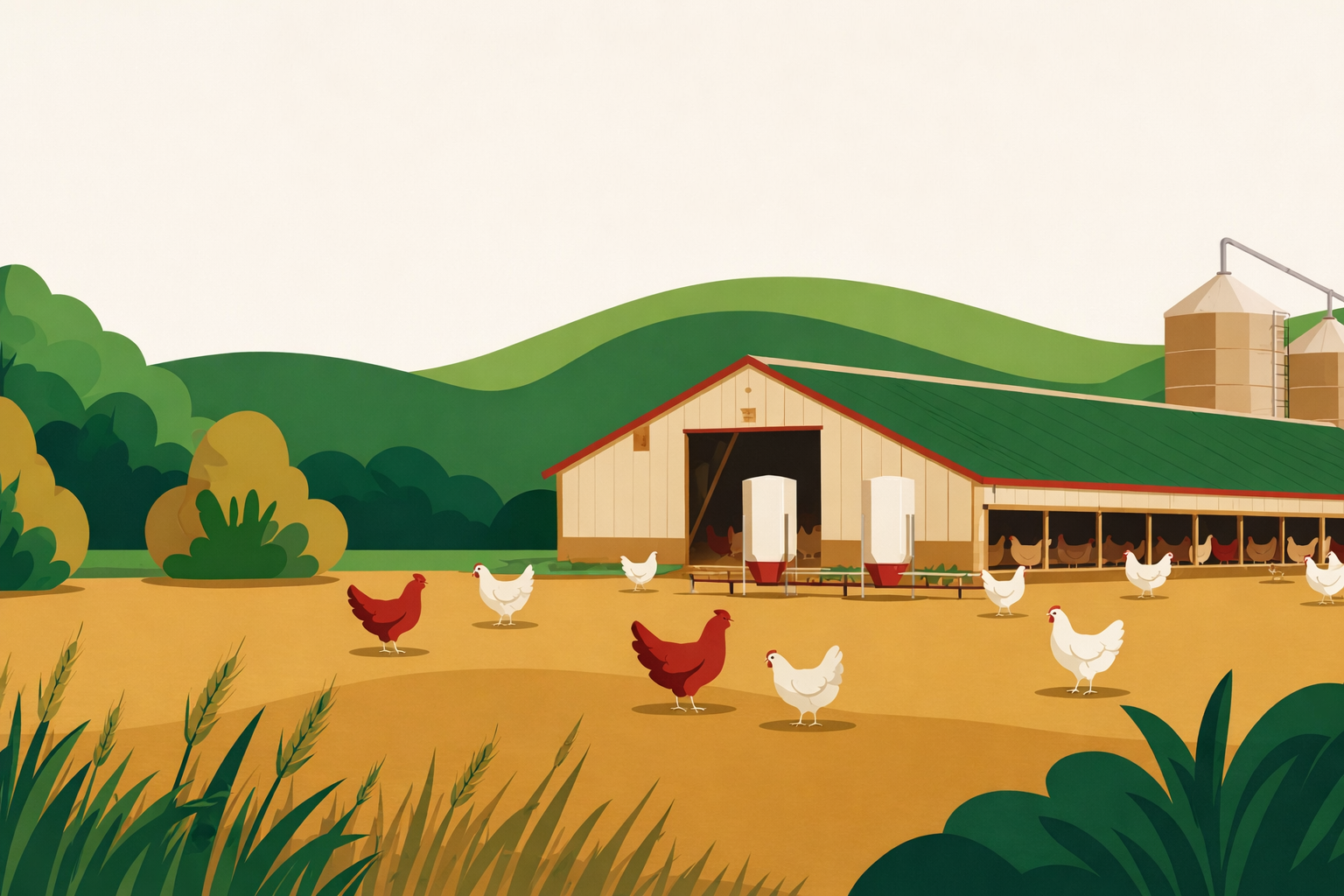
The meat turkey — what kind of bird is it
A meat turkey is a bird raised for meat, most often from heavy commercial lines (BUT — British United Turkeys, or Nicholas). Unlike a chicken broiler, the turkey grows for longer and reaches a much higher body mass. It is kept in floor housing, in barns with a controlled microclimate. It is a more demanding species at the start — sensitive to conditions in the first days of life and to diseases specific to turkeys, which is why rearing is handled more carefully than with chickens.
Sexual dimorphism — toms and hens
The most important feature of the turkey is its pronounced sexual dimorphism, the large difference between males and females. Toms (males) are much heavier and are fattened for longer — usually about 20–22 weeks, to a weight of 18–20 kg or more. Hens (females) are lighter and reach their target weight faster — they are slaughtered earlier, usually around 16 weeks, at about 10 kg. For this reason flocks are often split by sex, because each group has a different feeding programme, a different stocking density and a different slaughter date.
Why turkeys need a different approach
A turkey is not a “big broiler”. Turkey poults are more fragile at the start — they regulate body temperature less well and require a higher ambient temperature and good access to feed and water from the first hours. Throughout the cycle the turkey needs higher protein in its feed, access to grit and a well-planned lighting programme. On top of that come specific diseases such as histomoniasis (blackhead), which are practically never seen in broilers. That is why biosecurity and flock observation matter even more here — we cover protecting the farm in the guide on poultry farm biosecurity.
A shared foundation with every poultry farm
Despite the differences, running a turkey farm rests on the same duties as any poultry farm. You need a farm veterinary number, you must keep flock records in IRZplus, document treatments while observing withdrawal periods, and comply with poultry transport rules at collection for slaughter. DlaFerm.pl brings these duties together in one poultry farm management software, and can send the IRZplus reports for you if you want — it works the same for turkeys as for chickens.
From the first day under the canopy to preparation for slaughter
Raising a meat turkey is divided into distinct stages. Each has different microclimate, feeding and handling requirements.
Brooding under the canopy (start)
The first days set the tone for the whole cycle. Poults are placed under heating canopies, where just under the canopy a temperature of about 40°C is maintained, while the barn temperature is lowered gradually — the profile steps down week by week from about 36°C to about 16°C. Easy access to warm water and feed and a calm, bright environment that encourages feeding are crucial. The guide on temperature and humidity in the house covers the details.
Fattening (mass gain)
After the rearing period the turkeys move onto fattening feeds with lower protein than the starter but still high in energy. The need for floor space and fresh air grows, so ventilation and keeping the litter dry become key. This is the stage where dimorphism is most visible — toms clearly outpace hens in weight and are fattened for longer.
Preparation for slaughter
Before collection the flock is prepared for transport: weights are evened out, a pre-slaughter feed withdrawal is planned and medication is stopped so the withdrawal period is observed. Collection and transport must meet welfare requirements in transit — deadlines and duties are covered in the guide on poultry transport rules.
What is different from a broiler
If you know broiler rearing, these differences will most quickly show what to watch out for with a turkey.
Higher start, longer rearing
The turkey starts from a higher temperature (about 40°C under the canopy) and is reared for much longer than a broiler — hens about 16 weeks, toms about 20–22 weeks, while a broiler finishes its cycle after about 6 weeks. This means a different work rhythm and different stocking planning.
Lower stocking density
A turkey is a large bird, so fewer of them fit per unit of floor space than broilers. Lower density means a better microclimate and litter quality, but also different kg/m² calculations and greater ventilation requirements — see poultry house ventilation.
Higher protein and grit
Turkey feeds have higher protein than broiler feeds, especially at the start. The birds are also given grit, which helps grind the feed in the muscular stomach (gizzard). This is an element not used in typical broiler rearing.
Lighting programme and darkness
In turkeys, from about day 5 a lighting programme is introduced with at least about 8 hours of darkness per day. The dark period supports proper development of the bird’s bones and legs. The guide on the poultry house lighting programme explains how to set it.
Specific diseases
The turkey is prone to diseases practically never seen in broilers — above all histomoniasis (blackhead). Leg problems such as bent legs or tibial dyschondroplasia (TD) are also more common. The poultry disease symptom table sets out the signs.
Welfare and footpad condition
With a longer cycle and greater mass, litter quality and dry bedding are especially important — they determine the condition of the bird’s feet and legs. Good litter management limits inflammation and improves welfare — see litter management in the house.
Frequently asked questions about turkey farming
How long does rearing a meat turkey take?add
It depends on the sex. Hens (females) are usually slaughtered after about 16 weeks, at about 10 kg. Toms (males) are fattened longer — about 20–22 weeks, to 18–20 kg or more. For comparison, a chicken broiler finishes its cycle after about 6 weeks. That is why turkey flocks are often split by sex, since each group has a different slaughter date and a different feeding programme.
How do toms differ from hens?add
Toms are males, hens are females — and in turkeys the difference between them is very large (sexual dimorphism). Toms are much heavier, grow to a greater mass and are fattened for longer (about 20–22 weeks, 18–20 kg or more). Hens are lighter and are slaughtered earlier (about 16 weeks, around 10 kg). For this reason the two groups are often kept separately, with separate feeding and stocking.
What is histomoniasis (blackhead)?add
Histomoniasis, known as blackhead, is a parasitic disease typical of turkeys, caused by the protozoan Histomonas meleagridis. It damages the liver and the caeca, leading to depression, diarrhoea and high mortality, especially in young birds. Turkeys are far more susceptible to it than chickens. Prevention matters most: biosecurity, clean ground and limiting contact with other poultry and their droppings.
What temperature do turkeys need at the start?add
At the start poults need a lot of warmth. Just under the heating canopy a temperature of about 40°C is maintained, and the barn temperature is lowered gradually, week by week — the profile steps down from about 36°C in the first week to about 16°C in the final rearing phase. Too low a temperature at the start is one of the most common mistakes, leading to poorer feeding and higher mortality.
Why do turkeys need grit?add
Grit, fine gravel, helps turkeys grind feed in the muscular stomach (gizzard). This lets the bird digest and use feed better. Feeding grit is part of turkey rearing that is not used in typical broiler rearing. It is one of the practical differences worth remembering when moving from chickens to turkeys.
How does a turkey differ from a broiler?add
A turkey is larger, grows for longer and is more demanding at the start. It needs a higher starting temperature (about 40°C under the canopy), a longer rearing period (16–22 weeks instead of about 6), lower stocking density, higher protein in the feed and grit, plus a lighting programme with a dark period. Add specific diseases such as histomoniasis. In short: it is a different production model, even though the farm’s formal duties are the same as for a broiler.
Run your turkey farm in one place with DlaFerm.pl
Raising toms, hens or a whole meat flock? We will show you how DlaFerm.pl simplifies records, treatment and turkey biosecurity. Write to us.
Phone
+48 796 258 151