All-in/all-out principle in poultry farming
All-in/all-out means placing all birds at once and removing them all at once — one shared cycle for the entire house. It is the fundamental health principle that breaks the chain of infection between consecutive flocks. We explain how it works, why it is effective, and how to apply it correctly.
verifiedFrom the team that has organised work on poultry farms for years.
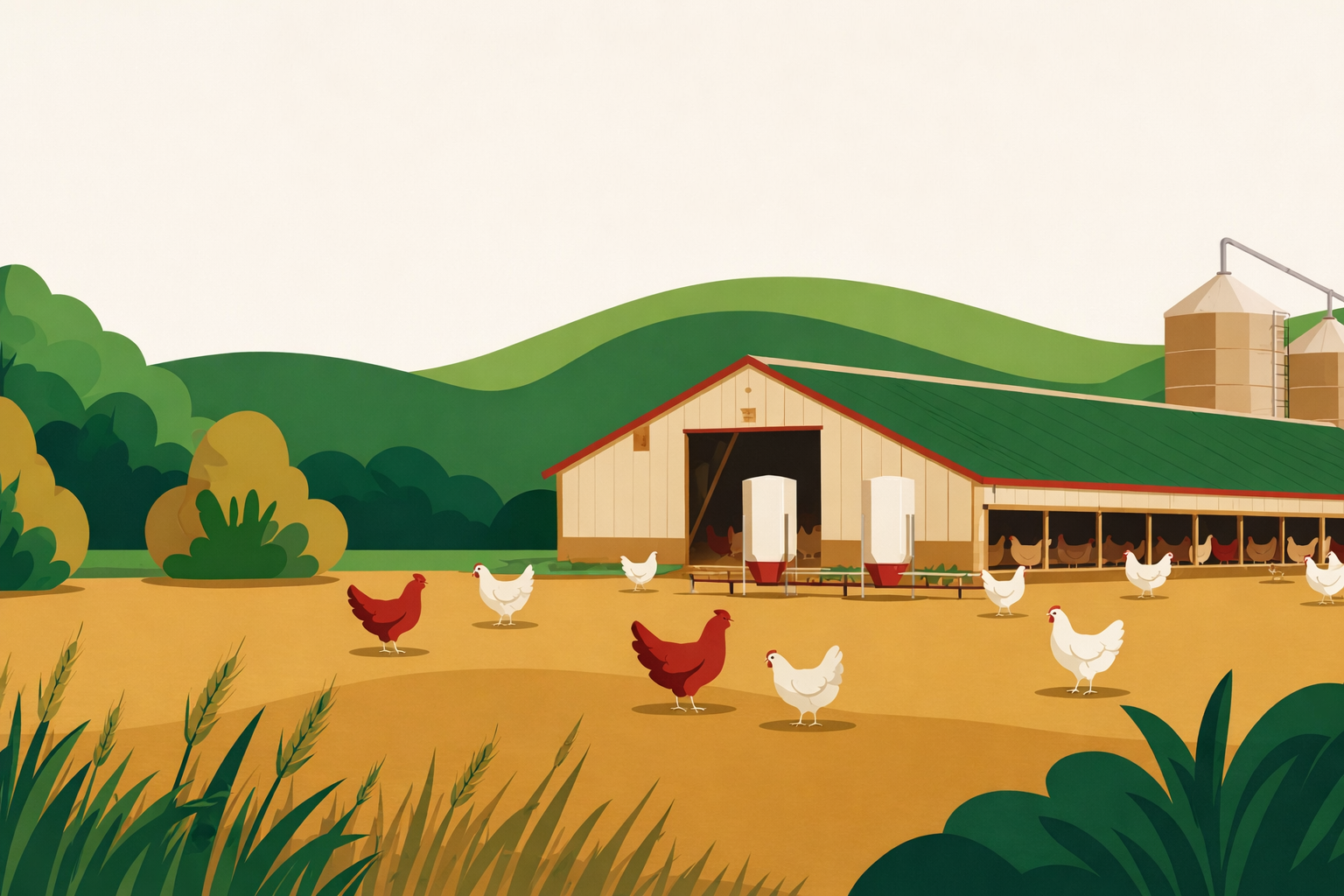
Imagine placing new chicks in a house where the previous flock has not yet been removed. Or keeping birds of different ages in the same building — some a week old, others six weeks. Pathogens from the older, already-exposed birds pass continuously to the younger ones. Disease circulates endlessly. This is continuous production — and it is exactly what all-in/all-out avoids.
What does all-in/all-out mean?
All-in/all-out means that an entire house — ideally the entire farm — is filled in a single placement. All birds are the same age and come from the same source, growing together as one flock. When slaughter time arrives, the entire house is emptied at once. The building then stands empty during the downtime period.
What is the downtime period?
The downtime is the interval between one flock leaving and the next one arriving. During this window the house is cleaned out, washed, disinfected and dried. This is not wasted time — it is when you destroy pathogens accumulated during the previous cycle before they can reach the next flock. More on the cleaning process in the guide on washing and disinfecting the poultry house, and on preparing for a new placement in preparing the poultry house before placement.
All-in/all-out step by step
- 1
Place the entire house in one batch — same age, same source
All chicks enter the building on the same day. They are the same age and, where possible, come from a single hatchery or supplier. This means the whole flock is at the same stage of immunity and disease susceptibility. Never add new chicks to an ongoing flock — even if you have spare space in the house. Cycle details for broilers are in the guide on the broiler production cycle.
- 2
Manage the whole flock as one group throughout the cycle
From placement to slaughter, treat the flock as a single unit. Monitor parameters, supply feed and water, respond to any health signs — but never mix age groups or move birds between houses during the cycle. A uniform flock grows predictably and is easier to manage.
- 3
Remove the entire flock for slaughter at once
When the flock reaches target body weight or slaughter age, the entire house is emptied simultaneously. Do not leave some birds behind to "grow out" — those remaining become a reservoir of pathogens for the next flock. Removing all birds at once is a prerequisite for effective all-in/all-out.
- 4
Remove all litter and manure
Immediately after the flock leaves, remove all litter and manure — the largest source of pathogens, mould and ammonia. Do not leave any old litter on the grounds of "natural substrate" or cost savings. Thorough removal of droppings is the first and most important step of clean-out.
- 5
Wash and disinfect the empty house
The empty, dry building is washed with a pressure washer (especially ceilings, walls, feeders, drinkers and fans) and then a disinfectant is applied according to the manufacturer's instructions. Disinfection effectiveness depends on cleaning thoroughness — dirt shields pathogens from the chemical agent. A detailed protocol is in the guide on washing and disinfecting the poultry house.
- 6
Allow sufficient downtime until the house is dry
A wet house after washing is ideal for many pathogens. The downtime must be long enough for the floor, walls and litter (if spread before placement) to dry completely. Minimum downtime depends on species, climate and the farm's disease history — typically a few to several days. Shortening downtime for economic reasons is one of the most common mistakes.
- 7
Only then place the new flock
When the house is clean, dry and checked (temperature, ventilation, feeders, drinkers), you can receive the new flock. House preparation guidelines are in the guide on preparing the poultry house before placement. The new flock starts from zero — without the infectious pressure left by the previous cycle.
Benefits of the all-in/all-out principle
Implementing all-in/all-out requires discipline and planning, but it pays off in production and health outcomes.
Lower mortality and fewer diseases
Breaking the chain of infection between flocks is the most important benefit. Pathogens accumulated during one cycle — viruses, bacteria, coccidia — have no chance to reach the next flock because there are no younger birds to infect. Mortality is lower, disease outbreaks are milder, and flocks less frequently require veterinary intervention. This is the direct result of good poultry farm biosecurity.
Lower use of medicines and veterinary products
A healthier flock means less need for antibiotics, coccidiostats and other treatments. This reduces costs and makes it easier to meet withdrawal period and residue requirements. In an era of increasing market and regulatory demands regarding antibiotic use, this is a significant advantage.
Uniform flock and more predictable results
When all birds in the house are the same age and from the same source, the flock grows evenly. Uniformity (body weight consistency) is higher — important especially when selling to processing plants that expect uniform batches. Feed planning, slaughter timing and logistics are also easier.
Simpler management and monitoring
One flock, one age group means one growth curve, one feeding programme and one vaccination schedule (if used). You do not have to juggle different plans for different age groups. Farm management is simpler and deviations from normal are detected faster.
Clear disease and production history
Each cycle has a clear start and end. Records are transparent: placement date, source, mortality, interventions, removal date. This makes it easier to analyse health problems and discuss them with a vet or regulatory authority.
More effective cleaning and disinfection
Empty houses are easier and more thoroughly disinfected than those containing birds or partially occupied pens. With all-in/all-out you have full access to every corner of the house — ceiling, fans, feeders, floor under the litter — without having to work around animals.
Most common mistakes when implementing all-in/all-out
The all-in/all-out principle loses its value when applied incompletely. Here are the most common pitfalls.
Adding new chicks to an existing flock
This is the most serious mistake — the direct opposite of all-in/all-out. New chicks are more susceptible and may pick up pathogens from older birds that carry infection without showing symptoms. Even a single such addition can negate the health advantage of the whole system.
Too short a downtime
Cutting the downtime by a few days is economically tempting but means the house does not dry out sufficiently and disinfectants work less well on moist surfaces. Pathogens survive and come into contact with the new flock from the very first hours. Minimum downtime should be tailored to farm conditions and history — not cut to the absolute minimum without justification.
Incomplete removal of litter and manure
Leaving old litter behind under the pretext of "natural substrate" or saving money is a mistake. Droppings are a reservoir for coccidia oocysts, Campylobacter, Salmonella and many viruses. Disinfectants cannot penetrate organic matter — so if litter is not removed, disinfection is largely ineffective.
Washing without disinfection or disinfecting without washing
Washing and disinfection must go together and in the right order: first litter removal, then washing, then disinfection. Washing alone does not destroy all pathogens. Disinfecting a dirty surface does not work because organic matter inactivates the chemical agent. Only both steps together deliver a full result.
Frequently asked questions about all-in/all-out
What does all-in/all-out mean in poultry farming?add
All-in/all-out means that an entire house — ideally an entire farm — is filled in a single placement: same age, same source. The flock grows together and is removed for slaughter all at once. The house then stands empty during a downtime period of cleaning, washing and disinfection. Only after this downtime is the next flock placed. In short: all birds enter together and all birds leave together.
Why is all-in/all-out better than continuous production?add
In continuous production, different age groups coexist on the farm — older birds can pass pathogens to younger, less immune ones. Disease circulates endlessly. All-in/all-out breaks this chain: pathogens from one cycle have nowhere to go because the house is empty and disinfected before the next placement. The result is lower mortality, fewer medicines and a healthier flock.
How long should the downtime period be?add
Minimum downtime depends on bird species, farm disease history and climate. As a rough guide it ranges from a few to several days. Importantly, within that time the house must first be thoroughly cleaned and disinfected and then have enough time to dry completely. Cutting downtime below the drying time needed is one of the most common mistakes.
Can I add a few birds to an existing flock if there have been losses?add
No. This directly breaks the all-in/all-out principle. New chicks are more susceptible and may become infected by older birds that carry pathogens without showing symptoms. Even a small number of added birds undermines the whole principle and can trigger health problems throughout the flock.
If a farm has several houses, should all-in/all-out apply per house or per farm?add
Ideally all-in/all-out should be applied at farm level — all houses filled and emptied simultaneously. This gives the best protection by eliminating the risk of pathogen transfer between houses via people, equipment or air. If this is not possible (e.g. for economic reasons), apply all-in/all-out at least per house — but then biosecurity procedures between houses become especially important.
Which poultry diseases does all-in/all-out control most effectively?add
All-in/all-out helps control most infectious poultry diseases, including Marek's disease, infectious bursal disease (Gumboro), coccidiosis, Salmonella, Campylobacter and viral respiratory diseases (IB, ILT, Newcastle). It is particularly effective against pathogens that survive long in the environment (e.g. coccidia oocysts in litter). The principle does not replace vaccination or other biosecurity measures, but it is their foundation.
Plan production cycles and downtime in DlaFerm.pl
Want to record placement dates, removal dates and downtime in one place together with flock mortality and results? Create a free farm account or write to us.
Phone
+48 796 258 151