Pre-slaughter feed withdrawal in broilers: how to plan it and why it matters
Feed withdrawal before slaughter is not about punishing birds — it is a critical food safety step. Learn when to remove feed, for how long, what poor planning risks, and how DlaFerm.pl links the process to your collection scheduling.
verifiedFrom the team that has organised work on poultry farms for years.
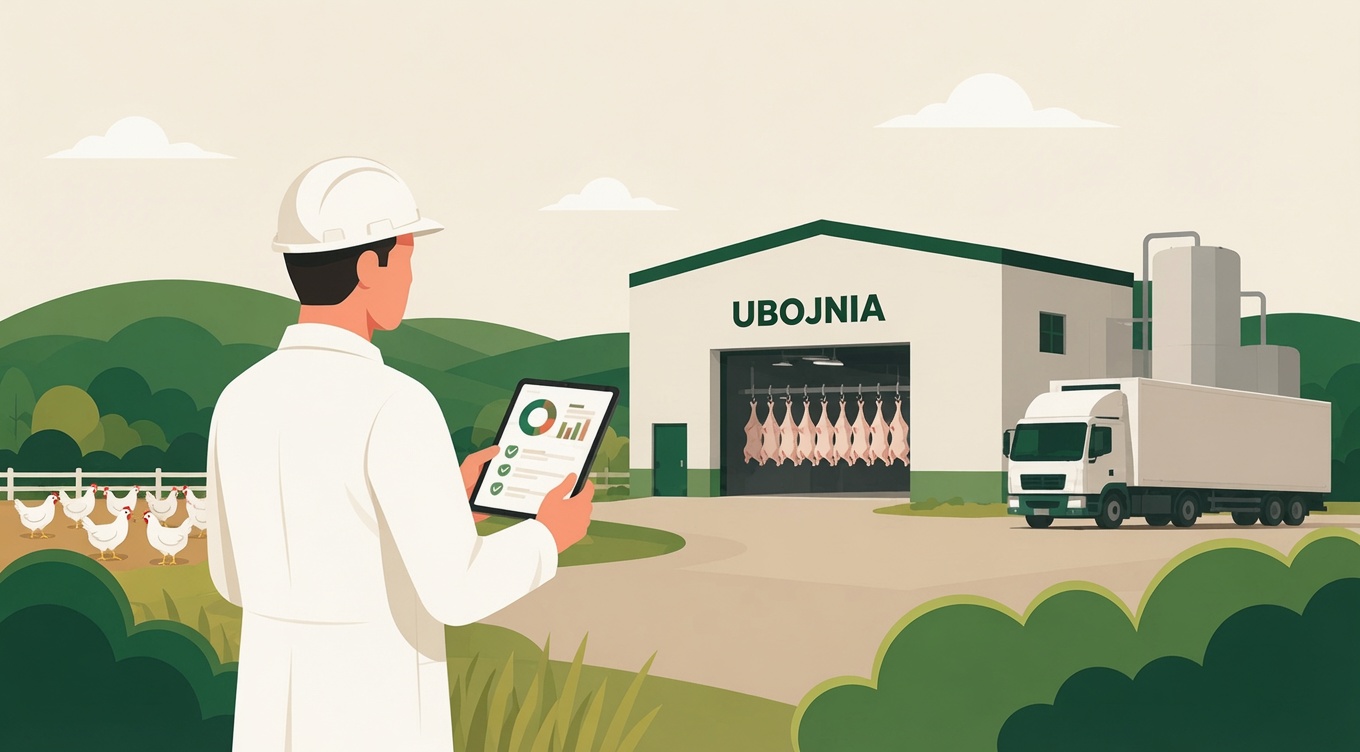
Why is pre-slaughter feed withdrawal used?
The main purpose of feed withdrawal is to empty the birds' gastrointestinal tract before slaughter. A full gut can rupture during evisceration and contaminate the carcass with intestinal contents, creating a serious microbiological risk — above all Salmonella and Campylobacter contamination. EC Regulation 1099/2009 on the protection of animals at the time of killing and EC Regulation 853/2004 on the hygiene of food of animal origin require carcasses to meet hygiene criteria, and correctly managed feed withdrawal is one of the primary tools for meeting those requirements.
Total feed withdrawal time — what it consists of
Farmers often confuse on-farm feed removal time with total feed withdrawal time. The total time covers several stages: feed removal in the poultry house, catching and loading time, transport to the slaughterhouse, and lairage time before stunning. Indicatively, the total withdrawal period is around 8–12 hours; the precise recommendation may vary depending on the slaughterhouse, buyer requirements, and flock management guidelines from the breed company. Always confirm the specific requirement with your slaughterhouse or producer organisation.
Water access: a requirement, not an option
Birds must have access to water until catching begins. Water does not hinder gut emptying — on the contrary, it supports intestinal transit and helps flush gut contents. Cutting off water too early impairs bird welfare and can lead to dehydration, which negatively affects both animal condition during transport and carcass quality (dry meat, bruising). EC Regulation 1099/2009 confirms that animals have the right to water at every stage of the pre-slaughter process.
Planning feed removal time — working back from the collection notice
The practical approach is to work backwards: if you know the planned slaughter time, subtract the lairage time, transport time and catching time to arrive at the latest point on the farm at which feed should be removed. DlaFerm.pl allows you to link production cycle records with the planned live-bird collection date — the farmer can immediately see the latest time at which feed must be withdrawn. Remember: a planning mistake costs either carcass quality (too short) or live weight and bird welfare (too long).
Weight loss and settlement with the slaughterhouse
During feed withdrawal, birds lose weight — approximately 0.3–0.5% of live weight per hour, though this is indicative and depends on temperature, humidity, stocking density and flock condition. With an excessively long withdrawal, losses mount and directly reduce the farmer's income. Linking the precise feed removal time to flock weight data is key for forecasting the settlement. DlaFerm.pl collects weight data from individual weighings, making it easier to track this process.
Total feed withdrawal time — 4 stages you must add up
Each stage adds to the total withdrawal time. Plan all of them in advance.
Feed removal on the farm
Feed is removed from feeders. Water remains available. Duration depends on the collection appointment time and the estimated time of the remaining stages. This is the only stage the farmer fully controls.
Catching and loading birds
Birds are caught, placed in containers or crates and loaded onto the vehicle. This stage takes approximately 1–3 hours depending on flock size and crew organisation. Water access in the house is no longer possible from this point.
Transport to the slaughterhouse
Transport time depends on distance. EC Regulation 1/2005 limits poultry transport time under normal conditions to 8 hours without watering. For longer journeys, drinkers in the vehicle are required. Stress and temperature during transport accelerate intestinal transit.
Lairage at the slaughterhouse
After arrival, birds wait in the pre-slaughter holding area. Lairage time should be as short as possible. Indicatively, slaughterhouses aim not to exceed 1–2 hours, though this depends on the plant's schedule. The total feed withdrawal period ends only at the moment of stunning.
What happens when withdrawal is too short or too long?
Both mistakes are costly — one for food safety, the other for the farmer's income and bird welfare.
Too short: carcass contamination risk
A full gut can rupture during evisceration. Intestinal contents carry pathogens: Salmonella, Campylobacter, Clostridium. Contaminated carcasses must undergo additional processing or be condemned — a cost to the slaughterhouse and potential legal liability for the farmer.
Too short: worse veterinary inspection outcome
The veterinary inspection at the slaughterhouse can reject a batch if carcasses fail to meet hygiene criteria. In extreme cases the entire batch may be detained and penalties imposed.
Too long: weight loss and lower income
Every extra hour of withdrawal means real live-weight loss. With a flock of 40,000 birds, even 0.1 kg loss per bird amounts to 4,000 kg less settled weight — a significant cost.
Too long: intestinal damage
With a very long withdrawal (beyond approximately 12 hours) there is increased bile secretion and inflammatory changes in the intestines. This can paradoxically increase contamination risk — bile alters the consistency of intestinal contents and complicates evisceration.
Too long: welfare and stress
Hungry birds are more aggressive, compete more strongly for space and experience higher stress levels. This leads to bruising, fractures and poorer carcass appearance. EC Regulation 1099/2009 explicitly prohibits unnecessarily prolonging feed withdrawal.
Poor documentation: problem at inspection
The absence of records showing when feed was withdrawn can make it difficult to demonstrate compliance during an inspection. DlaFerm.pl logs key production cycle events, making it easy to reconstruct batch history.
Frequently asked questions about pre-slaughter feed withdrawal in broilers
How many hours should pre-slaughter feed withdrawal last for broilers?add
Indicatively, the total feed withdrawal time (from on-farm feed removal to slaughter) is around 8–12 hours. The precise requirement may vary depending on the slaughterhouse, buyer, and breed company guidelines. Always confirm the specific requirement with your slaughterhouse.
Can birds drink water during feed withdrawal?add
Yes — water access should be maintained until catching begins. Water supports gut emptying and prevents dehydration, which impairs bird welfare and carcass quality.
When should I remove feed if collection is at 4:00 a.m.?add
Work backwards: from 4:00 a.m. subtract the estimated catching time (e.g. 2 h), transport time (e.g. 1.5 h), and lairage time (e.g. 1 h). That gives you the approximate on-farm feed removal time. Also check your slaughterhouse's total withdrawal requirement — it may differ from the indicative 8–12 h range.
Can excessively long feed withdrawal actually increase contamination risk?add
Yes. With a very long withdrawal (beyond approximately 12 hours), increased bile secretion into the intestines can make evisceration harder and paradoxically raise contamination risk. An optimal withdrawal time minimises both risks simultaneously.
How does DlaFerm.pl help with pre-slaughter withdrawal planning?add
DlaFerm.pl lets you link production cycle records with the planned collection date. The farmer can see the latest on-farm feed removal time and can reconstruct batch history for inspections. Weight data from individual weighings also makes it easier to forecast weight-loss deductions.
What regulations govern pre-slaughter feed withdrawal in poultry?add
The key legislation is EC Regulation 1099/2009 (protection of animals at the time of killing), EC Regulation 853/2004 (hygiene of food of animal origin) and EC Regulation 1/2005 (transport of animals). In Poland, compliance is supervised by the Veterinary Inspection service.
Sources & resources
- linkEFSA — scientific opinion on welfare of poultry at slaughter
- linkAviagen — Ross Broiler Management Handbook (pre-harvest feed withdrawal guidance)
- linkEUR-Lex — EC Regulation 1099/2009 on the protection of animals at the time of killing
- linkEUR-Lex — EC Regulation 853/2004 laying down specific hygiene rules for food of animal origin
- linkEUR-Lex — EC Regulation 1/2005 on the protection of animals during transport
Plan live-bird collection with DlaFerm.pl
Want to see how DlaFerm.pl links production cycle records with collection scheduling? Write to us.
Phone
+48 796 258 151