Gas sensors — turn “it smells off” into a number
In winter you save heat, so you ventilate little — and that is exactly when ammonia and carbon dioxide build up. High NH3 stings the birds’ eyes and airways and cuts growth, and carbon monoxide from faulty heating can be deadly. A sensor reads the concentration live and tells the controller to air the hall before things go wrong.
verifiedFrom the team that has organised work on poultry farms for years.
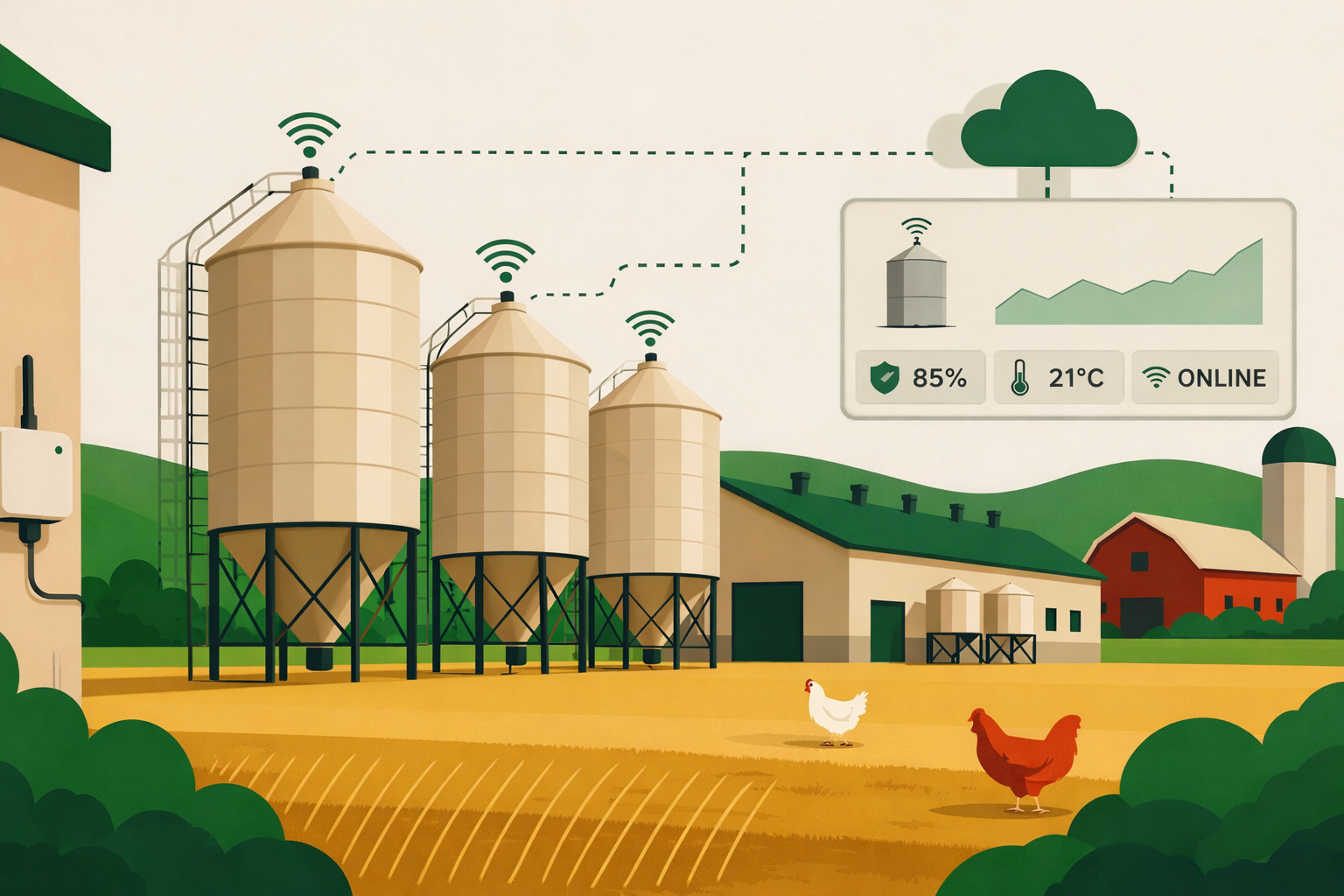
Air in a poultry house is not just temperature. The birds breathe, the litter ferments and heating consumes oxygen — so gases build up in the hall that your nose cannot measure precisely. A gas sensor shows the concentration in numbers at all times, so instead of guessing “it feels stuffy” you see a concrete value and know when to ventilate. That is the foundation for reconciling winter heat saving with flock welfare.
Which gases should you even measure?
Three matter most. Ammonia (NH3) comes from droppings and wet litter — it irritates the birds’ eyes and lungs; as a rough guide keep it below ~20 ppm, and ideally under 10–15 ppm. Carbon dioxide (CO2) rises when you ventilate too little; roughly it should not exceed ~3000 ppm. Carbon monoxide (CO) is a separate matter: it forms during faulty combustion in gas heating, it is odourless and deadly — which is why, wherever you heat with gas, a CO sensor is mandatory.
What makes up air measurement
The choice of sensors depends on how you heat, the season and how you run ventilation.
Ammonia (NH3) sensors — electrochemical
The most common way to measure ammonia. They react to the gas electrochemically and report the concentration in ppm. They are accurate, but their element wears out over time and needs periodic calibration and replacement. This is the sensor that tells you fastest that the litter is too wet and the ventilation too weak.
CO2 sensors — NDIR (infrared)
They measure carbon dioxide optically in the infrared (NDIR). They are stable and drift little, so they suit continuous monitoring well. A high CO2 reading is the simplest sign that the hall is under-ventilated — often earlier than your own sense of stuffiness.
Carbon monoxide (CO) sensors
Essential wherever you heat with gas, oil or any other combustion. CO is odourless and very dangerous, so treat the sensor as life protection — for birds and people. It should raise an alarm and increase ventilation the moment the threshold is crossed.
Humidity and temperature sensors
On their own they do not measure gases, but they give context. Wet litter and high humidity are an ammonia factory, and temperature decides how much you can ventilate without chilling the birds. Together with the gas sensors they let the controller make sound decisions.
Integration with the climate controller
Sensors deliver their full value only when wired to a controller. Once a threshold is crossed the controller boosts ventilation itself, and when the concentration drops it returns to economy mode. That way you don’t have to watch the readings by hand and react only when things are already bad.
Placement and wiring
A sensor must sit where the birds breathe — at the height of their heads, away from inlets and fans that would distort the reading with fresh or extracted air. Good placement decides the credibility of the numbers more than the class of the sensor itself.
Air measurement step by step
- 1
Choose the gases to measure
Start from how you heat and the time of year. Always measure ammonia and CO2 — these are everyday hazards, especially in winter with economical ventilation. Add carbon monoxide as a must wherever there is combustion in the hall (gas, oil). No combustion heating is the only case in which CO can be skipped.
- 2
Place sensors at bird height
The birds breathe at litter level, so measure there — at the height of their heads. Keep sensors away from air inlets and extraction fans, because fresh inflow lowers the reading and the stream toward a fan distorts it. A badly placed sensor will show nice numbers even when it is bad down at the birds.
- 3
Set the alarm thresholds
Enter the values at which the equipment should react. As a rough guide: ammonia below ~20 ppm (better aim under 10–15), CO2 below ~3000 ppm, and for carbon monoxide a precautionary threshold per the manufacturer’s guidance. Treat the thresholds as a starting point and adjust them to the species, the birds’ age and the season.
- 4
Connect to the controller
Wiring the sensors to the climate controller turns measurement into automatic action. Once a threshold is crossed the controller increases ventilation, and when the air improves it returns to economy mode. This is crucial in winter, when by hand it is easy to overshoot one way or the other.
- 5
Calibrate regularly
Sensors, especially the electrochemical ones for ammonia and CO, drift over time — they read less and less accurately while seeming to work. Calibrate them at the intervals the manufacturer recommends and replace worn elements. An uncalibrated sensor gives a false sense of safety, which can be worse than having none.
- 6
Act on alarms and log the trend
An alarm is not noise — check the litter moisture, the ventilation settings and the heating. Record the readings, because the trend is more valuable than a single number: slowly rising ammonia warns that the litter is deteriorating before it crosses the threshold. The data also helps plan litter changes and servicing.
Frequently asked questions about gas sensors in a poultry house
What are the safe ammonia and CO2 thresholds for poultry?add
As a rough guide, ammonia (NH3) is kept below about 20 ppm, and ideally under 10–15 ppm — at such levels the birds’ eyes and airways are not irritated. Carbon dioxide (CO2) usually should not exceed about 3000 ppm. These are indicative values; the exact target depends on the species, the birds’ age and the supplier’s guidance, so treat them as a starting point.
Where should I place the sensor in a poultry house?add
At the height of the birds’ heads, because that is where they breathe and where air quality counts. Keep the sensor away from inlets and extraction fans — fresh inflow lowers the reading and the stream toward the extractor distorts it. A well-chosen spot gives credible numbers; a badly placed sensor can read calm while it is stuffy down at the litter.
How often should I calibrate the sensors and why do they drift?add
Calibrate at the intervals the manufacturer recommends — usually every few months, more often for the electrochemical ammonia and CO sensors. These sensors drift over time because their reactive element wears down chemically and starts under- or over-reading. An uncalibrated sensor looks healthy but gives false numbers, so scheduled calibration and replacement of worn elements are essential.
Do I need a CO sensor with gas heating?add
Yes. Carbon monoxide (CO) forms during incomplete combustion in gas or oil heating, it is odourless and deadly — your nose will not detect it. Wherever there is combustion in the hall, treat the CO sensor as life protection, not an extra. It should raise an alarm and boost ventilation the moment the threshold is crossed.
Describe your building’s equipment in DlaFerm.pl
In DlaFerm.pl, in the “Technical equipment of the building” step, you record what sensors and climate control you have — all in one place. Create a free account or write to us.
Phone
+48 796 258 151