Chicken farm — broilers and layers
The chicken is really two worlds: the broiler raised for meat and the layer kept for eggs. We explain how they differ, how to choose the right direction for your farm, and what both paths share — from biosecurity to flock records.
verifiedFrom the team that has organised work on poultry farms for years.
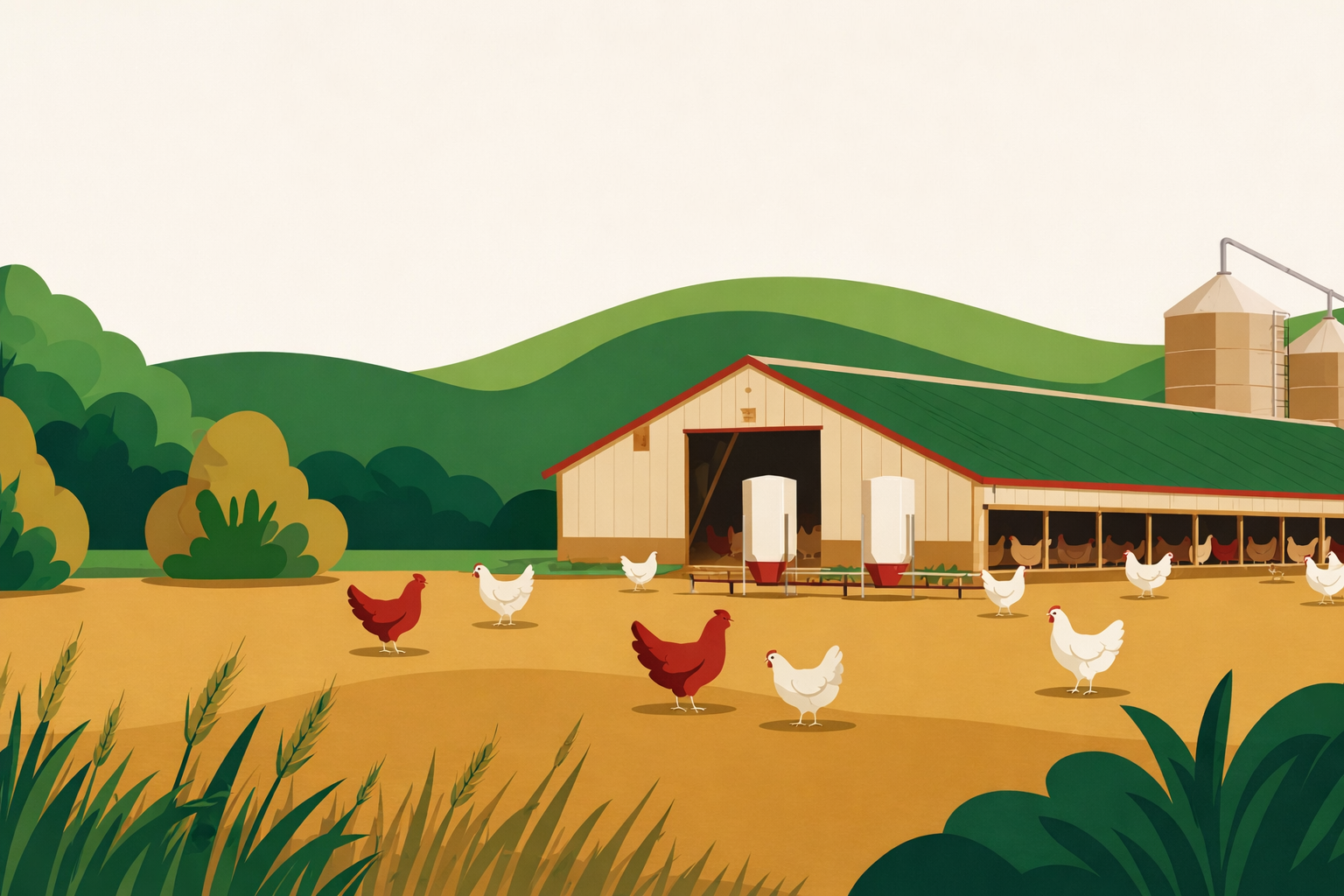
Chicken — one species, two production directions
Although both are the domestic chicken, a broiler farm and a layer farm are two completely different production models. The broiler is a meat chicken — a fast-growing bird sent to slaughter after about 42 days. The layer is an egg chicken — kept for over a year to produce table eggs. They differ in genetics, growth rate, feeding, house equipment and welfare requirements. The chosen direction shapes everything: from how the building is constructed to how settlements are handled.
Cycle length — 42 days versus over a year
This is the most important practical difference. A broiler cycle usually lasts about 35–42 days from placing the chicks to collecting the live birds — allowing 6–7 batches per year in the same house. A layer, by contrast, works far longer: after the rearing period (about 16–18 weeks) it comes into lay and stays in the flock for roughly 12–14 months. This means a different work rhythm, a different cash flow and different stocking planning. We cover the meat cycle in detail in the guide on the broiler production cycle step by step.
Growth rate and feeding
The broiler is selected for maximum body-mass gain — from a 40 g chick it reaches 2.5–3 kg in under six weeks. It needs high-energy, high-protein feed delivered in phases (starter, grower, finisher). The layer grows more slowly and does not lay down meat — its feed is geared towards egg production: lower protein, more calcium (for the shell). The lighting programme also differs: in broilers it stimulates feeding, in layers it sustains lay.
Welfare and housing systems
Welfare requirements apply to both directions, but in different areas. For broilers, stocking density (kg/m²), litter quality and microclimate are key — they influence, among other things, footpad health. For layers, cages have been giving way for years to barn, free-range and organic systems — which directly affects egg pricing and labelling. Whatever the direction, good conditions are not only a legal duty but also real payments — see the section on poultry welfare payments.
What do both paths share?
Despite the differences, the foundation of running a farm is the same. Every chicken operation requires registration and a farm veterinary number, keeping flock records in IRZplus, implementing poultry farm biosecurity, and documenting treatments while observing withdrawal periods. DlaFerm.pl brings these duties together in one poultry farm management software — whether you raise broilers or layers.
Choose the production direction of your chicken farm
Each direction is a different production model, with different equipment and settlements. See which one fits your holding.
Broiler farm (meat production)
Fast cycle (about 42 days), 6–7 batches a year, producing live birds for slaughter. Ventilation, microclimate, litter quality and smooth live-bird collection are key. A digital broiler Flock Card and the guide to the broiler production cycle will help.
Layer farm (egg production)
Long cycle (about 12–14 months), a flock kept for table eggs. The housing system (barn, free-range, organic) determines egg labelling and price. Different feeding (more calcium) and a different lighting programme than for broilers.
Parent stock (breeding)
A breeding or reproduction farm keeps cockerels and hens to obtain hatching eggs. This is the most demanding direction in terms of biosecurity and health status — the quality of the parent stock determines all downstream production.
The foundation of every chicken farm — whatever the direction
Broiler or layer — these duties apply to anyone keeping chickens. DlaFerm.pl runs them for you in one place.
Biosecurity
Protecting the farm against the introduction of diseases (including avian influenza) is fundamental. A disinfection mat, hygiene barrier, entry control and work clothing are required on every farm. Details in the guide on poultry farm biosecurity.
Records and IRZplus
Every flock must be reported and recorded in the IRZplus system — placements, mortality, movements. This is the basis for settlements and inspections. You can leave the IRZplus flock-change reports to DlaFerm.pl — it files them for you automatically, if you would rather not log into the ARiMR portal. See how flock records in IRZplus work.
Microclimate
Temperature, humidity and air exchange translate directly into flock health and results. Although the standards differ between broilers and layers, the principle is the same — a stable microclimate means fewer losses and better production.
Welfare
Proper stocking density, access to feed and water, litter quality and the lighting programme are legal requirements, but also the route to welfare payments. Good conditions pay off economically too.
Treatment and withdrawal
Every medication must be documented and the withdrawal period observed before selling meat or eggs. Reliable treatment records and drug withdrawal protect you from sanctions and product recalls.
Farm registration
Before placing the first chicks, the farm must have a veterinary number and be registered. This is a formal condition for legal production — of both meat and eggs.
Frequently asked questions about chicken farms
How does a broiler differ from a layer hen?add
A broiler is a meat chicken — a fast-growing bird raised for meat, with a cycle of about 42 days. A layer is an egg chicken — kept for around 12–14 months to produce table eggs. They differ in genetics, growth rate, feeding, lighting programme and house equipment. These are two different production models, even though both are the domestic chicken.
How long is a production cycle on a chicken farm?add
On a broiler farm one cycle usually lasts about 35–42 days from placing the chicks to collecting the live birds, allowing 6–7 batches a year. On a layer farm the cycle is far longer: after the rearing period (about 16–18 weeks) the layer stays in the flock for roughly 12–14 months. That is why work planning and cash flow look completely different in the two directions.
What permits do you need to start a chicken farm?add
Whatever the direction, the farm must be registered and obtain an identification (veterinary) number issued by the district veterinary officer. At larger scale, environmental and building permits may also be required. Every flock is reported and recorded in the IRZplus system. We cover the details in the guide on the farm veterinary number.
Cage or barn — how are laying hens kept?add
Egg production is moving away from cages (caged housing, marked 3) towards systems regarded as higher-welfare: barn (2), free-range (1) and organic (0). The housing system is coded on every egg and directly affects its price and sales options. Broilers, by contrast, are kept on litter — here the result is determined mainly by stocking density and microclimate.
Can one house suit both broilers and layers?add
Usually not without rebuilding. A broiler house is optimised for a short, intensive cycle and floor housing, while a layer house needs nests, perches and egg-collection equipment. Ventilation and the lighting programme also differ. The decision on direction is best made before building or modernising the facility.
How does DlaFerm.pl help on a chicken farm?add
DlaFerm.pl keeps your flock, treatment and withdrawal, biosecurity and farm-entry records for you — in one poultry farm management software. It works the same way for broilers and layers, so if you run both directions you have everything in one place, ready for an inspection.
Run your chicken farm in one place with DlaFerm.pl
Raising broilers, layers or both? We will show you how DlaFerm.pl simplifies records and biosecurity. Write to us.
Phone
+48 796 258 151