Broiler production cycle step by step
From an empty house to loading — all rearing stages, what to do and what to watch for in each week.
verifiedFrom the team that has organised work on poultry farms for years.
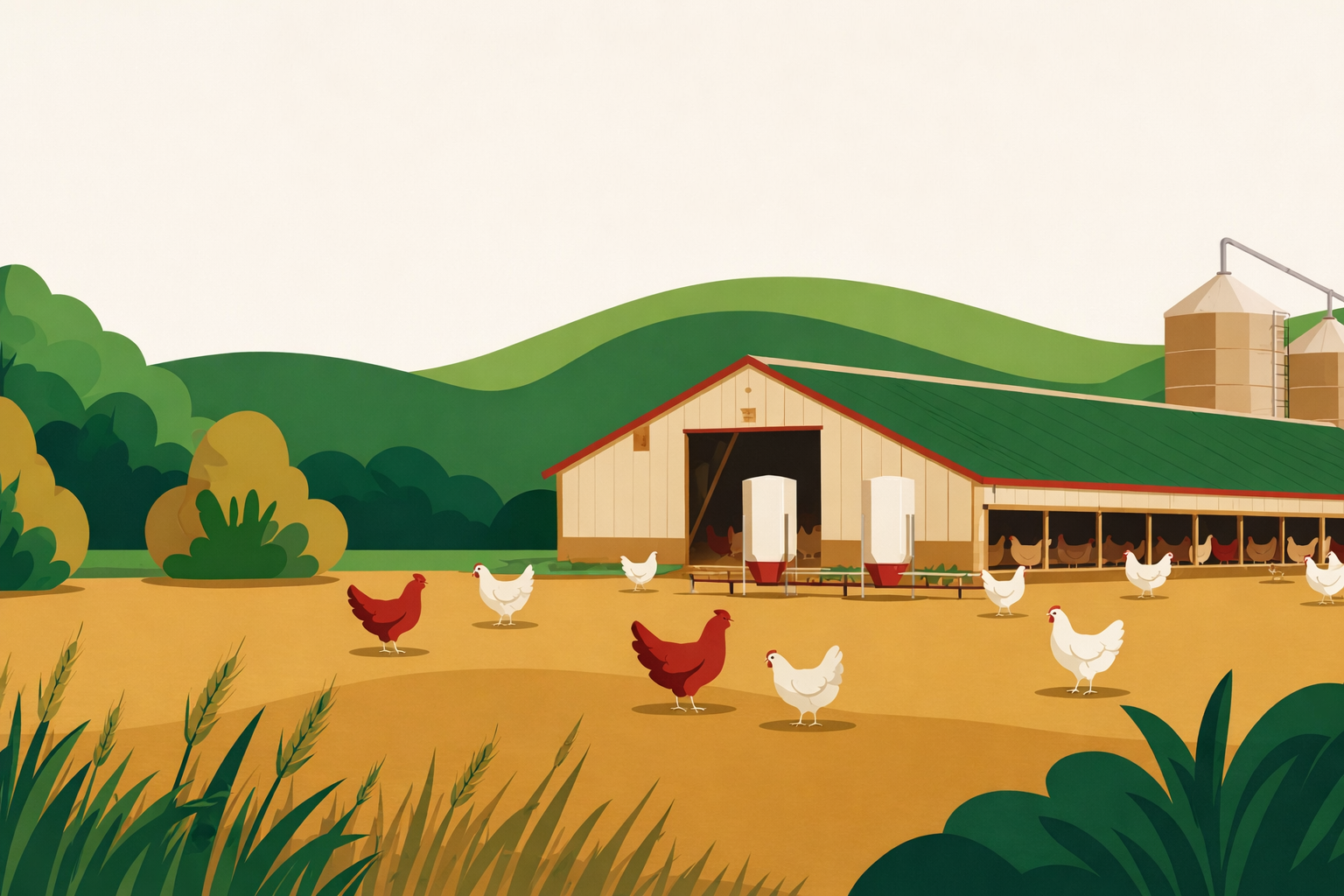
Broiler rearing typically takes 35–42 days, although the exact slaughter age depends on the breed, target weight and slaughterhouse requirements. This guide describes a classic 42-day cycle using light breeds (Ross 308, Cobb 500*) as an example — the stages are similar for most broiler breeds.
Where do the numbers in this guide come from?
Indicative figures (temperature, body weights, FCR) are drawn from the official Aviagen (Ross 308 Broiler Management Guide) and Cobb-Vantress (Cobb 500 Broiler Management Guide) breed guides and IZ-PIB national standards. Values may differ between breeds, chick suppliers and farm conditions — treat them as reference points, not fixed norms.
The first week determines the whole cycle
A good start matters most — chicks that eat and drink well from day one produce an even, fast-growing flock later. In practice two simple checks are enough: crop fill assessment at 24 hours (more than 95% of chicks should have a full crop) and checking that body weight at day 7 is within the breed norm. If both are on track, the cycle is usually heading in the right direction. If either falls short, it's better to act early than to make up losses mid-flock. For more on what to check in the first days, see the guide on chick rearing — the first week.
Broiler production cycle — 6 stages from empty house to loading
- 1
House preparation and disinfection (day -14 to 0)
After removing litter and manure, carry out dry cleaning, then wet washing under high pressure, disinfection with a broad-spectrum product and fumigation. Keep the house sealed for at least 7–10 days. Before placement, check equipment integrity, warm the house to placement temperature and top up litter (straw or shavings, approx. 5–8 cm). Biosecurity: restrict entries to a minimum throughout.
- 2
Chick placement and the first 72 hours (day 1–3)
Receive chicks as quickly as possible after delivery. Temperature in the heating zone: 32–34°C at floor level (per breed guide*). Immediately after placement, check that chicks spread evenly within the brooding ring — clustering under the heat source = too cold, moving away = too hot. Ensure constant access to water (water temperature approx. 25°C) and starter feed in the first 24 hours. Check crops in 100 random chicks after 24 hours — more than 95% should have a full crop (good feeding start).
- 3
Brooding — starter phase (day 1–14)
Gradually lower temperature by about 0.5°C per day, targeting approx. 24°C by the end of week 2 (schedule depends on breed and heating system). Monitor flock behaviour: even distribution across the house = optimal conditions. Feeding: starter feed (high protein and energy, per integrator or own recipe). Record body weight every 3–5 days — deviation from the breed growth curve is an early sign of a health or nutritional problem. Check mortality daily and remove fallen birds.
- 4
Grower feeding phase (day 15–28)
Switch to grower feed (lower protein, higher energy) — the changeover point depends on the feeding programme. Target temperature: approx. 20–21°C*. Ventilation becomes critical: minimum night ventilation prevents ammonia condensation. Monitor feed conversion (FCR): by the end of week 4 it should be around 1.5–1.7 for well-reared flocks*. Weigh weekly and compare against the breed growth curve. Watch appetite — a sudden drop in feed intake is one of the first disease signals.
- 5
Finisher phase and pre-harvest monitoring (day 29–38)
Switch to finisher feed (weight and fatness optimisation). At this stage the flock is sensitive to heat stress: maintain peak ventilation and night cooling. Stocking density becomes critical — monitor behaviour, breast scratching and foot condition. Do a benchmark weighing around day 35 and calculate the projected slaughter weight. Ensure water access: 4–5 litres of water per 1 kg of feed consumed* is a reference norm.
- 6
Pre-slaughter withdrawal and loading (day 39–42)
Feed withdrawal: typically 8–12 hours (water available). Too short increases contamination risk at evisceration; too long reduces weight and meat quality — agree timing with the slaughterhouse. Reduce lighting 24 hours before loading (lowers catching stress). Load during the cooler part of the day. After the flock leaves, seal the house, document the cycle results (FCR, mortality, final weight) and move on to the disinfection phase.
Key cycle indicators — what to measure and what the results mean
A few numbers let you assess the whole cycle. Indicative values for well-reared flocks (light breeds, 42 days)*.
Final body weight
Target: 2.5–2.9 kg live weight at day 42 for light breeds (Ross 308, Cobb 500)*. A deviation of more than 10% from the growth curve signals a nutritional or health problem.
Feed conversion ratio (FCR)
Ratio of kg feed to kg live weight gain. A good result for a 42-day cycle: FCR 1.6–1.9*. The lower the FCR, the more efficient the rearing. FCR is affected by feed quality, temperature and flock health.
Cumulative mortality
Target: below 3–4% for the whole cycle*. Mortality above 0.5% per day mid-cycle requires investigation (infection, heat issue, drinker problems).
EPEF index
European Production Efficiency Factor: (survival% × weight kg × 100) / (age days × FCR). A value above 300 is considered a good result for a 42-day cycle*. It combines weight, FCR and mortality into a single index.
Water intake
The water-to-feed ratio should be around 1.7–2.0:1 under normal temperature conditions. A sudden drop in water intake (more than 20% below norm) is an early sign of disease or drinker problems.
Frequently asked questions about the broiler production cycle
How many days does a broiler production cycle last?add
A typical cycle is 35–42 days, depending on breed, target weight and slaughterhouse requirements. Light breeds (Ross 308, Cobb 500) reach 2.5–2.9 kg live weight around day 38–42*. Heavy breeds raised for carcase cuts may run longer.
What is the correct temperature at chick placement?add
The heating zone should be around 32–34°C at floor level at placement. Temperature is reduced gradually (approx. 0.5°C per day) to around 20–21°C by the end of the cycle. Chick behaviour is a better indicator than a thermometer: even distribution across the house = optimal temperature*.
What is FCR and what is a good result?add
FCR (Feed Conversion Ratio) is the ratio of feed consumed to live weight gain. For a 42-day cycle a good result is around 1.6–1.9*. A lower FCR means more efficient feed use. FCR is influenced by genetics, nutrition, temperature and flock health.
When should I switch from starter to grower and finisher feed?add
The starter-to-grower changeover typically happens around day 10–14, and grower-to-finisher around day 28–35. Exact timing depends on the integrator's or own feeding programme and target weight requirements. The switch should be gradual (2–3 days of blending) or as recommended by the feed manufacturer.
How long is the pre-slaughter feed withdrawal?add
Typically 8–12 hours (with continuous water access). Agree the timing with the slaughterhouse. Too short a withdrawal increases contamination risk at evisceration; too long reduces weight and meat quality.
How do I track cycle results without paper tables?add
In DlaFerm.pl you enter mortality, weight and feed intake every day — the system automatically calculates FCR and EPEF and draws comparative charts against previous cycles. Weighing once a week is enough to see whether the flock is following the breed growth curve.
How do I know the first week is going well?add
Two things tell you almost everything: after 24 hours more than 95% of randomly checked chicks should have a full crop — a sign they found feed and water. Then at day 7 body weight should be within the breed norm (e.g. around 170–190 g for Ross 308). Both indicators together give a clear picture of whether the cycle has started properly.
Track your cycle in DlaFerm.pl
Want to calculate FCR automatically and compare cycles? Write to us or create a free account.
Phone
+48 796 258 151