Broiler chick brooding — the first 7 days
The first week decides the whole growing cycle — the chick grows very fast, and mistakes from this period are hard to recover from. We explain in plain language how to pre-heat the house and litter, how to check whether chicks have eaten and drunk, and how to set up light, water and feed so the flock gets a good start.
verifiedFrom the team that has organised work on poultry farms for years.
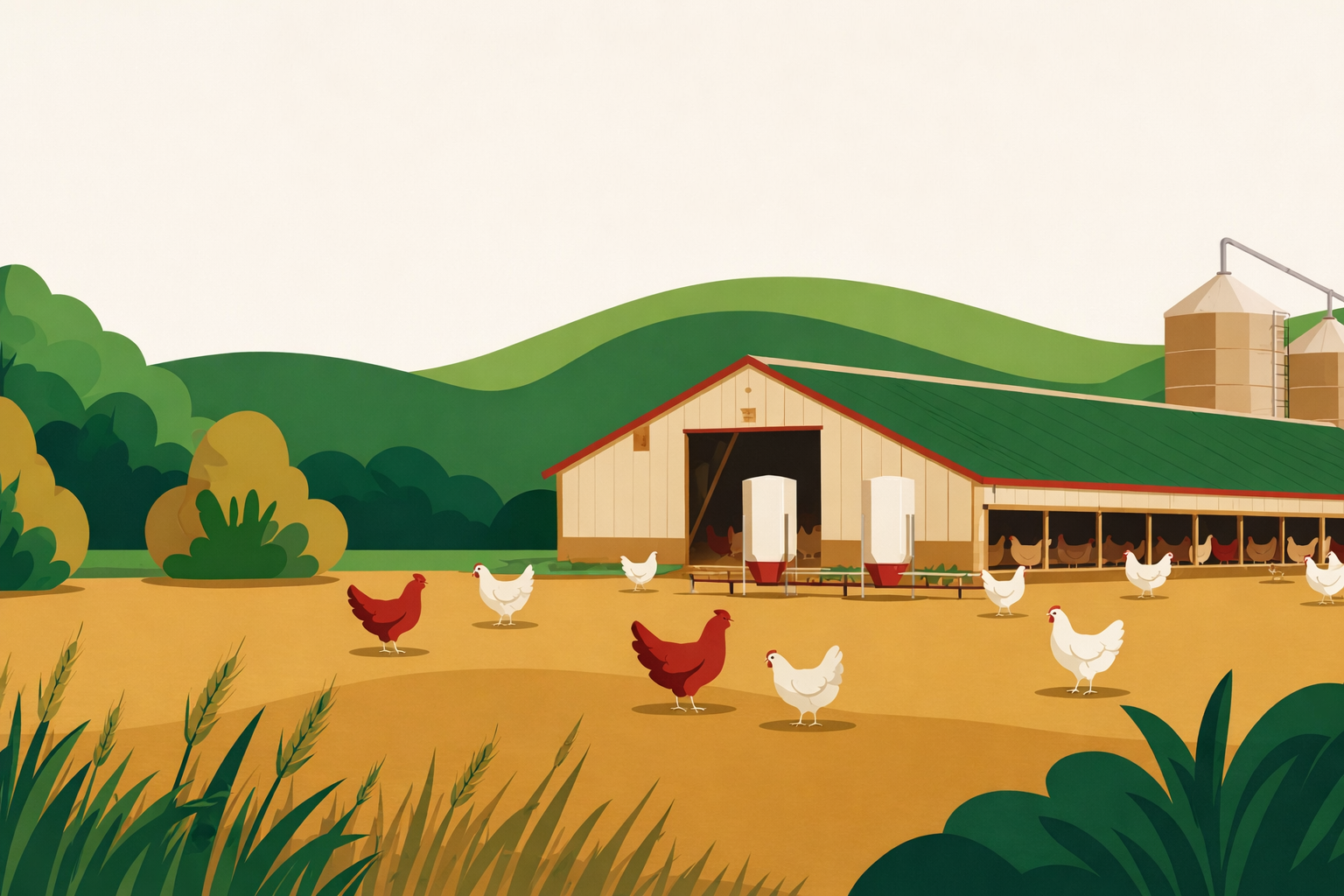
A broiler chick grows extremely fast — it can nearly triple its body weight in the first week. That means every hour at the start counts: a chick that starts eating and drinking too late will never close that gap. This is part of the broiler cluster — the full picture of the production cycle is in the guide on broiler farming and in the article broiler production cycle step by step.
Why the first 7 days matter so much
Mistakes from the first week are felt throughout the grow-out. A chick that was too cold or too hungry in the first days will never catch up with a healthy flock — it will be smaller, weaker and more susceptible to disease. That is why the start of rearing is organised so that warmth, food and drink are literally under the beak — close to the heat source (the brooding canopy), easy to reach and clearly visible.
Where do the numbers in this guide come from?
The indicative values (temperatures, crop fill threshold, humidity, water-to-feed ratio) come from the Aviagen Ross 308 Broiler Management Handbook. They may differ between lines, chick suppliers and farm conditions — treat them as reference points, not fixed norms. The week-by-week temperature profile is covered in the guide on house temperature and humidity.
Starting broiler rearing — from pre-heating the house to the crop check
- 1
Pre-heat the house and litter BEFORE placement
The house and litter are heated BEFORE the chicks arrive. A cold floor chills the chick through its feet and belly — the effect is immediate and hard to fix. Indicatively: litter about 30–32°C, air in the house about 30–34°C on day 1 (per Aviagen Ross 308; dependent on line and conditions). The best test is the chicks themselves — cold feet to the touch mean the floor is too cold. Detailed recommendations are in the guide on house temperature and humidity.
- 2
Place chicks and watch how they spread
After placement, watch how chicks spread through the house. Clustering under the brooding canopy — too cold; fleeing from the canopy to the walls — too hot; even, calm distribution — correct. The brooding canopy (sometimes called a hover brooder) hangs above the litter and replaces the natural hen — chicks can go under it for warmth. Chick body temperature of about 39.4–40.5°C (measured at the cloaca) is the precise way to check whether chicks are warm enough.
- 3
Check relative humidity
Relative humidity (how much water vapour is in the air) at the start should be about 60–70% (per Aviagen Ross 308; dependent on line and conditions). Air that is too dry dehydrates chicks — they lose moisture through skin and breathing before they have a chance to drink. If humidity is too low, reduce ventilation or use humidifiers. More on controlling humidity is in the guide on house temperature and humidity.
- 4
Set out feed and water close to the heat source
At the start, feed goes onto paper and trays laid close to the brooding canopy — chicks will find it by sight and do not need to walk far. Drinkers are set low and easy to reach. Chicks drink about 1.6–1.8 times more water than they eat feed (per Aviagen Ross 308; dependent on line and conditions) — water is almost more important than feed. A drop in water intake is a warning signal before you see the problem in behaviour. More on drinking norms is in the guide on broiler water intake.
- 5
Set strong, long lighting
At the start, long hours and high-intensity light (e.g. about 20–40 lux or more, depending on the supplier) are used so chicks can see feed and water and forage actively. Bright light promotes activity and eating. A programme for gradually reducing hours is described in a separate guide — in the first week the priority is for the flock to eat actively.
- 6
Check crop fill at 24 hours
The crop is a pouch for food at the base of the chick's neck (also known as "crop fill" in English) — after eating and drinking it becomes full and soft. Twenty-four hours after placement, more than about 95% of chicks should have full, soft crops (per Aviagen Ross 308; dependent on line and conditions) — proof that they ate and drank. A soft but small crop = eating too little; hard and dry = eating but drinking too little; balloon-like and watery = drinking but eating too little. The full guide on this check is at crop fill assessment.
Checkpoints for the first week of rearing
A few numbers worth keeping to hand in the first week. Indicative values from the Aviagen Ross 308 Broiler Management Handbook*.
Litter and air temperature
Litter about 30–32°C, air about 30–34°C on day 1. Lower gradually over the following weeks. Chick behaviour (distribution under the canopy) is a better indicator than the thermometer alone.
Crop fill at 24 h
Twenty-four hours after placement, > about 95% of chicks should have full, soft crops — proof that they ate and drank. The crop is the food pouch at the base of the neck. A lower result = fix conditions immediately.
Relative humidity
About 60–70% at the start. Relative humidity measures water vapour in the air — air that is too dry dehydrates the chick before it can drink. Measure at floor level, not under the ceiling.
Water-to-feed ratio
Chicks drink about 1.6–1.8 times more water than they eat feed. Keep a daily water log — a sudden drop is a warning before mortality appears.
The most common first-week mistakes
Most first-week losses come from a few repeated mistakes. Below are those most often flagged by advisers.
Cold house or litter at placement
Placing chicks into an under-heated house is the most common start mistake. A cold floor causes chicks to cluster under the canopy, not eat or drink, and lose body heat. Pre-heat the house well in advance — at minimum several hours early — and check temperature at floor level, not under the ceiling.
Skipping the crop fill check
Without checking crop fill at 24 hours it is easy to miss that part of the flock has not started eating and drinking. A few minutes on this check is the cheapest way to catch the problem early — before it turns into mortality and an uneven flock.
Drinkers or feeders at the wrong height
A chick will not look for feed or water beyond what it can see. Feeders and drinkers must be at the right height — too high and the chick cannot reach, too low and litter contaminates the water. Feed on paper and trays must be close to the brooding canopy.
Air too dry (low humidity)
A newly hatched chick is susceptible to dehydration. Air that is too dry — relative humidity below about 60% — accelerates moisture loss through skin. Measure humidity and act: reduce ventilation or humidify before humidity drops too low.
Frequently asked questions about the first week of broiler rearing
What temperature do broiler chicks need in the first week?add
Indicatively, litter about 30–32°C and air about 30–34°C on placement day (per Aviagen Ross 308; dependent on line and conditions). Temperature is lowered gradually over the following weeks. The best indicator is chick behaviour: clustering under the canopy = too cold, fleeing from the canopy = too hot, even distribution = correct. Chick body temperature of about 39.4–40.5°C (measured at the cloaca) is the precise way to check.
What is crop fill and when should I check it?add
The crop (in English: crop fill) is a food pouch at the base of the chick's neck — after eating and drinking it becomes full and soft. Twenty-four hours after placement, more than about 95% of chicks should have full, soft crops. That is proof they ate and drank. If the result is lower, fix conditions immediately: check water and feed availability, temperature, lighting. Details at crop fill assessment.
What humidity is needed in the house at the start?add
Relative humidity (the amount of water vapour in the air) at the start should be about 60–70% (per Aviagen Ross 308; dependent on line and conditions). Air that is too dry dehydrates the chick before it can drink. If humidity is too low, reduce ventilation or use humidifiers.
How much water does a broiler chick drink in the first week?add
Chicks drink about 1.6–1.8 times more water than they eat feed (per Aviagen Ross 308; dependent on line and conditions). Keeping a daily water log lets you catch a problem quickly — a sudden drop in water intake is a warning signal before visible mortality appears. More at broiler water intake.
How should I set out feed and water for chicks in the first days?add
At the start, feed is spread on paper and trays close to the brooding canopy so chicks can find it by sight and do not need to walk far. Drinkers are set low and easy to reach. Both feed and water must be close to the warmth — a chick will not look for food in a cold corner of the house.
What is a brooding canopy and why does it matter?add
A brooding canopy (also called a hover brooder) is a device that hangs above the litter and emits heat — it replaces the natural hen. Chicks go under it for warmth and come out to eat and drink. A correctly adjusted canopy is one of the most important elements of a good start: too low = too hot, too high = chicks cannot reach the warmth.
Sources & resources
Run broiler rearing in DlaFerm.pl
Want temperatures, crop checks and mortality from the first week in one place? Create a free farm account or write to us.
Phone
+48 796 258 151