Clean and dirty zones on a poultry farm — how to set the boundary
Biosecurity starts with a simple division: what is "clean" (inside the poultry house and the production area) and what is "dirty" (car park, loading ramp, access road). Between these two worlds is the hygiene boundary — and respecting it is the foundation of protecting your flock from disease. We explain how to set this boundary and how to enforce it every day.
verifiedFrom the team that has organised work on poultry farms for years.
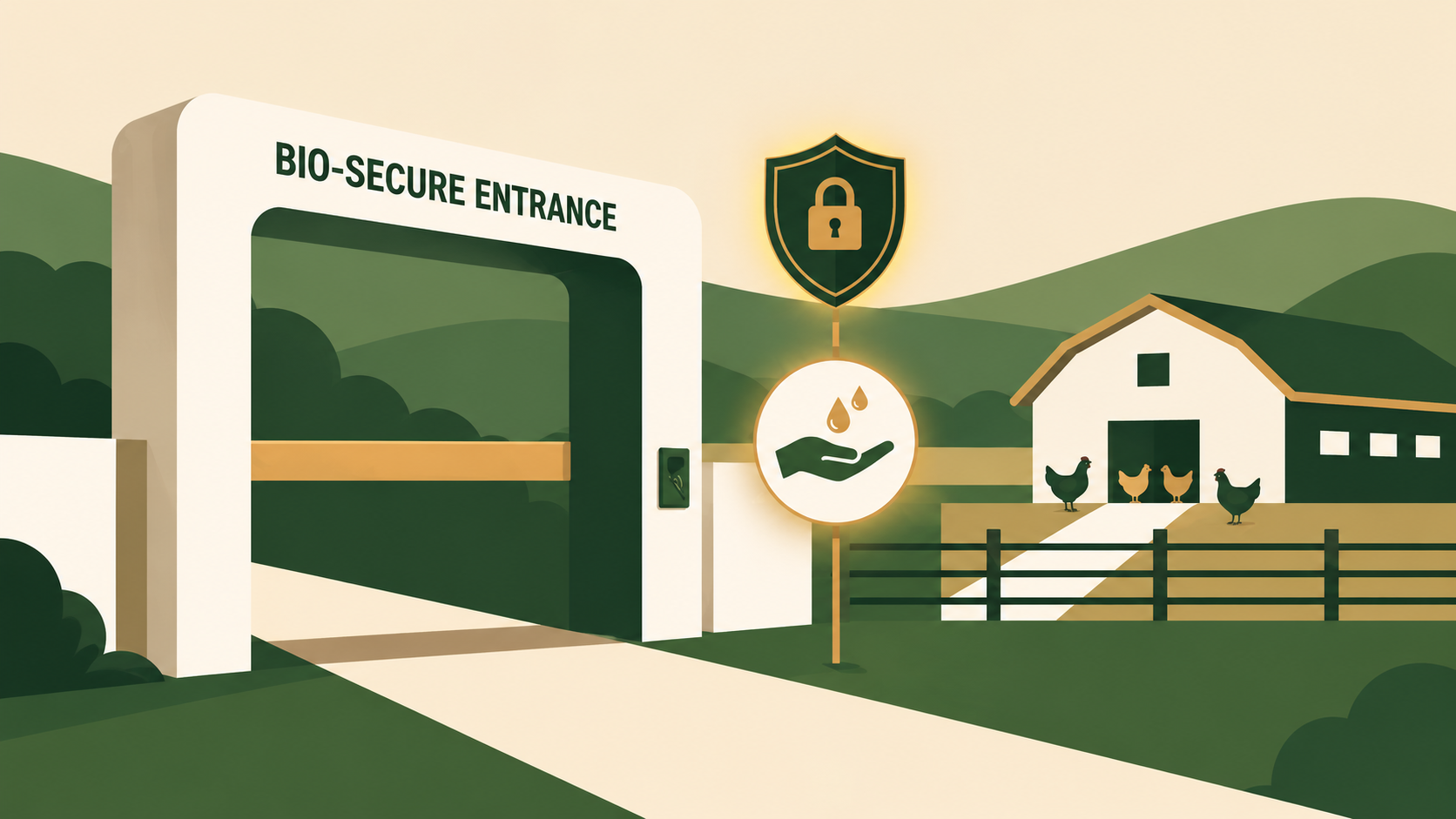
Think of a poultry farm as a hospital. The operating theatre (poultry house) must be clean — only people who have changed clothes and washed their hands may enter. The corridor near the entrance (car park, ramp, road) is where deliveries, vehicles and external visitors circulate. Between them is a clear boundary — and crossing it without following the procedure puts the whole flock at risk. That is the point of dividing the farm into clean and dirty zones.
What are the clean and dirty zones?
The dirty zone (external) covers everything outside the poultry house: the car park for delivery vehicles, the loading ramp, the access road, feed and equipment delivery points, and the live bird collection area. External vehicles arrive here, delivery personnel enter here — contact with the outside world is unavoidable. The clean zone (internal) is the inside of the poultry house and the entire production area — only personnel who have completed the full procedure of changing footwear, clothing, and disinfecting their hands may enter. For detailed procedures on vehicle entry, see the guide on vehicle access and deliveries to the farm.
Where do these rules come from?
The division into zones and the requirement to establish a hygiene boundary comes from poultry biosecurity regulations in Poland and across the European Union. The main requirements are set out in Commission Delegated Regulation (EU) 2020/687 and national rules supervised by the Chief Veterinary Inspectorate (GIW). In practice, farmers implement this division not only because they are required to — but because it works: farms with a well-defined hygiene boundary record fewer outbreaks of infectious disease. For the broader biosecurity picture, see the guide on poultry farm biosecurity.
How to establish and maintain the hygiene boundary — step by step
- 1
Establish a physical boundary line
The hygiene boundary is not a line drawn only on paper — it must be visible on the ground. The most effective solution is a boundary bench (also called a "Danish entry"): a narrow bench set across the entrance to the poultry house or its anteroom. One side of the bench is the dirty zone, the other is the clean zone. You can also use a clearly marked line on the floor (e.g. yellow tape or paint) combined with a foot dip mat. Important: the boundary must be positioned so that it cannot be bypassed — the only way into the poultry house should be through it.
- 2
On the dirty side: remove outdoor footwear and outer clothing
Before crossing the boundary, on the dirty side remove your outdoor footwear (or whatever shoes you arrived in from outside) and leave them on that side. If you are wearing outer clothing (jacket, work overalls), leave it here too. With a boundary bench: sit on the bench from the dirty side, remove your shoes, swing your legs over to the clean side.
- 3
Disinfect your hands (and shower if there is a hygiene lock)
Before moving to the clean side, wash and disinfect your hands — a dispenser with disinfectant should be placed right at the boundary, on both sides. If your farm has a hygiene lock (a separate room with a shower), take a shower before entering the poultry house. Hygiene locks are required on farms with a higher biosecurity status (so-called closed farms). For more on hygiene locks, see the guide on hygiene locks and showers on the farm.
- 4
On the clean side: put on farm footwear and clothing
On the clean side you have farm footwear (wellingtons or work boots dedicated solely to the poultry house) and farm clothing (overalls, coat) ready. You get dressed and only then enter the poultry house. Key point: farm footwear must never cross the hygiene boundary — if you leave the poultry house and return to the dirty zone in your farm boots, the entire procedure becomes meaningless.
- 5
When leaving: the same procedure, in reverse order
When leaving the poultry house: at the boundary remove your farm boots and leave them on the clean side, disinfect your hands, swing your legs to the dirty side, put on your outdoor footwear. Leave farm clothing in the anteroom or changing area on the clean side. A foot dip mat at the exit provides additional protection for boot soles. The rules for keeping a visitor log are described in the guide on the farm visitor register.
What belongs to the dirty zone and what to the clean zone?
Below are examples of areas and activities assigned to each zone. A helpful reference when planning a farm layout or setting a boundary on an existing site.
Dirty zone — what belongs here
Car park for external vehicles. Loading ramp (live bird collection). Feed, litter and equipment delivery point. Access road (up to the gate). Fallen stock collection container (mortality bin). Manure collection point. Farm office, if accessible from outside without crossing the hygiene boundary. In short: everything that is regularly accessed by people and vehicles from outside the farm.
Clean zone — what belongs here
Inside the poultry house (production hall). The poultry house anteroom (on the clean side). Feed store inside the farm perimeter (if accessible only through the boundary). Farm equipment (feeders, drinkers, fans) — stored on the clean side. Each house on a multi-house farm has its own mini hygiene boundary in its own anteroom — the principle is the same: change footwear and clothing at every entry. For more on washing and disinfection after each production cycle, see the guide on washing and disinfecting the poultry house.
Zone marking with colours and signs
Good practice is to mark both zones visibly: signs reading "CLEAN ZONE — no entry without changing footwear and clothing" and "DIRTY ZONE — change footwear here before entering". Colours: the clean zone is often marked in green (floor, anteroom walls), the dirty zone in yellow or red. Markings do not replace the physical boundary — they support it and remind everyone who enters the farm, including infrequent visitors (service engineers, inspectors), of the procedure.
The boundary bench and foot dip mat — how to set them up in practice
The two simplest physical elements of the hygiene boundary, which any farmer can install themselves.
Boundary bench (Danish entry)
The boundary bench is a simple, narrow bench set across the entrance — the ideal width is about 30–40 cm (wide enough to sit on and swing your legs over). One side is the dirty side, the other is the clean side. Outdoor shoes stay on the dirty side; farm footwear is ready on the clean side. The name "Danish entry" comes from Denmark, where this model has been standard in pig and poultry farming for decades. You can build a bench from timber or buy a ready-made plastic one — the important thing is that it is stable and easy to clean.
Foot dip mat
A foot dip mat is a shallow tray or rubber mat soaked in disinfectant, placed at the poultry house entrance — within the dirty-to-clean flow. You press your boot sole onto it each time you pass. Important: the mat only works when it is wet (soaked with disinfectant) and replaced on schedule. A dry mat is a dead mat — check it daily. Choose the disinfectant for the mat in line with your vet's advice or your farm biosecurity programme — indicatively, mats are changed every 1–3 days or more frequently under heavy traffic. The mat is a supplement to the procedure, not a substitute for it.
Each house has its own boundary
On farms with several poultry houses, each building has its own anteroom with its own hygiene boundary. This means that when moving from house A to house B, you must go through the full procedure of changing footwear and clothing twice — once when leaving A and once when entering B. A single boundary at the farm gate is not enough. This rule is especially important when disease is suspected in one of the houses: boundaries between buildings prevent pathogens from spreading across the farm.
The most common mistakes when maintaining the hygiene boundary
A few things that look like minor details but in practice mean the hygiene boundary stops working.
Entering the poultry house in outdoor footwear "just for a moment"
"Just for a moment" is the most common reason for hygiene boundary failures. One step in outdoor shoes onto the clean side transfers whatever was on the floor of the dirty zone — mud, droppings from the previous transport, soil from outside. If the boundary is inconvenient to cross (bench too high, farm boots wet, no space to change), improve its ergonomics — but never make exceptions.
Dry foot dip mat
A foot dip mat that has dried out or has not been replenished does not disinfect — it only creates the impression of safety. Check the mat daily: it should be clearly wet to the touch and smell of disinfectant. If not — top it up or replace it. Detailed rules for washing and disinfecting the entire poultry house are described in the guide on washing and disinfecting the poultry house.
No individual boundary for each house on a multi-house farm
A common mistake: a hygiene boundary only at the farm entrance gate, with no separate boundaries at each poultry house. The result is that after entering the farm, a worker can move between houses without changing footwear. This is a serious gap: if a pathogen appears in one house, without boundaries between buildings it can quickly spread across the entire farm.
No visitor register
The hygiene boundary is not just about physical footwear and clothing — it is also about knowing who entered the poultry house and when. Without a visitor register (guest list, entry log), in the event of a disease outbreak you cannot determine who may have introduced the pathogen and when. Regulations require keeping such a record. How to maintain it is described in the guide on the farm visitor register.
Frequently asked questions about clean and dirty zones on a farm
What are the clean and dirty zones on a poultry farm?add
The dirty zone is the external area of the farm: the car park, loading ramp, access road, and all points of contact with people and vehicles from outside the farm. The clean zone is the inside of the poultry house and the production area — accessible only to personnel who have completed the full procedure of changing footwear, clothing, and disinfecting their hands. Between the two zones is the hygiene boundary — a clear line that cannot be crossed without following the biosecurity procedure.
What is a hygiene boundary on a farm?add
A hygiene boundary is a visible, physical line between the clean and dirty zones. It is most commonly implemented using a boundary bench (also called a Danish entry) in the anteroom of the poultry house, or using a clearly marked line on the floor with a foot dip mat. Crossing the boundary always requires changing footwear, changing clothing, and disinfecting hands — without exception.
What is a Danish entry and how do I build one?add
A Danish entry is a boundary bench set across the entrance to the poultry house. You sit on the bench from the dirty side, remove your outdoor footwear and leave it on that side, swing your legs to the clean side, and put on your farm footwear. The bench should be about 30–40 cm wide, stable, and easy to clean. You can build it from timber or buy a ready-made plastic version.
Does each poultry house on a farm need its own hygiene boundary?add
Yes. On farms with several poultry houses, each building should have its own hygiene boundary in its own anteroom. A single boundary at the farm entrance gate is not sufficient — workers must change footwear and clothing at every entry to and exit from each house. This is especially important when disease is suspected in one of the buildings.
How often should the foot dip mat be changed?add
The foot dip mat should be checked daily — it should be clearly wet and have an active disinfectant. Indicatively, it is changed every 1–3 days, or more frequently under heavy traffic (e.g. on delivery days). A dry mat does not disinfect and gives a false sense of security. Set the exact frequency and choice of disinfectant with your vet or in line with your farm biosecurity programme.
Who must follow the hygiene boundary procedure?add
Everyone entering the poultry house — without exception. This applies to regular farm staff and to visitors alike (vet, inspector, sales representative, service engineer). Visitors should be given disposable boot covers or use farm footwear available on the farm. The obligation to keep a visitor log is a regulatory requirement under biosecurity rules.
Keep a visitor log and manage biosecurity in DlaFerm.pl
Want to keep an electronic visitor register and biosecurity procedure records in one place? Create a free farm account or write to us.
Phone
+48 796 258 151