Hygiene lock on a poultry farm — shower-in/shower-out principle
A hygiene lock is a room on the border of the farm that every person entering the clean zone must pass through. The best hygiene lock works on the shower-in/shower-out principle — the person entering showers and completely changes into farm clothing. We explain how the lock is built, what each of its three zones is for, and exactly what you do when passing through it step by step.
verifiedFrom the team that has organised work on poultry farms for years.
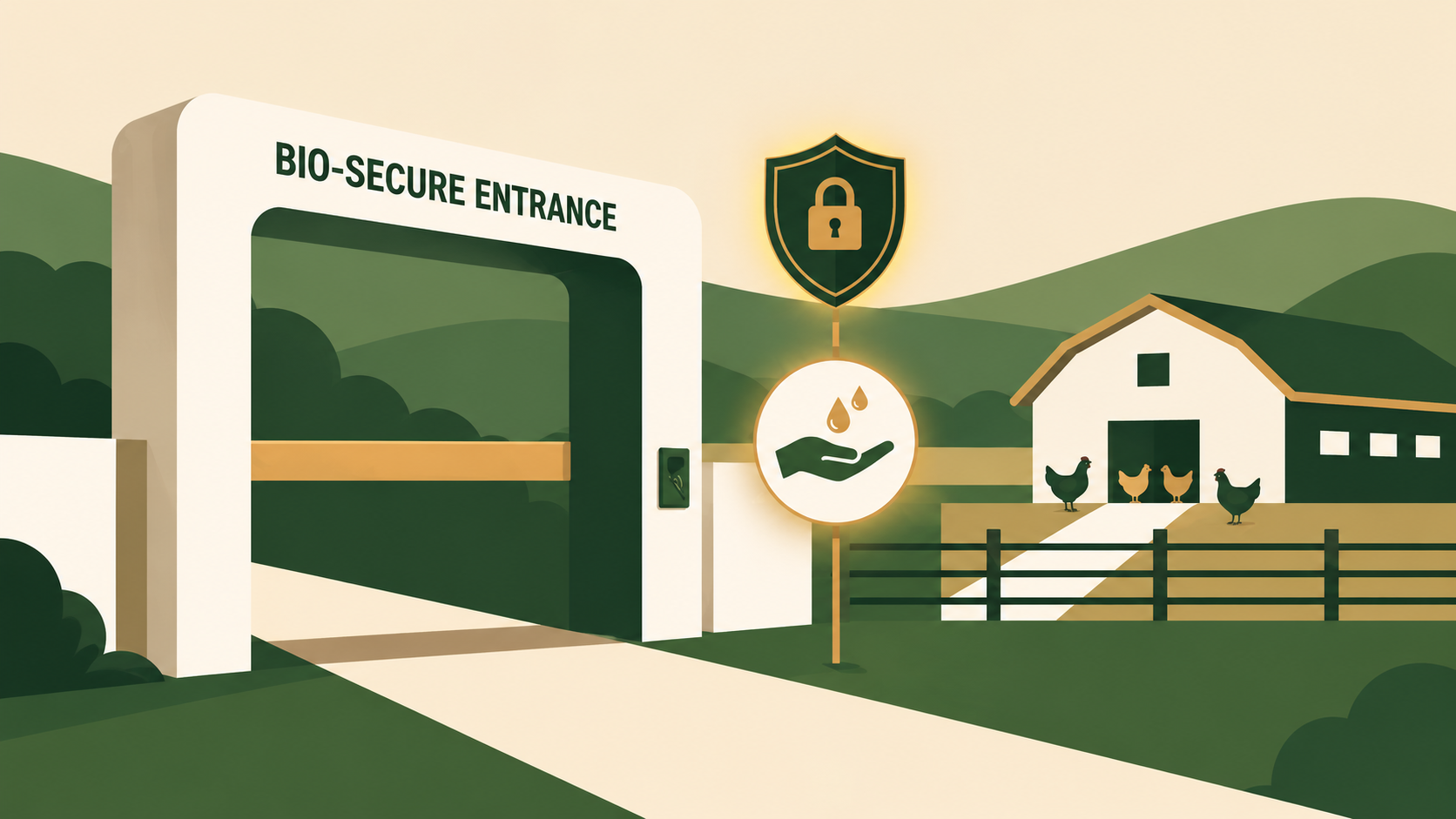
A poultry farm is divided into two zones: the clean zone (where the birds are) and the dirty zone (everything outside the farm). To prevent pathogens from outside entering with people, there must be a barrier between these zones — the hygiene lock. This is not an ordinary corridor you walk through in passing. It is a deliberately designed room that enforces a clothing change, washing and disinfection before a person reaches the clean zone. Zone principles are described in the guide on clean and dirty zones on a poultry farm, and general biosecurity foundations in poultry farm biosecurity.
Why is a shower-equipped lock the best solution?
A shower on entry removes pathogens from the body and hair that cannot be removed by changing clothes — viruses and bacteria attached to skin and hair contamination. A shower on exit removes potential contamination picked up during the visit to the clean zone, protecting the external environment from disease spread. That is why farms with the highest biosecurity requirements (breeding farms, some commercial farms) use the shower-in/shower-out principle — a shower is compulsory both on entry and on exit. On smaller farms a simplified lock without a shower is acceptable, but always with a clothing and footwear change and hand disinfection.
Who must pass through the hygiene lock?
Every person entering the clean zone must pass through the hygiene lock — the farmer, employees, vets, pest controllers, inspectors. No exceptions. The entry in the entry log is usually made after passing through the lock, already on the clean side. Vehicles and deliveries have a separate procedure described in the guide on vehicle entry and deliveries — biosecurity.
Passing through the hygiene lock — step by step
- 1
Enter on the dirty side and undress
After entering the lock from the outside (dirty side) you remove your own clothing and footwear. Everything — including your phone, jewellery and watch — stays on the dirty side or in storage outside the clean zone. Nothing from outside crosses to the clean side. Remember: the phone casing can carry pathogens. If you must take it to the clean side, you disinfect it with a surface disinfectant before crossing the barrier.
- 2
Shower
You take a shower — washing your body and hair. The time under the shower should be sufficient for thorough washing; on many farms the rules specify a minimum (often 2–3 minutes). The shower removes pathogens from the body surface and hair that cannot be removed by changing clothes alone. After the shower you dry off with a towel available on the clean side or a disposable towel.
- 3
Cross the barrier
The barrier (often a bench or threshold) marks the boundary between the dirty and clean sides. You cross it after the shower — you do not go back across the barrier to retrieve anything from outside. On many farms the bench is a physical obstacle — you sit on it and swing your legs to the clean side so your feet do not touch the dirty-side floor.
- 4
Wash and disinfect your hands
On the clean side you wash your hands with water and soap, then disinfect them with an alcohol-based or other approved product. Washing removes dirt and some pathogens; disinfection kills those that survived washing. The order matters: washing first, then disinfection — the reverse order is less effective.
- 5
Put on farm clothing and footwear
On the clean side you put on farm clothing (a coverall or a set of trousers and a jacket) and farm footwear assigned only to this farm, ideally to a specific house. Farm clothing is washed and disinfected after each visit or according to the farm schedule. Farm footwear does not leave the clean zone.
- 6
Sign the entry log and enter the clean zone
After completing the full procedure you sign the entry log — date, time, name, purpose of visit. Only then do you enter the clean zone. On exit the same route in reverse: remove farm clothing on the clean side, shower, cross the barrier and exit on the dirty side.
Three zones of the hygiene lock
A well-designed hygiene lock has three zones arranged in a straight line — so that passage through it is possible in one direction only (from dirty to clean). Below each zone with a description.
Dirty side — external changing room
The first zone is the changing room where you remove your own clothing and footwear. This is where all items from outside stay: phone, jewellery, keys, bags. There should be enough hooks and lockers for all people who may enter at once. The floor on the dirty side should be easy to clean and disinfect — as should the entire lock.
Middle — shower and barrier
The second zone is the shower (or washbasin in the simplified version) and the barrier separating the dirty from the clean side. The barrier — a bench or threshold — must be clearly visible and physically make it difficult to cross accidentally without changing position. Here: showering takes place, drying off and crossing the barrier. Nothing from outside crosses the barrier with you.
Clean side — internal changing room
The third zone is the changing room on the clean side where farm clothing and footwear are available. Farm clothing is stored, washed and disinfected here. On the clean side there is also a washbasin for hand washing and disinfection (if not directly at the barrier). From here you pass directly into the clean zone of the farm.
Minimum without a shower — what must always be present
Smaller farms cannot always build a shower-equipped lock. Below is the minimum that should be met even in the simplest lock.
Footwear change on the border bench
A bench separating the dirty from the clean side is the absolute minimum for any lock. You sit on the bench, remove your own footwear on the dirty side, swing your legs to the clean side and put on farm footwear. You do not step on the clean-side floor with your own shoes. Farm footwear does not leave the lock.
Change into farm clothing
On the clean side you put on farm clothing — at least a coverall or apron. Your own clothing stays on the dirty side or in a designated locker. Farm clothing is regularly washed and disinfected.
Hand washing and disinfection
On the clean side or directly at the barrier there should be a washbasin with soap and a hand disinfectant dispenser. Hand washing and disinfection are compulsory at every entry — regardless of whether the farm has a shower or not.
Most common mistakes when using the hygiene lock
The lock works only when everyone follows the procedure. Below are the mistakes that most often undermine its effectiveness.
Carrying personal items across the barrier
A phone, pen, keys — any item from outside can carry pathogens across the barrier. The rule is simple: nothing from outside crosses to the clean side without disinfection. You disinfect the phone with a surface disinfectant or leave it on the dirty side. If you need to take notes, use a pen and notepad available on the clean side.
Going back after crossing the barrier
Going back to the dirty side after crossing the barrier — even for one forgotten item — invalidates the entire procedure. The barrier is a point of no return. If someone goes back, the procedure must start from the beginning (undressing on the dirty side).
Skipping the shower or shortening the washing time
A 30-second shower does not fulfil its function. The minimum washing times set in the farm rules have a biological basis — effectively removing pathogens from the body requires time and the mechanical action of water with soap. Shortening the shower is a false economy whose cost can be very high in the event of a disease outbreak.
Farm footwear outside the clean zone
Farm footwear that has left the lock even once becomes a potential carrier of pathogens. The colour or marking of farm footwear should be clearly different from outdoor footwear — to make a mix-up difficult. Farm footwear never goes into the external area or a vehicle.
Frequently asked questions about the hygiene lock
What is a hygiene lock on a farm?add
A hygiene lock is a room on the border between the clean zone (where the birds are) and the dirty zone (outside the farm). Every person entering the clean zone must pass through the lock — remove their own clothing and footwear, shower or wash their hands, cross the barrier and put on farm clothing and footwear. The lock prevents pathogens from outside being brought into the zone where the birds live.
What is the shower-in/shower-out principle?add
The shower-in/shower-out principle means that every person showers both before entering the clean zone and after leaving it. The shower on entry removes pathogens from the body and hair. The shower on exit protects the external environment from potential pathogen transfer from the farm. This is the highest level of protection, used on breeding farms and farms with elevated biosecurity requirements.
What are the three zones of the hygiene lock?add
The three zones are: (1) dirty side — changing room where you remove your own clothing and leave outside items; (2) middle — shower or washbasin and a barrier (bench or threshold) separating the dirty from the clean side; (3) clean side — changing room with farm clothing and footwear, and a washbasin for hand washing and disinfection. The zones must be arranged in a straight line so that passage is possible in one direction only.
What must be in a lock without a shower?add
If a farm cannot build a shower-equipped lock, the minimum is: a border bench (you sit, swing your legs and change footwear), farm clothing on the clean side, and a washbasin with soap and a hand disinfectant dispenser. Changing footwear and clothing plus hand washing and disinfection are always compulsory — regardless of farm size.
Can you take a phone into the clean zone through the lock?add
A phone is a potential pathogen carrier on its casing. If you must take it to the clean zone, you should disinfect it with a surface disinfectant (e.g. alcohol-based or chlorine-based) before crossing the barrier. The best solution is to leave the phone on the dirty side and use a dedicated farm phone assigned only to the clean zone, or go without a phone during the visit.
What should you do if someone has gone back across the barrier?add
Going back across the barrier means the lock procedure has been interrupted and must start again from the beginning. The person who returned to the dirty side removes all farm clothing (it stays on the clean side or goes for washing), showers again, crosses the barrier and puts on clean farm clothing. There is no shortcut — the full procedure from the start.
Keep your entry log and biosecurity checks in DlaFerm.pl
Want to record all farm entries, hygiene lock checks and biosecurity events in one place? Create a free farm account or write to us.
Phone
+48 796 258 151