What breeds make a broiler? Ross, Cobb and the production pyramid
The broiler you rear is not a breed — it is a hybrid (a cross of breeding lines) developed for rapid growth and a lot of meat. We explain where the chick placed in your house comes from, what the Ross and Cobb lines are, and what the production pyramid is — the one that starts with a handful of birds at the very top and ends with millions of broilers for farmers like you.
verifiedFrom the team that has organised work on poultry farms for years.
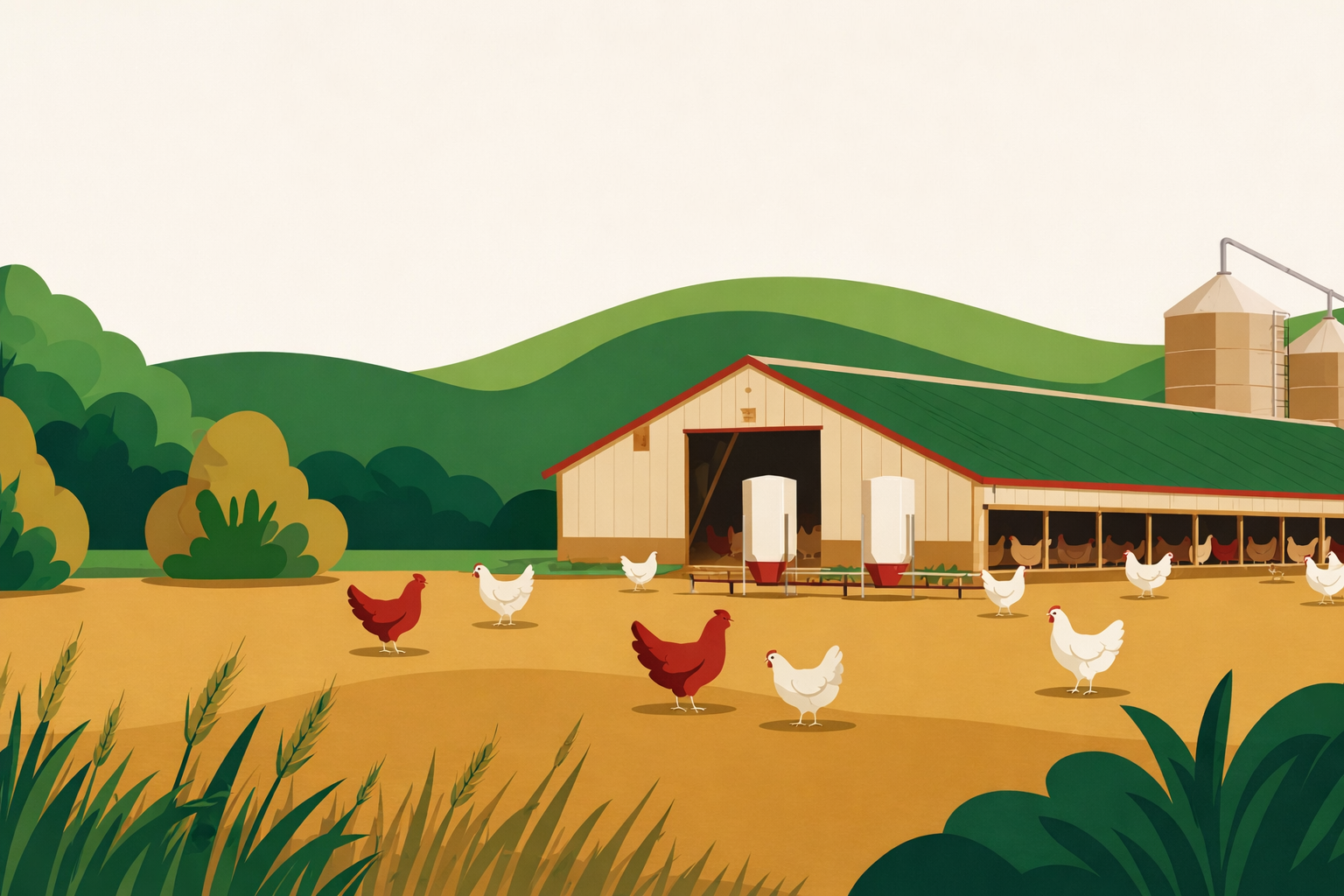
A broiler is a hybrid — not a breed
When you hear "broiler breed", it is a shorthand. The commercial broiler — the one you place in your house and rear for about 6 weeks — is a hybrid, a cross of breeding lines. A hybrid is a cross of breeding lines. It is not a pure-breed bird that can be further bred to consistently produce the same chicks. The same principle applies as with hybrid maize: the cross delivers excellent results, but it is not suitable for rearing on to the next generation. That is why you buy chicks from a hatchery every time. A hatchery is a facility that hatches chicks from eggs.
Where the Ross and Cobb lines come from
Two brands dominate the world and Polish markets: Ross — from Aviagen (UK/USA) — and Cobb — from Cobb-Vantress (USA). Hubbard is also present but less common. These are breeding companies that spent decades selecting birds for growth rate, breast meat yield and a good feed conversion ratio (how many kilograms of feed a bird uses per kilogram of gain). As a producer you buy chicks from a hatchery that sources eggs from parent stock flocks. Parent stock means the birds from which the broiler chicks originate. The Ross or Cobb lines themselves are not sold directly to commercial producers.
Ross 308 and Cobb 500 — the main differences
Ross 308 and Cobb 500 are the most commonly seen variants of these lines. Both are fast-growing and deliver a lot of breast meat. The differences are subtle: a different growth profile (which day is the "mass spike"), slightly different performance at higher temperatures, and a slightly different breast-to-leg ratio. In practice on a typical commercial farm the choice between Ross 308 and Cobb 500 often depends on what your hatchery offers and what the integrator or slaughterhouse requires. Both are very close today — there is no single "always better" option. The full cycle after placement is covered in the guide on the broiler production cycle step by step.
Why the commercial broiler cannot be used for breeding
The commercial broiler is terminal — meaning that if you kept it for breeding, the offspring would not repeat its traits. A hybrid "breaks down" in the next generation — the chicks would be non-uniform, grow more slowly and give poorer results. The model therefore works like this: the breeding company (Aviagen, Cobb-Vantress) maintains pure lines and sells eggs to hatcheries — and the hatchery delivers day-old chicks to you. You cannot (and it is not worth trying to) "breed your own" — every placement means new chicks from the hatchery. The first days after placement are covered in the guide on rearing a broiler chick — the first week.
Ross, Cobb and Hubbard — what sets them apart
Three main broiler line brands on the market. Ross and Cobb dominate in Poland — here is what you should know about each.
Ross 308 (Aviagen)
One of the most popular lines in the world. Ross 308 is known for even growth and good feed utilisation. Aviagen originated in the United Kingdom and runs selection programmes on several continents. The management materials (the Ross Broiler Management Manual) are publicly available and cover recommendations on temperature, lighting, feeding and ventilation. A good starting point for understanding what this line requires.
Cobb 500 (Cobb-Vantress)
The most widely used broiler line globally, originating in the United States. Cobb 500 stands out for high breast meat yield and good growth even in warmer conditions, which matters in the summer months. Cobb-Vantress publishes its own flock management guides (the Cobb Broiler Management Guide) setting out the standards for this line.
Hubbard
The third of the main lines — less common in Poland than Ross and Cobb, but present on the market. Hubbard offers several line variants, including ones intended for free-range or organic production (slower-growing). Less often seen in intensive commercial rearing than Ross 308 or Cobb 500, but worth knowing if your hatchery proposes it.
From great-grandparents to the commercial broiler — how the pyramid works
The poultry production pyramid has four levels. The higher the level, the fewer birds — but they are the ones who determine what chicks arrive in your house.
Pure lines — great-grandparents (top of the pyramid)
At the very top of the pyramid are the pure lines, the "great-grandparents". These birds are kept by breeding companies (Aviagen, Cobb-Vantress) under strictly controlled conditions. There are very few of them — a few thousand birds worldwide. Each generation is selected for traits destined to reach the final broiler: growth rate, meat yield, health. A commercial producer never sees them — this is the breeding company's "closed" level.
Grandparents (GPS — Grandparent Stock)
The second level is the grandparent flocks (GPS, Grandparent Stock). They are produced by crossing pure lines. Eggs from grandparents hatch into parent stock birds. There are more grandparents than pure lines, but still relatively few worldwide — several hundred thousand birds. Their eggs go to specialised hatcheries that produce parent stock.
Parent stock (PS — Parent Stock)
The third level is parent stock (PS) — the birds from which broiler chicks originate. Parent stock means the birds from which broiler chicks originate. These are hens and roosters kept on dedicated PS farms. Their eggs go to hatcheries, where day-old chicks are hatched — the ones you buy. There are far more birds at this level than at the grandparent level. Learn more about the full production chain at poultry production pyramid.
Commercial broiler — base of the pyramid (and the largest number of birds)
At the very bottom of the pyramid is the commercial broiler — the one you rear. There are the most of these: billions of birds per year worldwide, hundreds of millions in Poland. This is the point where all the breeding work turns into meat. The commercial broiler is terminal — it does not go back into breeding. After slaughter the pyramid starts again: the hatchery delivers the next batch of chicks. A hatchery is a facility that hatches chicks from eggs. The full rearing cycle is covered in the guide on broiler farming.
Frequently asked questions about broiler lines and breeds
Is a broiler a breed?add
No. The commercial broiler is a hybrid — a cross of several breeding lines selected for rapid growth and large breast meat yield. A hybrid gives excellent results in the first generation, but its offspring would not repeat those traits. That is why broiler chicks always come from a hatchery, not from your own breeding.
What is a hybrid in poultry farming?add
A hybrid is a cross of breeding lines — birds that breeding companies have selected over many generations for specific traits (growth, meat, health). The cross produces an effect called heterosis: the bird grows better than the parental average. In the case of a broiler the hybrid gives rapid growth and a lot of breast meat, but hybrid offspring no longer repeat those traits.
How does Ross 308 differ from Cobb 500?add
Both are fast-growing broiler lines with high breast meat yield. They differ in detail: growth profile (which week is the "mass spike"), response to higher temperatures (Cobb 500 performs slightly better in the heat) and the producer's feeding recommendations. In practice the choice between Ross 308 and Cobb 500 often comes down to what your hatchery or integrator offers — there is no single "always better" line.
Where does the broiler chick I place in my house come from?add
The chick comes from a hatchery, which hatches it from parent stock eggs. Parent stock are the hens and roosters kept on dedicated farms — their sole job is to produce hatching eggs. Day-old chicks hatch from those eggs and arrive in your house. The hatchery, the parent stock and the breeding lines are the three layers of the poultry production pyramid above you.
Why can I not keep a few broilers for breeding?add
The commercial broiler is terminal — it is a hybrid. If you kept it for breeding, the offspring would not repeat its traits: they would grow more slowly, be non-uniform and give poorer results. That is how hybridisation works. To get good chicks you have to go back to the parent stock — and that is in the hands of the hatchery. That is why every placement means new chicks bought from the hatchery.
What is the poultry production pyramid?add
The poultry production pyramid has four levels: at the top are the pure lines (great-grandparents) — a few thousand birds at the breeding company. Below them the grandparents (GPS). Then the parent stock (PS) — hens and roosters whose eggs hatch into your chicks. At the bottom the commercial broiler — the one you rear. Each level produces far more birds than the level above — that is why it is a pyramid. As a commercial producer you are at the very bottom, but that is exactly the level where the pyramid turns into meat.
Run your broiler farm in one place with DlaFerm.pl
Rearing Ross 308, Cobb 500 or another line? DlaFerm.pl helps you record the flock, document treatments and keep on top of farm obligations — whatever broiler line you use. Write to us.
Phone
+48 796 258 151