Egg quality assessment — Haugh units, Roche scale, grades A and B
Egg quality is not just about freshness. Producers and buyers assess it using several measures: Haugh units (white quality), the Roche scale (yolk colour) and commercial grades A/B. We explain what each measure means and how to carry out a step-by-step assessment.
verifiedFrom the team that has organised work on poultry farms for years.
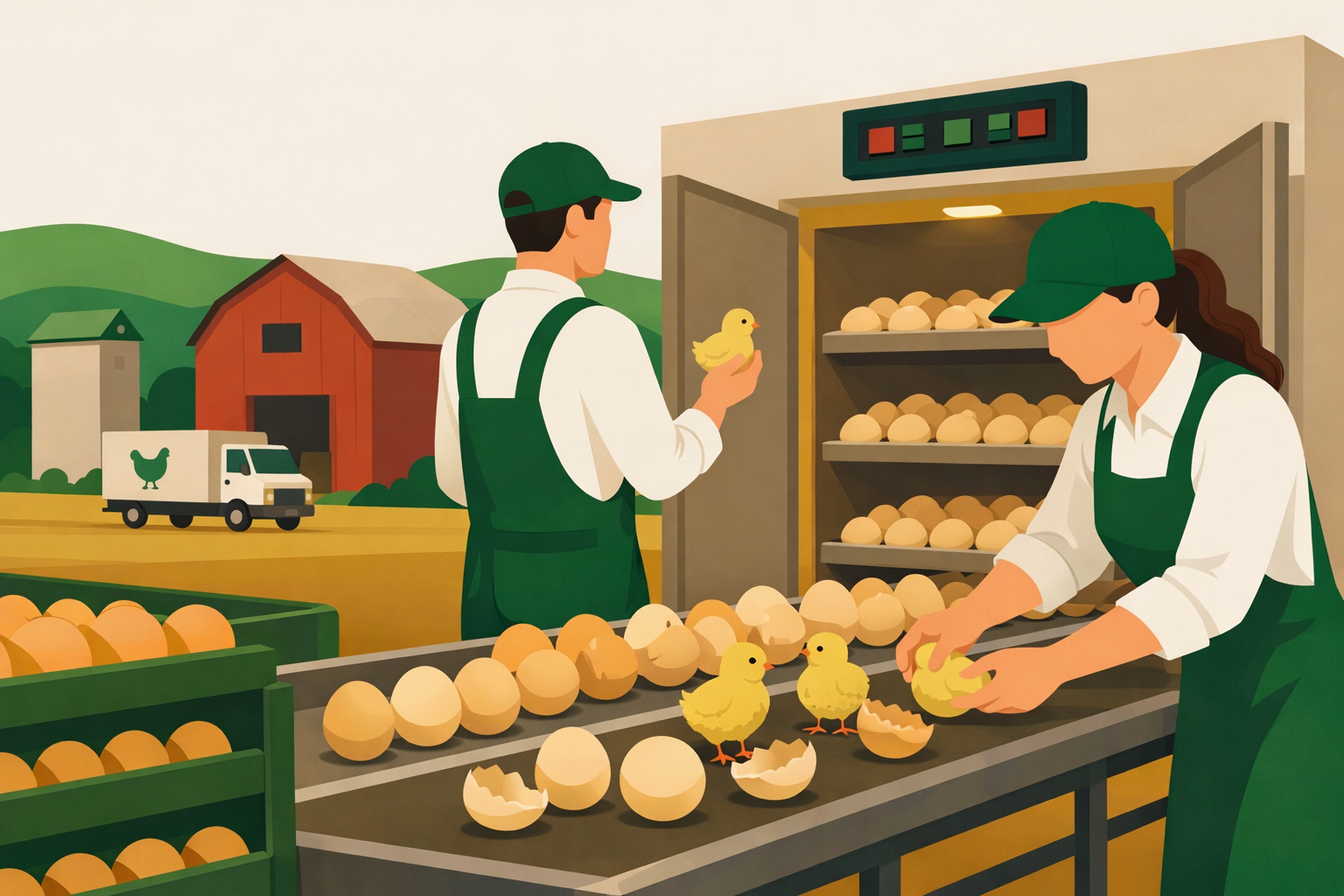
Every egg leaving a farm reaches the market with a defined quality level. That quality determines the price, commercial category and buyer — retailer, processor or direct consumer. It is therefore worth knowing how quality is measured, what affects it and how to improve it. This guide covers the three main measures: Haugh units, the Roche scale and grades A/B, as well as how to carry out an assessment yourself.
Why does egg quality change?
An egg starts to lose quality immediately after laying. The albumen becomes less viscous, the yolk membrane weakens and the air cell grows. The rate of these changes depends on storage temperature and humidity, time since laying, and the hen's age and diet. The older the egg and the worse it is stored, the lower the quality rating. More on egg structure in the guide egg structure and on how an egg forms in how an egg is formed.
Where do the numbers in this guide come from?
The values given (e.g. "above 72 Haugh units = grade AA") are indicative, based on generally accepted thresholds in the poultry industry, and may differ slightly between laboratories, national standards and hen breeds. Treat them as reference points, not rigid rules. For commercial trade, the current EU regulations on egg grades always apply.
How to assess egg quality — step by step
- 1
Weigh the egg
Before breaking the egg, weigh it on a gram scale. The weight is needed to calculate Haugh units, and also allows the egg to be assigned to a weight category (S, M, L, XL). Record the mass in grams — you need this figure for the next step.
- 2
Break the egg onto a flat, level plate
Carefully break the egg onto a smooth, level surface (e.g. a laboratory glass plate or a regular flat plate). It is important that the albumen does not spill over the edges — if it spreads too much the measurement will be inaccurate. Wait a moment for the albumen and yolk to stabilise.
- 3
Measure the height of the thick albumen
Using a micrometer, calliper with a stand, or a dedicated albumen height gauge, measure the height of the thick albumen surrounding the yolk — where the white is highest and most compact. Do not measure next to the yolk or at the thin edge. Record the result in millimetres. The higher the albumen, the fresher the egg.
- 4
Calculate (or look up) Haugh units
Haugh units are calculated from a formula that uses the egg mass and albumen height. The formula is mathematically involved, but in practice ready-made tables or online calculators are used. Simply enter the egg mass (g) and albumen height (mm) to read the result. Indicative scale: above about 72 = very fresh (grade AA), about 60–72 = fresh (grade A), about 31–60 = grade B, below about 31 = poor quality. These are approximate figures.
- 5
Compare the yolk colour with the Roche fan
The Roche colour fan is a set of numbered colour tiles ranging from about 1 (pale yellow) to about 15–16 (deep orange). Hold the fan next to the yolk under neutral (daylight) light and find the number closest to the yolk colour. Record the result. Yolk colour depends primarily on feed — hens receiving carotenoid-rich plants (e.g. maize, dried grass) produce darker yolks.
- 6
Inspect and candle the shell
Inspect the shell with the naked eye: is it clean, undamaged, free of cracks and stains? Then candle the egg with a candling lamp in a dark room. Look at the air cell (the dark space at the blunt end of the egg) — the smaller it is, the fresher the egg. Check for shell cracks visible in the light and whether the yolk is mobile but distinct.
- 7
Assign grade A or B
Based on all observations, assign the egg a commercial grade. Grade A: clean and undamaged shell; air cell no deeper than approximately 6 mm; dense, clear albumen; distinct, centred yolk — a fresh egg fit for direct consumption. Grade B: lower quality (dirty shell, large air cell, watery albumen) — sent to food processing only.
The three main egg quality measures — how they differ
Each measure describes a different characteristic of the egg. Below is a plain-language explanation of each.
Haugh units — freshness and albumen quality
Haugh units are the most important laboratory measure of egg freshness and albumen quality. They are calculated from a formula using the total egg mass and the height of the thick albumen after breaking the egg onto a flat surface. The higher and more "standing" the albumen, the more Haugh units and the better the quality. Indicative scale: from about 20 (old egg, completely watery albumen) to about 100–110 (very fresh egg, just laid). Numbers are approximate and depend on the measurement method.
Roche scale — yolk colour
The Roche scale (also called the Roche colour fan) is a colour reference with numbered tiles in shades of yellow and orange — from pale yellow (about 1) to deep orange (about 15–16). The assessor compares the yolk colour with the fan under neutral light and assigns the closest number. Yolk colour does not directly affect nutritional value, but is commercially important — darker, more orange yolks (about 10–14 on the Roche scale) are typically preferred by the market. Colour is determined primarily by feed (carotenoid content).
Commercial grades A and B — regulation and market
Egg commercial grades (A and B) are defined by EU regulations on egg trade. Grade A eggs are fresh eggs for direct consumer use: clean, undamaged shell; air cell no deeper than approximately 6 mm; dense albumen; clearly visible yolk through candling; no foreign inclusions. Grade B eggs are of lower quality or washed, and go exclusively to food processing (e.g. liquid whole egg, egg powder). Grade B eggs may not be sold as fresh eggs for direct consumption.
What damages egg quality and how to improve it
Egg quality is determined before the egg ever reaches the buyer. Below are the key factors and ways to improve them.
Hen age and storage time
Older hens (after about 60–65 weeks of age) lay eggs with thinner shells and slightly lower albumen quality — Haugh units naturally decline with age. Time has a similar effect: every day stored in poor conditions reduces quality. The keys are frequent egg collection (at least 3 times daily), cool and humid storage, and a short time from laying to delivery. More on laying flock management in the guide laying hen farming.
Nutrition (calcium, pigments, fatty acids)
Calcium in the diet is fundamental for a hard, thick shell — deficiency shows as soft, brittle eggs that must be rejected as defective. Carotenoids (e.g. from maize, xanthophylls, dried alfalfa) colour the yolk darker — a higher number on the Roche scale. Omega-3 fatty acids (from linseed or fish) enhance nutritional value without changing the egg's appearance. Laying hen nutritional standards are covered in the guide laying hen nutrition — standards.
Storage temperature and humidity
Eggs stored at room temperature (about 20°C) lose quality several times faster than refrigerated eggs (about 4–8°C). Humidity also matters — air that is too dry accelerates water evaporation from the egg, enlarging the air cell and reducing Haugh units. Optimal conditions are approximately 4–8°C and relative humidity of about 70–80%. This matters equally for farms and retail chains.
The most common mistakes when assessing egg quality
A few things that can distort the assessment result or lead to incorrect conclusions.
Measuring albumen height at the edge or next to the yolk
The height of the thick albumen is measured at its highest point — typically in the ring surrounding the yolk, but not directly against it. Measuring too close to the yolk or at the thin, watery albumen at the edge gives an inflated or deflated Haugh unit result.
Assessing yolk colour under yellow or artificial light
The Roche scale should be used under neutral daylight or a neutral light source (approximately 5000–6500 K). Yellow or orange artificial lighting artificially inflates the reading, while cold blue light deflates it. Always compare colour under the same, neutral light source.
Confusing weight category with quality grade
An egg's weight category (S, M, L, XL) is a completely different attribute from its quality grade (A or B). A large, heavy egg can be grade B (e.g. dirty shell or large air cell), while a small egg can be grade A. Do not confuse the two.
Skipping candling
Looking at an egg from the outside is not enough to detect cracks beneath the waxy cuticle, an oversized air cell or inclusions inside the egg. Candling is mandatory when sorting eggs into commercial grades and detects faults that are invisible to the naked eye.
Frequently asked questions about egg quality
What are Haugh units and why are they measured?add
Haugh units are a measure of egg freshness and albumen quality. They are calculated from the total egg mass and the height of the thick albumen after breaking the egg onto a flat surface. The higher the albumen, the more Haugh units and the fresher the egg. Indicative scale: about 100 = very fresh, about 60–72 = good, below about 31 = poor quality. Numbers are approximate.
What is the Roche scale?add
The Roche scale is a yolk colour reference in the form of a "fan" with numbered tiles ranging from pale yellow (about 1) to deep orange (about 15–16). The assessor compares the yolk colour with the fan under neutral light and records the closest number. Colour depends mainly on feed (carotenoid content) and says nothing about egg freshness, but is important for market preferences.
What is the difference between a grade A and a grade B egg?add
A grade A egg is a fresh egg for direct human consumption: clean, undamaged shell; small air cell (indicatively up to about 6 mm); dense, clear albumen; distinct and centred yolk. A grade B egg is of lower quality (e.g. dirty or washed shell, large air cell, watery albumen) and goes exclusively to food processing. Grade B may not be sold as a fresh egg.
Does yolk colour affect the nutritional value of the egg?add
Directly — no, or only to a very minor extent. A darker yolk indicates a higher carotenoid content in the feed, which is beneficial, but does not determine the overall nutritional value of the egg. Nutritional value is primarily shaped by protein, fat, vitamin and fatty acid content — which depend on the hen's overall diet.
How quickly does an egg lose quality?add
It depends on storage temperature and humidity. At room temperature (about 20°C) an egg loses quality noticeably faster than in cold storage (about 4–8°C). In hot weather the process is faster still. Indicatively: an egg stored in good cold-chain conditions can retain grade A for several weeks; at room temperature quality declines much faster, especially in summer.
How can yolk colour be improved?add
Yolk colour is improved by increasing the carotenoid content of the feed — maize, dried grass (grass meal), dried alfalfa, paprika, and in compound feeds — xanthophyll additives. The effect is visible after a few weeks from the diet change. More in the guide laying hen nutrition — standards.
Monitor egg quality and flock results in DlaFerm.pl
Want to track laying performance, egg quality results and flock indicators in one place? Create a free farm account or write to us.
Phone
+48 796 258 151