Broiler house temperature: age-based table and the role of humidity
The right temperature in the poultry house is one of the key factors that determine rearing results. Learn what values to use at each stage of the cycle and how to monitor the microclimate with DlaFerm sensors.
verifiedFrom the team that has organised work on poultry farms for years.
Why is poultry house temperature so important?
Day-old chicks are incapable of effective thermoregulation — their body temperature depends almost entirely on ambient conditions. Too low a temperature slows metabolism, increases feed consumption for body heat maintenance, and weakens the immune system. Too high a temperature causes heat stress, dehydration, reduced feed intake and higher mortality. A correct microclimate is the foundation of a good FCR and low mortality rate.
Perceived temperature vs measured temperature
Values given in breed management guides (e.g. Aviagen Ross, Cobb-Vantress) refer to temperature at bird level — about 5–10 cm above the litter. A thermometer hung high under the roof will show a noticeably higher reading, which can be misleading. It is also worth remembering that at high air velocities the temperature felt by birds is lower than the measured temperature — the wind-chill effect. In tunnel ventilation, air speeds above 2.5 m/s can lower the perceived temperature by several degrees.
Litter temperature at chick placement
Before chicks arrive, the house should be warmed up for at least 24–48 hours. Litter temperature at placement should be 28–30°C — cold litter chills chicks through their feet and can cause diarrhoea and increased mortality in the first days. Measuring litter temperature with a contact thermometer before the delivery arrives is a good practice worth keeping.
Bird behaviour as a natural comfort indicator
The best signal of the right temperature is the birds themselves. When the temperature is correct, they spread evenly across the whole house. Clustering under heaters or in the centre of the building signals it is too cold. Crowding near the walls, panting and raised wings are signs of overheating. It is worth observing the distribution of birds at least several times a day — especially in the first 7 days of rearing.
DlaFerm sensors — live monitoring
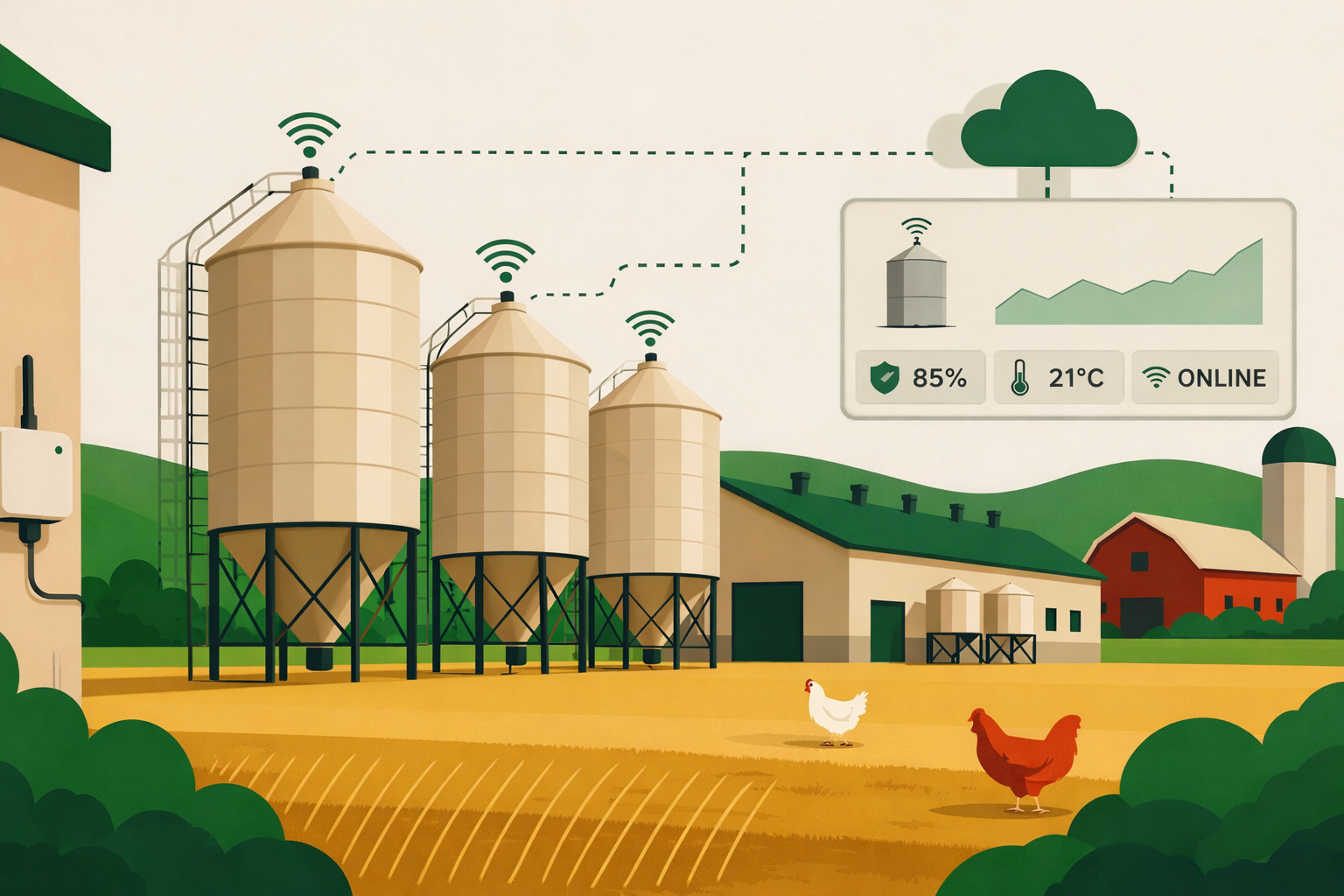
DlaFerm.pl IoT sensors measure temperature and humidity in the poultry house in real time and send data to the app. You can set SMS/push alerts when values go outside a set range — even in the middle of the night. This eliminates the need for physical condition checks every few hours and allows a fast response to heating or ventilation failures. Read more: DlaFerm.pl IoT Sensors.
Turkeys vs broilers — differences in heat requirements
Turkey poults are more sensitive to chilling than broiler chicks, particularly in the first days after placement. They cannot maintain body temperature as efficiently, so they require a warmer and more stable environment at the start. As a general indication, litter temperature directly under the brooder at turkey poult placement should reach approximately 39–40°C (indicative values from Aviagen Turkeys guides; always measure under the heat source, not in the air to the side). This is noticeably higher than for broilers, where litter in the brooding zone should reach approximately 28–30°C. More on turkey requirements: turkey temperature table and turkey rearing — first days.
Target poultry house temperature — table by broiler age
Indicative values based on Aviagen Ross and Cobb-Vantress breed management guidelines. Always check the guide for your specific breed — the producer may give slightly different values.
Day 0–3
32–34°C at bird level (5–10 cm above litter). Litter temperature at placement: min. 28–30°C. Chicks cannot regulate body temperature — every degree below the norm increases energy expenditure for heating.
Day 4–7 (week 1)
30–32°C. Gradual reduction — approx. 0.5°C per day or as recommended for the breed. Observe bird distribution: even spread across the whole house = correct temperature.
Week 2 (day 8–14)
28–30°C. Chicks begin to regulate body temperature more effectively, but remain sensitive to draughts and sudden night-time cooling.
Week 3 (day 15–21)
26–28°C. Period of intense growth — heat stress or cold directly reduces weight gain and FCR. Ensure proper minimum ventilation.
Week 4 (day 22–28)
22–26°C. Birds now have fully developed feathering; the risk of overheating increases at high external temperatures. In summer, tunnel ventilation may be essential.
Week 5 and beyond (day 29+)
20–22°C. Final values depend on breed, season and bird weight. At high stocking densities and weights, even 18°C may be sufficient — the key is observing birds and measuring at their level.
Relative humidity — target range, effects of deviations and practical tips
Monitor humidity together with temperature — both values affect the thermal comfort of birds and litter quality.
Recommended range: 60–70% RH
The optimal value through most of the cycle is 60–70% relative humidity. At this humidity level the litter remains dry and friable, reducing ammonia emissions and the risk of foot-pad dermatitis (pododermatitis).
Too low humidity (< 50% RH)
Dry air desiccates the respiratory mucosa of birds, increasing their susceptibility to infections. Dust levels in the house rise and eye irritation increases. In the first week, humidity below 50% can slow yolk-sac absorption in chicks.
Too high humidity (> 75% RH)
Wet litter promotes rapid growth of bacteria (Clostridium, Escherichia coli) and ammonia, which irritates the respiratory tract and eyes. High humidity combined with low temperature significantly increases the birds' perceived cold.
Humidity in the first 3 days
During the starter phase it is worth keeping humidity towards the upper end of the range (65–70%) to prevent dehydration of chicks through dry air. This is especially relevant in forced-air heating systems, which dry the air quickly.
Frequently asked questions about poultry house temperature and humidity
What temperature should the poultry house be on day 1 of rearing?add
On placement day (day 0–3) the temperature at bird level should be 32–34°C and litter temperature at least 28–30°C. These are indicative values based on breed management guidelines (Aviagen Ross, Cobb-Vantress) — exact recommendations may vary by breed and chick producer.
By how many degrees and how quickly should poultry house temperature be reduced?add
Standard breed guidelines recommend reducing temperature by about 2–3°C per week, i.e. approximately 0.3–0.5°C per day. Adjust the pace to bird behaviour — if they cluster under heaters, you are reducing too fast. If they pant and crowd near the walls, the temperature is too high.
What should the humidity be in a poultry house?add
The optimal relative humidity in a poultry house is 60–70% RH for most of the production cycle. In the first 3 days of rearing, aim for 65–70% to prevent chick dehydration from excessively dry air.
How does bird behaviour indicate incorrect temperature?add
When the temperature is too low, birds cluster under the heat source or in the centre of the house and are noisy. When it is too high, they move to the walls, pant, hold their wings away from their bodies and eat less. Even distribution across the whole house = correct temperature.
What is the difference between perceived temperature and measured temperature?add
Measured temperature is the thermometer reading. Perceived temperature for birds also depends on air movement speed — the wind-chill effect. In tunnel ventilation at 2–3 m/s, perceived temperature can be 3–5°C lower than the thermometer reading. This is why the thermometer in the house should hang at bird level and air speed must be factored into heating adjustments.
How do DlaFerm sensors help control temperature and humidity in the poultry house?add
DlaFerm.pl IoT sensors measure temperature and humidity continuously and send data to the mobile app. You can set alert thresholds — when values go outside the range you receive a push notification or SMS. The reading history helps analyse trends and adjust heating or ventilation settings before the problem affects rearing results.
Do turkeys need a higher starting temperature than broilers?add
Yes. Turkey poults are more sensitive to chilling than broiler chicks. The indicative litter temperature under the brooder at turkey poult placement is approximately 39–40°C, compared to approximately 28–30°C for broilers. The difference stems from the slower maturation of the thermoregulatory system in turkey poults — any chilling in the first days leads to health losses and poorer final results. Details: turkey temperature table.
Sources & resources
- linkAviagen — Ross Broiler Management Handbook (environmental requirements)
- linkCobb-Vantress — Cobb Broiler Management Guide (temperature and humidity)
- linkEFSA — welfare of broilers kept for meat production (environmental conditions)
- linkWPSA — World's Poultry Science Journal: microclimate in poultry production
- linkKRD-IG — Polish Poultry Council Industry Chamber
Monitor temperature and humidity with DlaFerm.pl
Want to see how IoT sensors work in the poultry house, or have a question about the system? Write to us.
Phone
+48 796 258 151