Poultry feeding systems — chain feeders, pan feeders, feed silos
Feed is the single largest cost in poultry production. An efficient and tight feeding system means less feed on the litter and less money wasted. We explain how feed travels from the silo to the feeder, what the main system types are, and what to check to keep everything working.
verifiedFrom the team that has organised work on poultry farms for years.
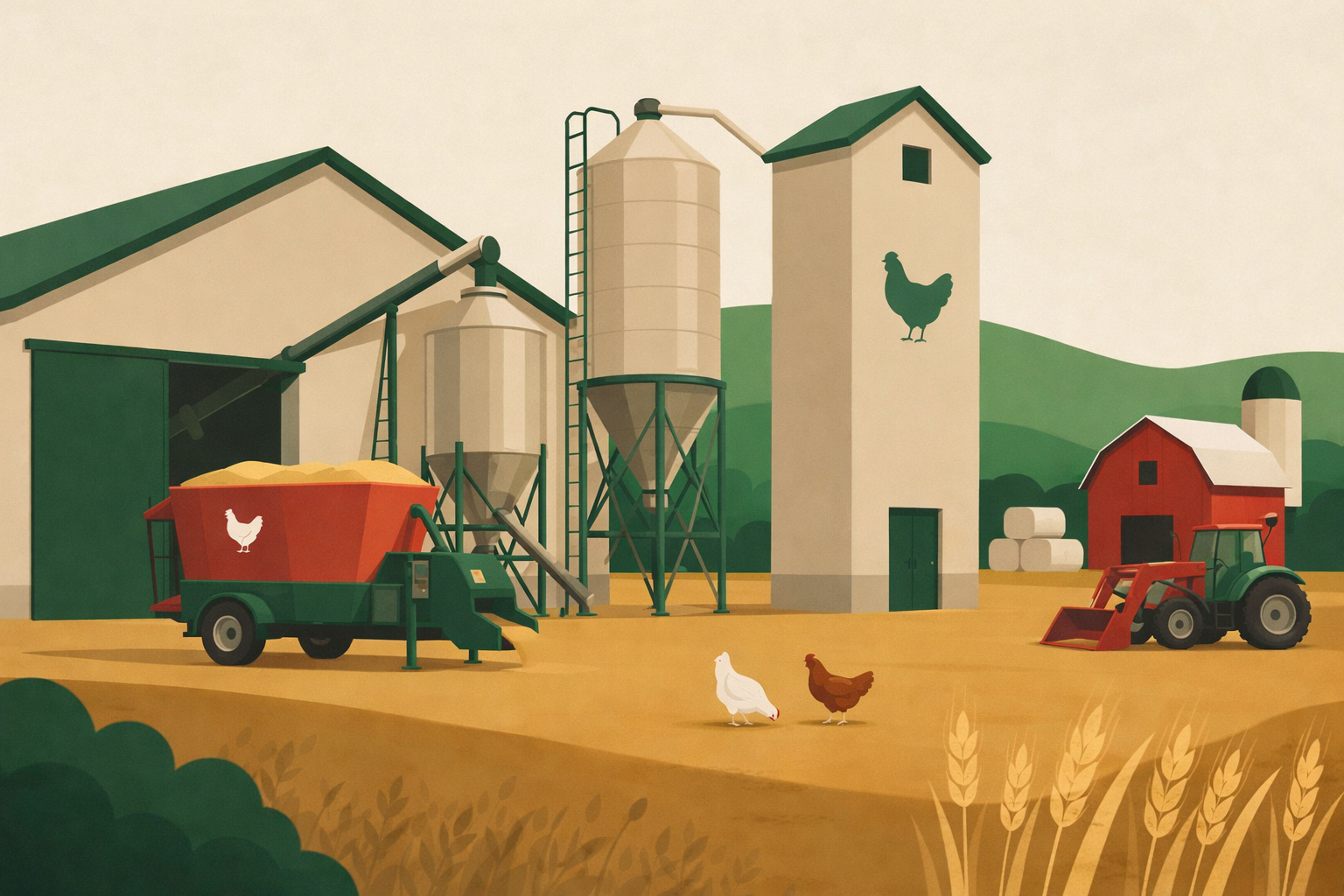
Feed typically accounts for 60–70% of poultry production costs. Every kilogram of spilled feed is a loss that cannot be recovered. That is why the feeding system — from the outdoor silo to the feeder where the bird stands — has a direct impact on the economics of the whole production cycle.
Three components of every feeding system
Regardless of system type, the feed always follows the same path: (1) a feed silo outside the building stores bulk feed; (2) a transport device — auger, spiral, or chain — moves feed from the silo into the house and along the building; (3) feeders — pan or trough — from which the birds eat. Each element must work properly, because a failure in one stops the whole chain. More on monitoring feed levels in the silo in the guide on feed silo monitoring.
Why is feeder adjustment so important?
Feeder height and feed level inside the feeder are two settings that a farmer changes several times during each production cycle. A feeder set too low or too full causes birds to scratch feed onto the litter — a straightforward path to losses. A feeder set too high is out of reach for young birds. The rule is simple: the feeder rim should be roughly at the height of the bird's back, and the feed level inside should be low enough that the bird cannot scratch it out with its beak. See also the guides on poultry feed mixes and the feed requirement calculator.
Three main poultry feeding systems
Each system has its strengths. The choice depends on the species, house size, and feed type.
Chain-trough feeder
Feed travels in a metal trough driven by a chain that runs in a loop around the whole house. When the motor starts, the chain moves feed along the trough and fills it evenly along its entire length. A simple, proven, and relatively low-maintenance system. Works well for turkeys and laying hens. Drawback: the trough sits close to the floor, which is good for chick access at placement, but with older birds you need to watch for feed contamination.
Pan feeder system
Round feeders — called pans — hang from a pipe through which a spiral driven by a motor pushes feed from the silo to each pan. The pan refills automatically — when the feed level drops below a sensor, the spiral starts and replenishes the pan. Birds stand around the pan and have equal access from all sides. This is the most popular system for broilers: low feed wastage, easy height adjustment as birds grow, and good visual control of feed levels in each pan.
Feed silo — bulk storage next to the house
The silo is a storage vessel outside the building that holds bulk feed — typically from a few to several tens of tonnes. Feed arrives by tanker truck and is blown in through an inlet at the top. An auger or spiral at the bottom of the silo transfers feed to the feeding system inside the house. Modern silos have a feed level sensor that sends data to an app — the farmer can see how much feed remains and order a delivery in advance. An empty silo means empty feeders, which quickly affects feed intake and flock results. More on sensor integration in the guide on IRZplus and sensor integrations.
From silo to feeder — how feed transport works
Feed passes through several devices before it reaches the bird. Each one requires regular inspection.
Silo and its outlet
The silo outlet is where feed leaves the storage vessel and enters the transport auger or spiral. A blockage at the silo outlet — caused by feed caking due to moisture or long periods of standstill — stops the entire system. It is worth regularly checking that feed flows freely from the silo, especially after extended downtime or in humid weather.
Transport pipe and spiral (or chain)
A pipe runs the length of the house with a rotating spiral inside (or a moving chain). This is what pushes feed from the silo to the feeders. The pipe must be tight — any gap means feed spilled in the wrong place and potential contamination. With each feeding cycle, check that the motor sounds even and that feeders fill in roughly the same time.
Feeders — the final destination
The feeder is the last link in the chain. Feed level inside the feeder is set using an adjustment mechanism — raising it increases the feed level (fuller feeder), lowering it reduces it. Recommendation: feed should reach about a quarter of the feeder depth so birds cannot scratch it onto the litter. The feeder rim must be raised as birds grow — do this regularly to match the flock's height. Feed and water management is also covered in the guide on drinker lines in the poultry house.
The most common mistakes in feeding systems
Small oversights in the feeding system translate directly into real feed losses and poorer flock results.
Overfull feeder
When a feeder is filled to the brim, birds scratch feed out with their beaks onto the litter. Feed that lands on damp litter cannot be returned to the feeder — it is a direct financial loss. Feed level should be low enough that the bird has to reach for it without being able to scratch it out.
Feeder hung too low or too high
Too low — birds sit on feeders, contaminate feed, and scatter it. Too high — younger or smaller birds cannot reach the feed, disrupting intake and flock uniformity. The feeder rim should be approximately at the height of the bird's back — adjust every few days.
No check on even filling along the line
Feeders nearest the motor fill first; those at the far end fill last. If the spiral is damaged or the pipe is leaking, some feeders may be permanently half-full while others are empty. Walk the whole line and visually check feed levels in each feeder, especially right after a filling cycle.
No monitoring of silo feed level
A silo running empty on a weekend or late afternoon can mean birds have no feed for several hours. That gap, especially during critical growth phases, hits daily weight gain and flock uniformity. A feed level sensor with an app notification is a simple safeguard against this problem.
Frequently asked questions about poultry feeding systems
What is the difference between a chain feeder and a pan feeder system?add
A chain feeder moves feed along an open trough by means of a chain — birds eat directly from the trough running the length of the house. A pan feeder system moves feed through a closed pipe by a spiral and dispenses it into round pans that birds stand around from all sides. Pan feeders are more popular for broilers because they reduce feed wastage and are easier to adjust as birds grow.
How high should a pan feeder hang?add
The feeder rim should be roughly at the height of the bird's back. For chicks in the first week, feeders are set very low — almost at floor level. As birds grow, feeders are raised regularly, every few days. A feeder hung too low with older birds leads to feed contamination and wastage.
What is a silo feed level sensor and is it worth having?add
A feed level sensor is a device mounted in the silo that measures how much feed remains and sends that information to an app or farm computer. This lets the farmer plan deliveries in advance and avoid the silo running empty on a Sunday or overnight. Even a few hours without feed lowers daily weight gain and disrupts flock uniformity.
Why do birds scatter feed from the feeder onto the litter?add
The most common reasons are an overfull feeder (feed reaches the rim and birds scratch it out) or a feeder hung too low (birds sit on it and kick feed onto the litter). The fix: lower the feed level inside the feeder and raise the feeder to the correct height. Feed scattered on the litter is practically impossible to recover — it is a real financial loss.
How do I check that feeders are filling evenly along the line?add
Walk the full length of the feeding line immediately after a filling cycle and compare the feed level in each feeder. Feeders near the motor fill first, those at the far end fill last. If the difference between the first and last feeder is large, or some feeders are empty, there may be a blockage in the transport pipe, a damaged spiral, or a leak in the line.
How does a drop in feed intake relate to bird health?add
If birds suddenly eat less than usual — and the feeding system is working properly and feeders are full — that is an important health signal. Birds that feel unwell reduce feed intake as one of their first responses. Monitoring daily feed consumption (ideally automatically via a silo weight sensor or a feed cycle counter) allows you to detect that signal early.
Sources & resources
Monitor feed and flock results in DlaFerm.pl
Want to track feed consumption, silo level, and production results in one place? Create a free farm account or write to us.
Phone
+48 796 258 151