Avian influenza (HPAI) — what every farmer should know
Highly pathogenic avian influenza (HPAI) is the most serious epizootic threat to poultry farms in Poland. Learn how it spreads, what to do when an outbreak appears in your area, and how to protect your flock.
verifiedFrom the team that has organised work on poultry farms for years.
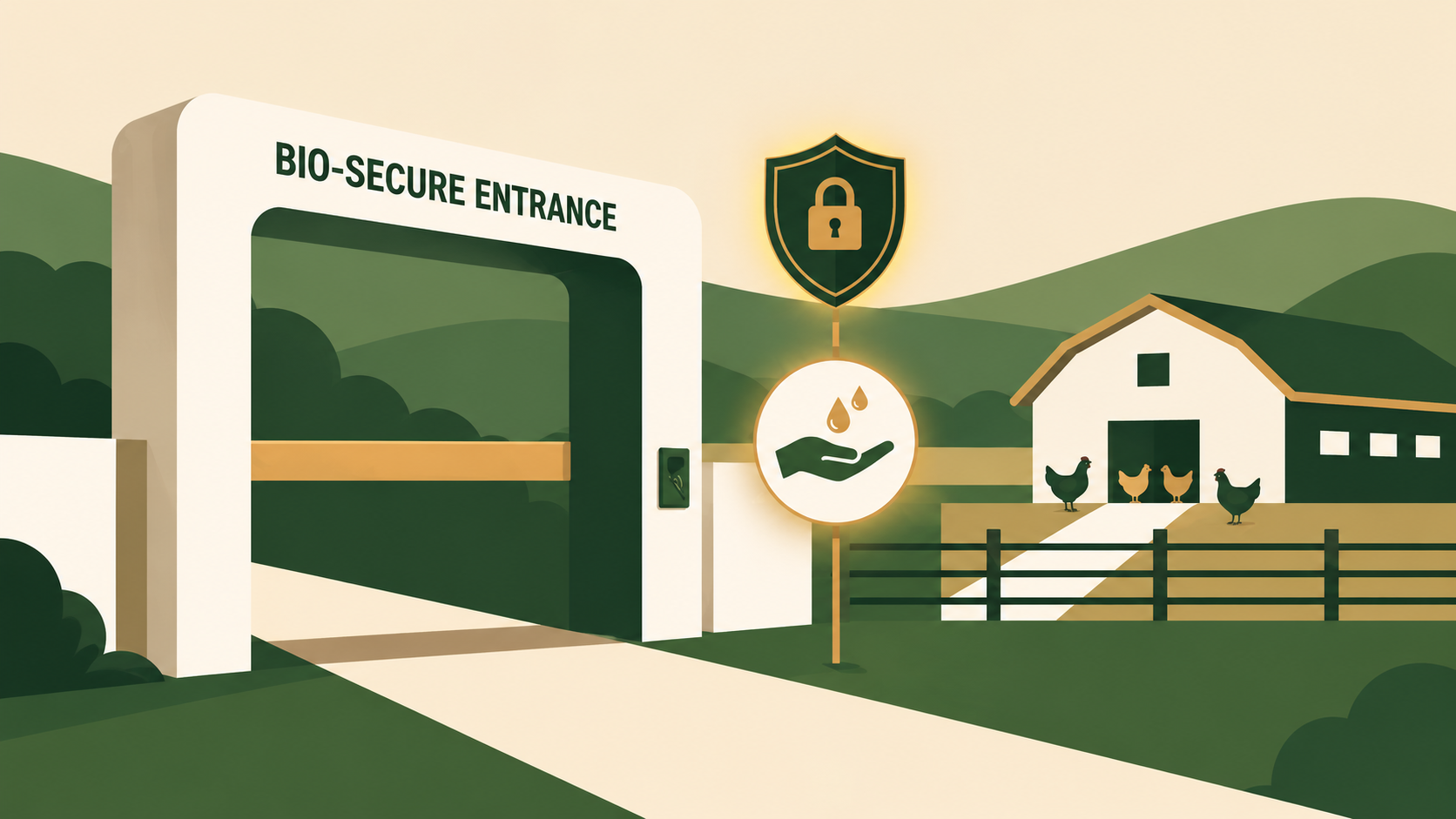
What is highly pathogenic avian influenza?
Highly Pathogenic Avian Influenza (HPAI) is an infectious disease caused by type A influenza viruses of high virulence, most commonly of the H5 and H7 subtypes. In domestic poultry it progresses rapidly: mortality in a flock can reach 90-100% within a few days. The H5N1 virus keeps expanding its host range — since 2024 infections of dairy cattle (a spillover to mammals) have been confirmed in the USA, which shows the global, structural nature of the problem. HPAI is subject to immediate mandatory reporting to the Veterinary Inspectorate — it is a notifiable disease (OIE/WOAH List A).
Current HPAI outbreak map in Poland
HPAI outbreaks appear in Poland seasonally, with a peak in autumn and winter when migratory birds pass through the country. The 2025/26 season was very intense in Europe — according to EFSA, more than two thousand HPAI detections were recorded in several dozen countries. Check the current HPAI outbreak map on DlaFerm.pl to see how far from your farm the virus has been detected. The map is updated on the basis of data from the Chief Veterinary Inspectorate (GIW), while the situation across Europe and worldwide is tracked by live tools: the EFSA HPAI dashboard and the WOAH WAHIS system.
EU regulations (Regulation 2020/689 and Regulation 2020/687) oblige member states to designate zones around each outbreak. In Poland the detailed rules are set out in the Act of 11 March 2004 on the protection of animal health and combating infectious animal diseases.
The HPAI virus is very resistant in the environment: it persists in water, faeces and on surfaces for many days, especially at low temperatures. Strict biosecurity is therefore more important than ever — read more on our poultry farm biosecurity page.
HPAI symptoms in poultry appear suddenly and violently — we describe them in detail on the Avian influenza — symptoms in poultry page. If you notice anything concerning in your flock, act immediately and do not wait until the next day.
How does avian influenza reach a farm?
The HPAI virus spreads mainly through wild migratory birds, but it can reach a farm in many ways.
Wild migratory birds
The main reservoir and vector of the HPAI virus is wild waterfowl — ducks, geese, swans and gulls. Free-range poultry has the greatest exposure to the droppings of wild birds and contaminated surface water.
Contaminated vehicles and equipment
Feed lorries, veterinary vehicles, poultry collection trailers and farm machinery can transfer the virus from one farm to another. Wheels, mudguards and loading crates must be disinfected on every entry.
People and clothing
Workers servicing several farms, feed suppliers or traders can carry the virus on footwear, overalls and gloves. Changing rooms at the farm entrance and protective clothing are a basic safeguard.
Contaminated feed and water
Feed stored in open containers can be contaminated by droppings from wild birds. Closed silos and sealed feed bins eliminate this risk. Surface water (from ponds and ditches) is not suitable for watering poultry.
Contact with infected stock
Bringing in poultry without health certificates and quarantine, exchanging hatching eggs from unverified sources or buying chicks from unknown hatcheries are routes of infection that a farmer can cut off through their own decisions.
Aerosol spread and farm density
Where poultry is highly concentrated, the virus can spread through the air over short distances (a few hundred metres). That is precisely why protection and surveillance zones are established around every outbreak.
What to do when HPAI appears in your area?
Two scenarios: you find yourself in a protection zone (approx. 3 km) or a surveillance zone (approx. 10 km) around a confirmed outbreak.
Protection zone (~3 km) — strict restrictions
The protection zone covers the area within approx. 3 km of an outbreak. Requirements include: a ban on moving and selling poultry and eggs, an obligation to keep poultry indoors (no free range), strict control of entry and exit from the farm, compulsory flock census and regular veterinary inspections, and vehicle disinfection. The exact scope of obligations is set out each time by the decision of the District Veterinary Officer.
Surveillance zone (~10 km) — heightened vigilance
In the surveillance zone (approx. 10 km from the outbreak) lighter but still strict requirements apply: registration and recording of moved poultry, a ban on shows and fairs, possible restrictions on egg sales, and enhanced sanitary and veterinary supervision. Farmers receive an administrative decision with a precise list of obligations.
Biosecurity every day, not just in a zone
Routine biosecurity is the best protection regardless of whether there is an outbreak nearby. Limit access by outsiders, use a sanitary lock, regularly disinfect equipment and vehicles, do not feed poultry in the open air and store feed in closed containers. More detail on our poultry farm biosecurity page.
Watch your flock and react immediately
Monitor daily mortality, feed and water consumption, egg production and bird behaviour. A sudden rise in mortality, depression in the flock, bluish wattles or combs and a sharp drop in feed consumption are alarm signals. Symptoms of HPAI are described on the Avian influenza — symptoms in poultry page.
Report any suspicion — immediately
Any suspicion of HPAI must be reported immediately to the District Veterinary Officer or the Veterinary Inspectorate. Do not wait for test results — report as soon as you have a suspicion. A detailed description of the reporting procedure is on our page about suspecting avian influenza and reporting.
Keep farm records up to date
In the event of an HPAI outbreak the inspectorate demands detailed data: daily mortality, a farm entry log, a record of feed deliveries and a list of persons who entered the farm. DlaFerm.pl lets you keep these records continuously — the Flock Card, Entry Log and silo monitoring are always inspection-ready.
Frequently asked questions about avian influenza (HPAI)
Is HPAI dangerous to people?add
Sporadic human infections with the HPAI H5N1 virus have been recorded around the world, but infection generally requires direct, intensive contact with infected poultry or its droppings. The risk to the general population is assessed by the WHO as very low. Personal protective equipment (gloves, mask, overalls) is nevertheless mandatory when working with a sick flock. In Poland, detailed recommendations are issued by the GIW in cooperation with the Chief Sanitary Inspectorate.
How long does the HPAI virus survive in the environment?add
The HPAI virus is very resistant at low temperatures: in bird droppings it can survive up to 35 days at 4°C, and in water — several weeks. At high temperatures (above 56°C for 3 minutes, or 70°C for a few seconds) it is rapidly inactivated. Most standard disinfectants (sodium hypochlorite-based, acid or aldehyde products) destroy it effectively.
What happens if I do not report a suspicion of HPAI?add
Failure to report a suspicion of a List A infectious animal disease (including HPAI) is a misdemeanour or criminal offence under Polish veterinary law. The farmer faces administrative penalties and, in extreme cases, criminal proceedings. More importantly, a delayed report hampers containment of the outbreak and can result in a wider restriction zone being imposed.
Can I sell eggs if my farm is in the surveillance zone?add
In the surveillance zone (approx. 10 km) egg sales are generally permitted, but require authorisation from the District Veterinary Officer and appropriate labelling of eggs as coming from the surveillance zone. In the protection zone (approx. 3 km) egg sales are as a rule prohibited. The exact conditions are set out each time in the administrative decision of the DVO.
How does compensation for flock culling work in the case of HPAI?add
If the Veterinary Inspectorate orders a flock to be culled because of HPAI, the farmer is entitled to compensation from the State Treasury, paid out by the Agency for Restructuring and Modernisation of Agriculture (ARiMR). The conditions are regulated by the Act on animal health protection. Compensation covers the value of poultry and eggs culled on the order of the veterinary services, but does not cover indirect economic losses.
Where can I find up-to-date information about HPAI outbreaks in Poland?add
The official source of information on animal disease outbreaks in Poland is the Chief Veterinary Inspectorate (GIW) at wetgiw.gov.pl. The GIW publishes bulletins on every new outbreak and updates restriction zone maps. DlaFerm.pl makes available an HPAI map based on GIW data — you can check it at /mapa/hpai.
Sources & resources
- linkChief Veterinary Inspectorate (GIW) — avian influenza bulletins
- linkGIW BIP — announcements and decisions
- linkEFSA — avian influenza and HPAI dashboard (seasonal data)
- linkWOAH WAHIS — World Animal Health Information System
- linkGov.pl — avian influenza zone announcements
- linkDlaFerm.pl — current HPAI outbreak map
Have a question about protecting your farm?
We will help you set up biosecurity and documentation before an inspection. Write to us.
Phone
+48 796 258 151