Turkey stocking density — how many birds per square metre
How many turkeys should go into one square metre of floor space? Too dense — wet litter, footpad lesions and poor growth. Too sparse — you overpay for floor area. We explain in plain language where the numbers come from and what drives them.
verifiedFrom the team that has organised work on poultry farms for years.
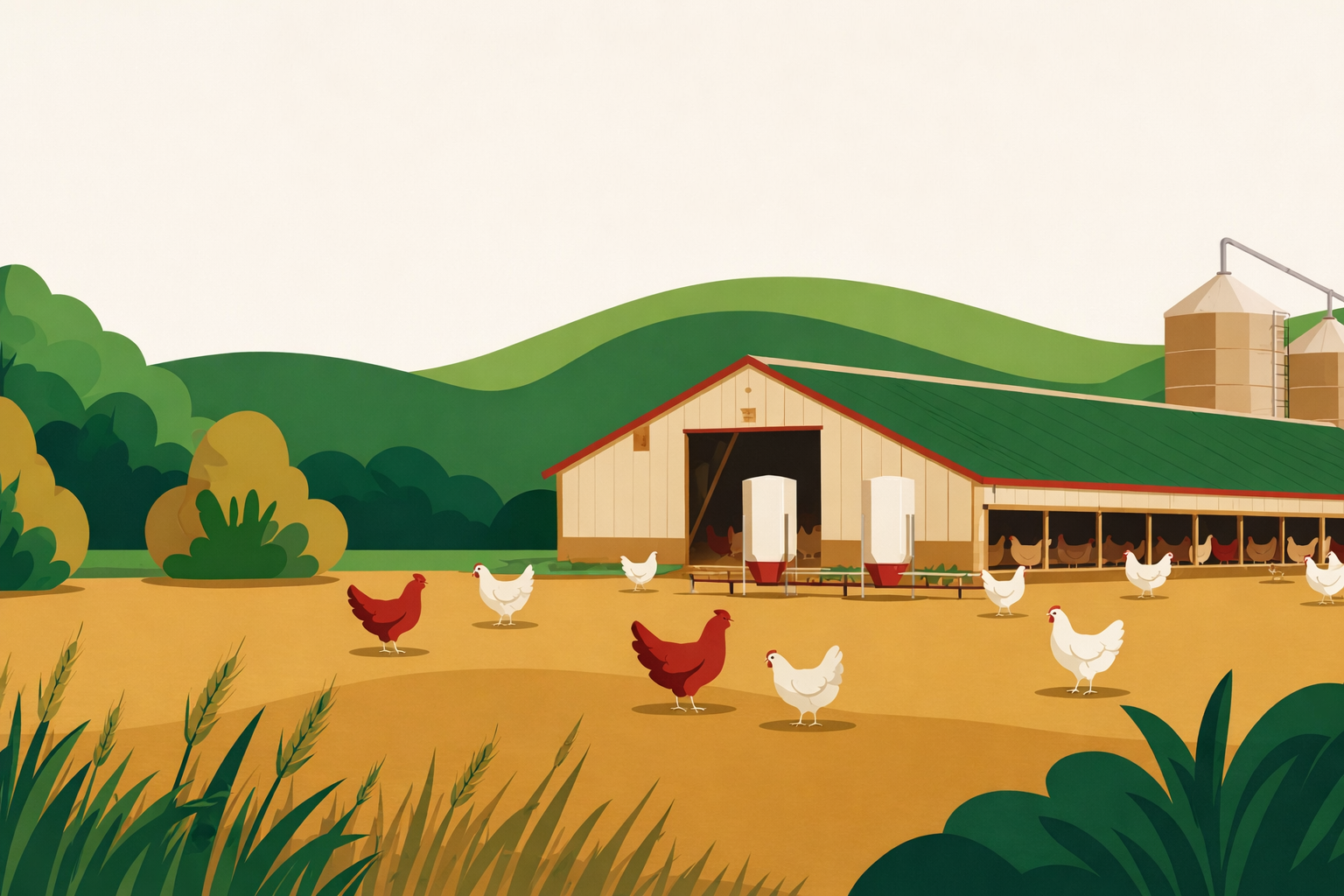
Stocking density is the number of birds (or kilograms of liveweight) per square metre of floor space. It is one of the most important parameters of the whole production cycle — it affects welfare, litter use, air quality, productive results and eligibility for welfare payment schemes. This guide is a spoke of the turkey cluster — the full picture of turkey farming is in the guide on turkey farming.
Birds per m² or kg per m² — which matters more?
Both, but kg of liveweight per m² matters more. A turkey grows throughout the whole cycle — a poult at the start may weigh half a kilogram, a tom at slaughter over 20 kg. If you only track birds per m², you end up at the end of the cycle with a house packed with bird biomass. This is why modern welfare norms and breeding company guides give the maximum liveweight per m² as the primary limit, and treat birds per m² as a starting-point figure.
Where do the numbers in this guide come from?
The indicative values (birds per m², kg per m²) are based on Aviagen Turkeys guides for commercial turkey lines (BUT — British United Turkeys, Nicholas) and typical Polish farming practice. They may differ between lines, sex, slaughter weight, ventilation and regulations — treat them as reference points, not fixed norms. More on the brooding start is in the guide on turkey rearing — the first days.
How many turkeys per m² — figures for toms, hens and mixed flocks
Indicative values from Aviagen Turkeys guides and typical Polish practice; dependent on line, sex, slaughter weight, ventilation and regulations*.
Toms (male turkeys) — final stocking density
A tom (male) is much heavier than a hen — at slaughter it may weigh over 20 kg. Indicative final stocking density: about 3.0–3.2 toms per m², giving about 58–60 kg liveweight per m². That is fewer birds per m² than for hens precisely because each bird is larger. With better ventilation and modern houses the density can be relaxed somewhat in favour of welfare. For a comparison with broiler stocking density, see the guide on broiler stocking density.
Hens (female turkeys) — final stocking density
A hen (female) is lighter than a tom, so more can be kept per square metre. Indicative final stocking density: about 5.8–6.2 hens per m², giving about 50–52 kg liveweight per m². Hens also have a shorter production cycle — they are slaughtered earlier at a lower liveweight — so litter pressure is lower than with toms.
Mixed flocks (toms and hens together)
For a mixed flock the indicative final stocking density is about 4.3–4.5 birds per m². That is a value midway between toms and hens. In practice, single-sex flocks (toms separately, hens separately) are better to manage and allow more precise stocking, feeding programmes and slaughter timing tailored to each sex.
The first days — starting stocking density
At the start of rearing the poults are kept more densely, in rings around the hover brooders. Low bodyweight means the number of birds per m² is very high at that point, but liveweight per m² is low. The key is that the poults have warmth, feed and water literally under their beaks. Details are in the guide on turkey rearing — the first days. As the birds grow, stocking is gradually relaxed by thinning the flock.
Welfare schemes — lower stocking density
Welfare schemes (payments for poultry production) typically require lower stocking densities than bare production capacity would suggest. Requirements vary between schemes and producers. Check the details before starting the cycle, because reducing density must be planned from the moment the poults are placed. More on welfare and payments is in the guide on poultry welfare — payments.
House temperature and permissible stocking density
The poorer the ventilation of a house, the fewer kilograms of liveweight can safely occupy one square metre. In summer, during hot spells, stocking must be lower than in winter — because every kilogram of live bird produces heat. Managing temperature, humidity and air movement is covered in the guide on house temperature for turkeys (table).
What happens when stocking density is too high
Too dense is not just poor results — it is a real welfare problem and a litter quality problem. Below are the most common effects of excessive stocking density.
Wet litter and footpad lesions
Too many birds per square metre produces too much dung and water vapour. The litter becomes damp and the birds stand on wet, irritating bedding. The result is pododermatitis — footpad lesions (sores on the underside of the feet). That means pain for the bird, poorer carcase score at slaughter and possible rejection at the processor. Litter management is covered in the guide on litter management in the poultry house.
Poorer growth and higher mortality
Too dense = more stress, poorer access to feed and water, poorer air quality. Birds grow more slowly and mortality rises. In extreme cases weaker birds are trampled, especially at the start when the poults are small and weak. Lower stocking density typically leads to a better feed conversion ratio and lower mortality.
Dirty carcases and processor problems
Wet litter and crowding mean dirty feathers and carcases at slaughter. Processors score birds visually — soiling, footpad lesions and marks from wet bedding contact all downgrade the carcase class and price per kilogram. Managing stocking density and litter is direct protection of your sale price.
Lameness and leg problems
Turkeys (especially toms) are prone to leg problems. Dense stocking, crowding and wet conditions are an environment in which lameness (difficulty walking, reluctance to stand) appears more often. Lame birds eat and drink less because they do not want to walk to the feeder and drinker. This is both a welfare and a production problem.
Frequently asked questions about turkey stocking density
How many toms (male turkeys) per square metre?add
The indicative final stocking density is about 3.0–3.2 toms per m², equivalent to about 58–60 kg liveweight per m². That is fewer birds per m² than for hens because a tom is much heavier — it can weigh over 20 kg at slaughter. The figures depend on the breeding line, house ventilation and welfare scheme requirements. Always check the specific scheme or poult supplier norms before starting the cycle.
How many hens (female turkeys) per square metre?add
The indicative final stocking density for hens is about 5.8–6.2 birds per m², giving about 50–52 kg liveweight per m². A hen is lighter than a tom and has a shorter production cycle, so the possible stocking density in birds per m² is higher. As with toms, the exact value depends on ventilation, line and welfare scheme requirements.
Why does liveweight per m² matter more than birds per m²?add
Because the bird grows. A poult at the start may weigh half a kilogram; a tom at slaughter over 20 kg. If you only track birds per m², at the end of the cycle you have a house packed with bird biomass. Liveweight per m² shows the true load on the house — and that is the indicator modern welfare regulations and breeding company guides use as the primary limit.
What happens when stocking density is too high?add
Excessive stocking density leads to wet litter, footpad lesions (pododermatitis — sores on the underside of the feet), poorer growth, higher mortality and dirty carcases at slaughter. Longer term it also means higher stress and more leg problems, especially in toms. Besides production losses, it risks rejection at the processor or loss of welfare payments.
Do welfare schemes require different stocking densities from standard regulations?add
Yes, usually lower. Welfare schemes — whether tied to payments or retailer specifications — set their own stocking density limits that are generally lower than maximum production capacity. Details differ between schemes. Check the specific scheme requirements before starting, because density must be planned from the moment the poults are placed.
How does starting stocking density differ from final stocking density?add
At the start of rearing poults are kept more densely, in rings around the hover brooders, so they do not stray from heat, feed and water. Liveweight is low at that point, so kg per m² is small despite a high bird count. As birds grow, stocking is relaxed by thinning the flock until the target final stocking density is reached.
Manage turkey stocking density in DlaFerm.pl
Want stocking density, liveweight and house parameters in one place? Create a free farm account or write to us.
Phone
+48 796 258 151