Broiler house ventilation: keeping the right air for your birds all year round
Good ventilation removes CO₂, ammonia, moisture and excess heat without exposing chicks to draughts. Learn how to match the ventilation mode to the season, and how microclimate sensors help automation keep parameters within target.
verifiedFrom the team that has organised work on poultry farms for years.
Why do broiler houses need ventilation?
A broiler house holding 40,000 birds produces enormous amounts of heat, moisture and gases — primarily carbon dioxide (CO₂) and ammonia (NH₃) from the litter. Without efficient air exchange, concentrations of these gases rise to levels harmful to bird health and performance. Birds breathe faster, eat less, grow more slowly and become more susceptible to respiratory disease. Ventilation is not a luxury — it is the foundation of broiler rearing technology.
Three ventilation modes throughout the year
In practice, three operational modes are used. Minimum winter ventilation maintains a constant, minimal air exchange even with side inlets closed — its goal is to remove moisture and ammonia without cooling the house. Transitional ventilation is used in spring and autumn when outside temperatures are moderate. Summer tunnel ventilation is a high-airspeed regime along the full length of the house — it acts like air conditioning through evaporative cooling and the wind-chill effect.
Cooling through air movement (wind chill)
In tunnel mode, airspeed inside the house can reach 2–3 m/s. Air flowing through a bird's feathers accelerates heat loss — the effective temperature felt by the broiler drops several degrees below the dry-bulb thermometer reading. At 28°C in the house and 2.5 m/s airspeed, birds feel approximately 5–7°C cooler. This mechanism maintains growth performance during hot summers without expensive air cooling.
Target microclimate parameters
Leading breed companies (Aviagen, Cobb) and scientific institutions define specific targets for automation to pursue: CO₂ below 3,000 ppm (optimally below 2,500 ppm), NH₃ below 20 ppm (optimally below 10 ppm in the first weeks of life), relative humidity 50–70%, and temperature adjusted to bird age according to the rearing programme's temperature curve.
Key thresholds worth knowing
A few reference figures help you judge whether ventilation is working correctly. Peak summer capacity reaches approximately 1 m³ of air per kg of bird bodyweight per hour — that is the capacity your installed fans should cover. Keep CO₂ below 3,000 ppm; for turkeys aim below around 2,500 ppm because they are more sensitive to the gas. Pay special attention during brooding: airspeed right at chick level must stay very low — below roughly 0.15 m/s — to avoid chilling the birds. For thermal conditions during that period see temperature and humidity and turkey rearing — first days. All figures are indicative; always verify against your specific breed's management guide.
Microclimate sensors and automation — integration with DlaFerm
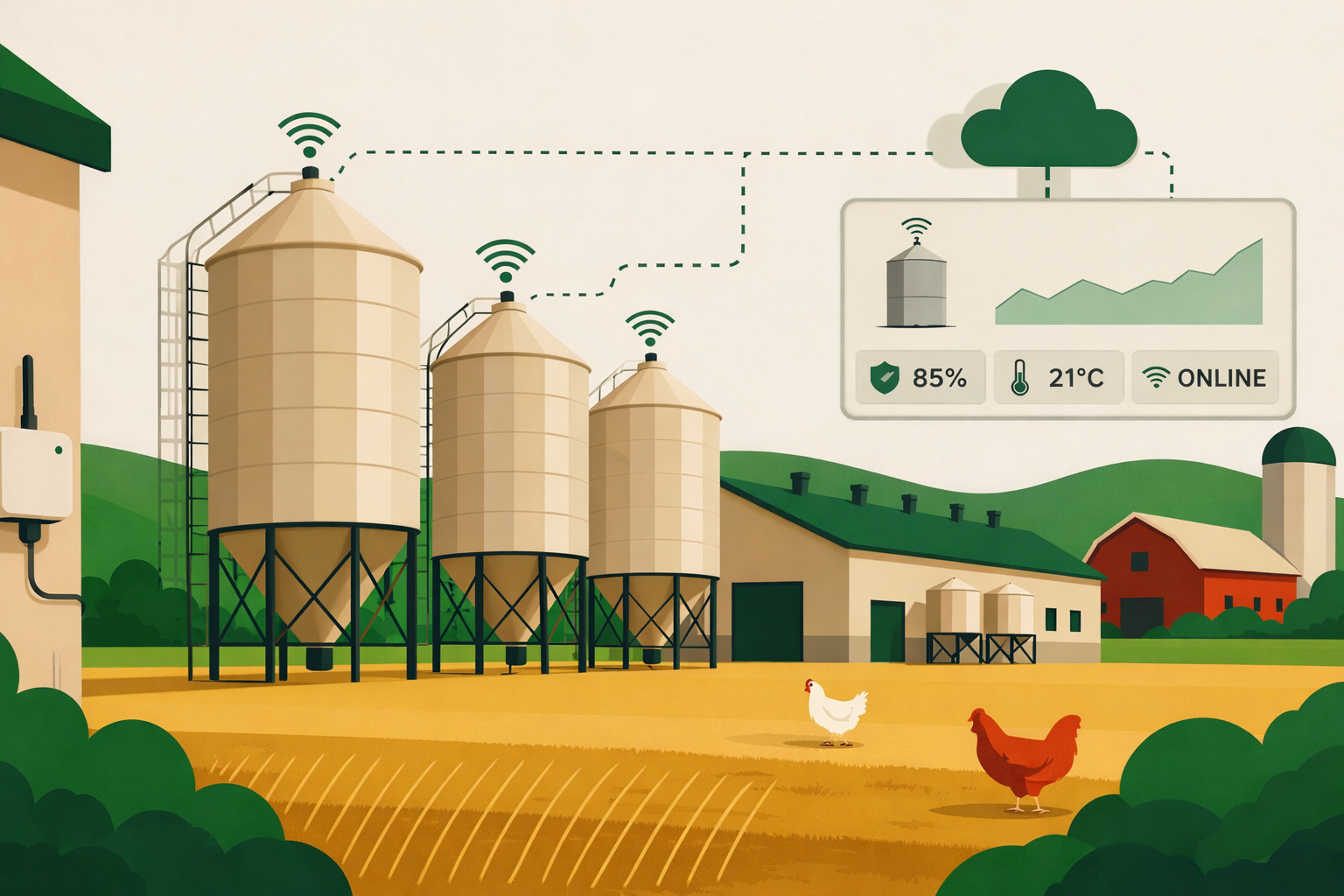
Manual parameter checks a few times a day do not guarantee that deviations are caught in time. CO₂, NH₃, temperature and humidity sensors connected to the DlaFerm.pl system transmit data in real time. The farmer can view parameter history in the app, set alarm thresholds and react before a poor microclimate starts damaging the flock. More about sensor integration: Integrations & sensors.
Four pillars of the broiler house ventilation system
Each mode solves a different problem — apply them according to outside temperature and bird age.
Minimum winter ventilation
Runs continuously even at low outside temperatures. The goal is to remove moisture and NH₃ from the litter, not to cool the house. Controlled by fan run-time timers or CO₂ and humidity sensors. Common mistake: switching ventilation off during frost causes a rapid spike in ammonia.
Transitional ventilation
Used when outside temperatures are 10–20°C. Side inlets open partially, fans run longer. Thermostat or multi-zone control. The key is to avoid draughts directed straight at chicks resting on the litter.
Summer tunnel ventilation
All side inlets closed; air is drawn in from one short end of the house and expelled at the other. Airspeed 2–3 m/s. Optional evaporative pads at the inlet. Reduces heat stress in summer and maintains growth rates at high outside temperatures.
Heated (warm) ventilation
In the first days of life, minimum ventilation can be assisted by heaters so that warm, fresh air enters near the roof and mixes before reaching birds. This prevents cold, damp air pockets forming at litter level.
Multi-zone control and controllers
Modern houses are equipped with controllers (e.g. Fancom, Skov, Roxell) that regulate fan output in steps or via variable-frequency drives. The controller collects signals from temperature, humidity and CO₂ sensors and adjusts fan speed and inlet position to current conditions.
Mesh and inlet protection
Ventilation openings must be covered with mesh no larger than 20×20 mm to prevent wild birds (HPAI risk) and rodents from entering. Clean mesh regularly — feathers and dust blocking the openings drastically reduce ventilation capacity.
Key ventilation benchmarks and standards for broiler houses
Keep these parameters within target — deviations even for a few hours reduce production performance.
Air exchange rate (m³/h/kg)
Minimum winter rate: approx. 0.7–1.0 m³/h per kg of bird bodyweight. Maximum summer rate: up to 5–7 m³/h/kg. Rearing programmes (e.g. Ross 308 Management Guide) specify the fan capacity required for a given house stocking density.
CO₂ concentration
Target: below 3,000 ppm; optimally below 2,500 ppm. At concentrations above 3,500 ppm, reduced feed intake, poorer growth and increased mortality are observed. Continuous measurement with an NDIR sensor provides immediate feedback for the automation controller.
Ammonia (NH₃) concentration
Target: below 10 ppm in the first 2 weeks of life; below 20 ppm for the remainder of the grow-out. NH₃ above 25 ppm damages the respiratory epithelium, increases susceptibility to disease and causes eye lesions (keratoconjunctivitis). Wet litter is the primary source — the link between ventilation management and litter condition is crucial.
Relative humidity (RH)
Target: 50–70%. Too low (< 40%) causes litter dust and respiratory irritation. Too high (> 75%) promotes wet litter, rising NH₃ and pathogen proliferation. In the first days of life, humidity should be 60–70% to prevent chick dehydration.
Airspeed in tunnel mode
Target in tunnel mode: 2.0–3.0 m/s at bird level. Measured with an anemometer at one-third of the house length from the inlet. Too low (< 1.5 m/s) gives no wind-chill benefit; too high (> 3.5 m/s) can cause stress and birds piling up.
House temperature along the rearing curve
Day-old chicks require approx. 32–34°C under the brooder; target house temperature 30°C. Temperature is reduced by approx. 2–3°C per week. By weeks 5–6 the target is around 18–20°C and cooling via tunnel ventilation becomes the priority.
Frequently asked questions about broiler house ventilation
Why is ammonia in a broiler house dangerous for birds?add
NH₃ irritates the mucous membranes of the birds' eyes and respiratory tract. At concentrations above 20 ppm, susceptibility to viral and bacterial infections (e.g. mycoplasmosis) increases. Prolonged exposure to 25–50 ppm leads to keratoconjunctivitis and lung damage. Good minimum ventilation and dry litter are the primary tools for controlling NH₃.
When should tunnel ventilation be switched on?add
Tunnel ventilation is typically switched on when the house temperature exceeds 25–27°C, or when outside conditions prevent other modes from keeping the house cool enough. The exact threshold depends on the rearing programme, bird weight and breed company specifications. Do not use tunnel mode with chicks under 14 days old — they are too small to thermoregulate effectively in high-airspeed conditions.
How do CO₂ and NH₃ sensors help manage ventilation?add
Sensors measure gas concentrations in real time and send data to the ventilation controller and — via integration with DlaFerm.pl — to the farmer's app. This allows minimum ventilation to adjust automatically to current conditions, and the farmer receives an alert when parameters approach the alarm threshold before production performance is affected.
What should I do when minimum winter ventilation still leads to high NH₃?add
The first step is to check litter condition — wet litter is the main ammonia source. Then verify that fan timers are correctly calibrated and that mesh screens are not blocked by feathers. If the house has heaters, consider pre-heating the inlet air to maintain ventilation without chilling the chick zone.
What airspeed is correct in tunnel ventilation mode?add
The standard target is 2.0–2.5 m/s measured with an anemometer at bird level. At this speed, the wind-chill effect lowers effective temperature by 5–7°C. The Aviagen Ross Broiler Management Guide provides a wind-chill table relating airspeed and temperature — it is worth using these figures when configuring the system.
How does DlaFerm.pl connect to microclimate sensors in the poultry house?add
DlaFerm.pl supports integration with LoRaWAN sensors and other IoT devices measuring temperature, humidity, CO₂ and NH₃. Sensor data flows to the farmer's dashboard in real time, where alarm thresholds can be set and parameter history tracked. Details: Integrations & sensors.
Why must airspeed at chick level be so low during brooding?add
In the first days of life chicks cannot yet regulate their own body temperature. Even a gentle draught — airspeed above roughly 0.15 m/s at floor level — can rapidly chill young birds, leading to stunted growth and higher mortality. Minimum ventilation during brooding should direct fresh air towards the roof, where it mixes with warm house air before reaching the chicks.
Sources & resources
- linkAviagen — Ross 308 Broiler Management Guide (ventilation, microclimate, temperature curves)
- linkEFSA — Scientific opinion on the welfare of broilers on farm (microclimate, NH₃, CO₂)
- linkIZ-PIB — Instructions for rearing broiler chickens (microclimate and ventilation)
- linkCouncil Directive 2007/43/EC — minimum standards for the protection of chickens kept for meat production
- linkLitter management in the poultry house — impact on NH₃ (related DlaFerm.pl guide)
- linkTemperature and humidity in the poultry house — broiler rearing curves (related DlaFerm.pl guide)
Monitor your poultry house microclimate with DlaFerm.pl
Want to see how CO₂ and NH₃ sensors work together with the app? Write to us.
Phone
+48 796 258 151