Measurable poultry welfare indicators — FPD, gait score, hock burn and stocking density
Poultry welfare can and must be measured with numbers. Footpad dermatitis (FPD), gait score, hock burn and stocking density are the key indicators used in welfare audits and payment schemes. We explain what each means, how to measure it and what thresholds are indicative.
verifiedFrom the team that has organised work on poultry farms for years.
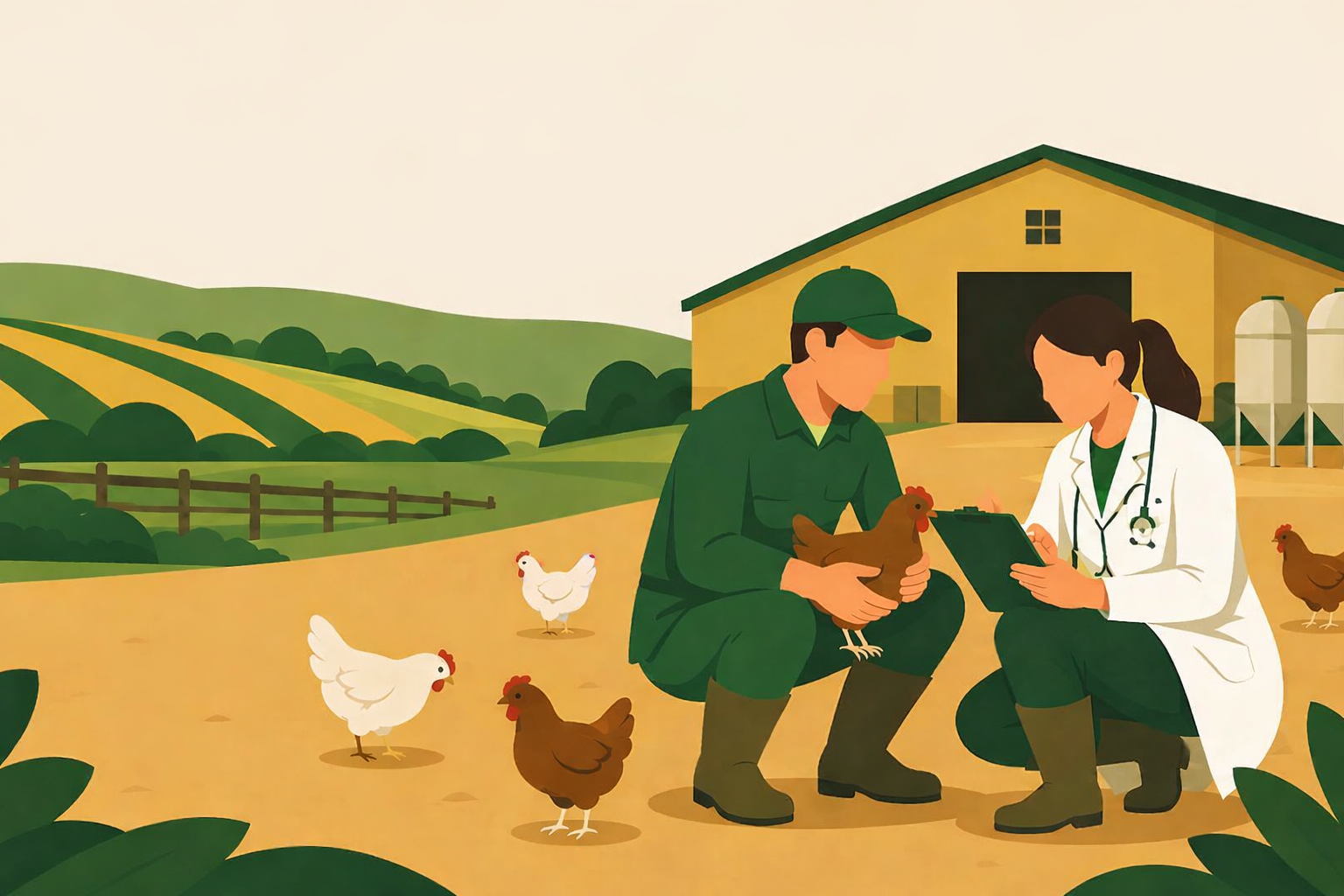
Poultry welfare is not just a general impression from a house visit — "birds look fine" or "litter is dry". Auditors, payment schemes and sound farming require specific numbers. These numbers are welfare indicators: measurable, repeatable, comparable between cycles and between farms.
Why are the indicators linked?
All major indicators share one common denominator: litter quality and moisture. Wet litter means birds sit or lie in a damp environment — a direct route to skin damage on footpads (FPD) and hock joints (hock burn). A bird with sore feet walks less and loses condition faster — hence a worse gait score. High stocking density makes every indicator worse, because litter gets wet more quickly and birds have less space for normal behaviour. More on causes of wet litter in the guide on wet litter — causes and effects.
Where do the thresholds in this guide come from?
We give indicative values — each welfare programme, slaughterhouse or audit may have its own thresholds and scoring scales. Treat them as a starting point for monitoring trends in your own flock, not as hard legal limits.
Key measurable poultry welfare indicators
Below are six of the most important indicators used on farms and during audits — each with its definition, scale and practical significance.
FPD — footpad dermatitis
FPD (footpad dermatitis, also called pododermatitis) is skin damage on the underside of the bird's foot — ranging from slight discolouration (grade 0–1) to a deep ulcer (grade 3–4). The scoring scale is usually 0–4, where 0 = healthy pad, 4 = severe, deep damage. Assessment is most often done on a sample of feet at slaughter. A high FPD score is the clearest warning sign that litter was too wet. More in the guide on pododermatitis — broiler foot quality.
Gait score — walking ability assessment
Gait score is an observation of how the bird walks, scored on a scale of 0–3: 0 = normal gait, 1 = slight awkwardness or lameness, 2 = clear difficulty walking, 3 = bird hardly walks or cannot rise. In a broiler flock, a score above 1 in a significant proportion of birds signals leg or litter problems. Assessment is done by walking through the house and observing randomly selected birds. Details in the guide on gait score — poultry walking assessment.
Hock burn — hock joint lesions
Hock burn is skin damage or discolouration on the back of the hock joint — where the leg bends. It is measured as the percentage of birds in a sample showing visible damage or discolouration. Like FPD, hock burn is a direct consequence of wet and dirty litter. The higher the percentage, the worse the litter quality was during the cycle.
Stocking density — kg of birds per m²
Stocking density is the total weight of all birds in the house divided by the usable floor area in square metres (kg/m²). Higher density increases the risk of poorer litter quality, worse ventilation and higher FPD, hock burn and gait scores. Indicative limits are typically 33–42 kg/m² depending on local regulations and the welfare programme. More in the guide on broiler stocking density.
Mortality — % of birds that die during the cycle
Mortality is the percentage of birds that die during the cycle. Indicatively, a healthy broiler flock stays below 3–4%, though this depends on cycle length and genetic line. High early-cycle mortality may point to placement or management problems, while late-cycle mortality often indicates leg disorders or difficulty reaching feed and water at high stocking densities.
Feather cleanliness and flock behaviour
Soiled plumage — especially on the breast and belly — is an additional sign of wet litter, visible to the naked eye during a house walk. Equally important is observing flock behaviour: are birds moving calmly and foraging, or are clumping and trembling indicating stress or disease? Uneven distribution of birds signals temperature, ventilation or feed and water access issues.
How to measure welfare indicators on the farm
Regular measurement and recording are the foundation — only a trend allows you to catch a problem before it grows. Below are practical methods for each indicator.
Regular sampling and visual assessment in the house
Gait score and flock behaviour observation are easiest to carry out during daily checks. Walk calmly into the house and watch how birds react to your movement — healthy birds rise and walk normally. Score a random selection of several dozen birds and note the percentage with gait score 2–3. Also check feather cleanliness and any uneven clustering.
Leg examination — in-house samples and slaughterhouse data
FPD and hock burn can be assessed in the house (near the end of the cycle, on live birds — gently invert a bird and inspect the footpads and hock joints) as well as from slaughterhouse data. Slaughterhouses regularly issue foot quality reports for each batch — this is the most accurate source of FPD data for your flock. Request the results after every kill and compare across cycles.
Calculating stocking density
Stocking density is straightforward: number of birds × average bird weight (kg) ÷ house floor area (m²). Track density at key moments — at placement (often expressed as target kg/m²) and around slaughter. Compare against the limits in your welfare programme or slaughterhouse contract.
Recording results and comparing across cycles
A single measurement tells you little. Only comparing several cycles reveals the trend: is FPD rising cycle by cycle (a sign of a growing litter or ventilation problem), or is mortality higher at higher stocking densities? Record results consistently — for example in DlaFerm.pl — to have a complete picture of the farm over time.
Data from welfare audits
If you participate in a welfare payment scheme, the auditor assesses the same indicators annually using a defined protocol. Audit results are also valuable data — compare them with your own measurements to understand where you stand against the programme thresholds. More on payments and audits in the guide on poultry welfare — payment schemes.
Common mistakes when measuring welfare indicators
A few things that lead to skewed results or misinterpretation.
Visual assessment only, without numbers
"The flock looks fine" is not enough — the human eye adapts to a situation that is gradually getting worse. Regular recording of numbers (% of birds with gait score ≥2, FPD result from slaughterhouse, % hock burn) lets you spot the trend before it becomes a serious problem.
No comparison across cycles
An FPD result of 15% after one cycle can be better or worse depending on whether the previous cycle was 8% or 25%. Without historical data you cannot tell whether things are improving. Keep a cycle log or use a farm management tool.
Confusing the indicator with the cause
High FPD is a signal — most often of wet litter. But the cause of wet litter can vary: faulty drinkers, poor ventilation, excessive density, feed composition. Don't just count the indicator — find the cause and fix it.
Ignoring slaughterhouse data
Foot quality data from the slaughterhouse is often available free of charge under the supply contract. It is the most accurate external FPD measurement you can get. Farmers who do not ask for this data lose a valuable feedback signal after every cycle.
Frequently asked questions about poultry welfare indicators
What is FPD in poultry?add
FPD (footpad dermatitis, also called pododermatitis) is skin damage on the underside of a bird's foot. It is scored on a scale of 0–4: 0 is a healthy pad, 4 is severe deep damage. A high FPD score most often means the litter was too wet. Assessment is usually done on a sample of feet at slaughter.
What is gait score and how is it assessed?add
Gait score is an assessment of how a bird moves, scored 0–3: 0 = normal gait, 1 = slight awkwardness, 2 = clear difficulty walking, 3 = bird barely rises. Assessment is done during a house walk — you observe randomly selected birds and note what percentage scores 2 or 3.
What is hock burn?add
Hock burn is skin damage or discolouration on the back of the hock joint. Like FPD, it is a direct result of contact with wet and dirty litter. It is measured as the percentage of birds in a sample showing visible damage.
What stocking density is permitted for broilers?add
EU rules (Directive 2007/43/EC) set a basic limit of 33 kg/m², with the possibility of increasing to 39 or 42 kg/m² when additional requirements and inspections are met. Welfare programmes and slaughterhouse contracts may have their own — often lower — limits. Check the conditions of your programme or contract.
Can I assess FPD myself without sending a sample to the slaughterhouse?add
Yes — near the end of the cycle you can gently invert a few randomly selected birds and inspect the footpads. The same 0–4 scale applies. Slaughterhouse data is more accurate because it covers a larger sample assessed by trained personnel, but an in-house check mid-cycle can give an early warning signal.
How do welfare indicators affect payment schemes?add
Many welfare payment programmes (e.g. under the Rural Development Programme or industry schemes) require regular audits assessing exactly these indicators. Exceeding FPD or gait score thresholds can result in a reduced payment or exclusion from the programme. For details see the guide on poultry welfare — payment schemes.
Track welfare indicators in DlaFerm.pl
Want to record FPD results, mortality, stocking density and audit outcomes in one place? Create a free farm account or write to us.
Phone
+48 796 258 151