Digital flock record vs paper — which is worth it?
A notebook on the shelf or an app on your phone — every poultry farmer asks this question eventually. We answer honestly: paper has real advantages, but also real limits. Find out which solution fits your farm.
verifiedFrom the team that has organised work on poultry farms for years.
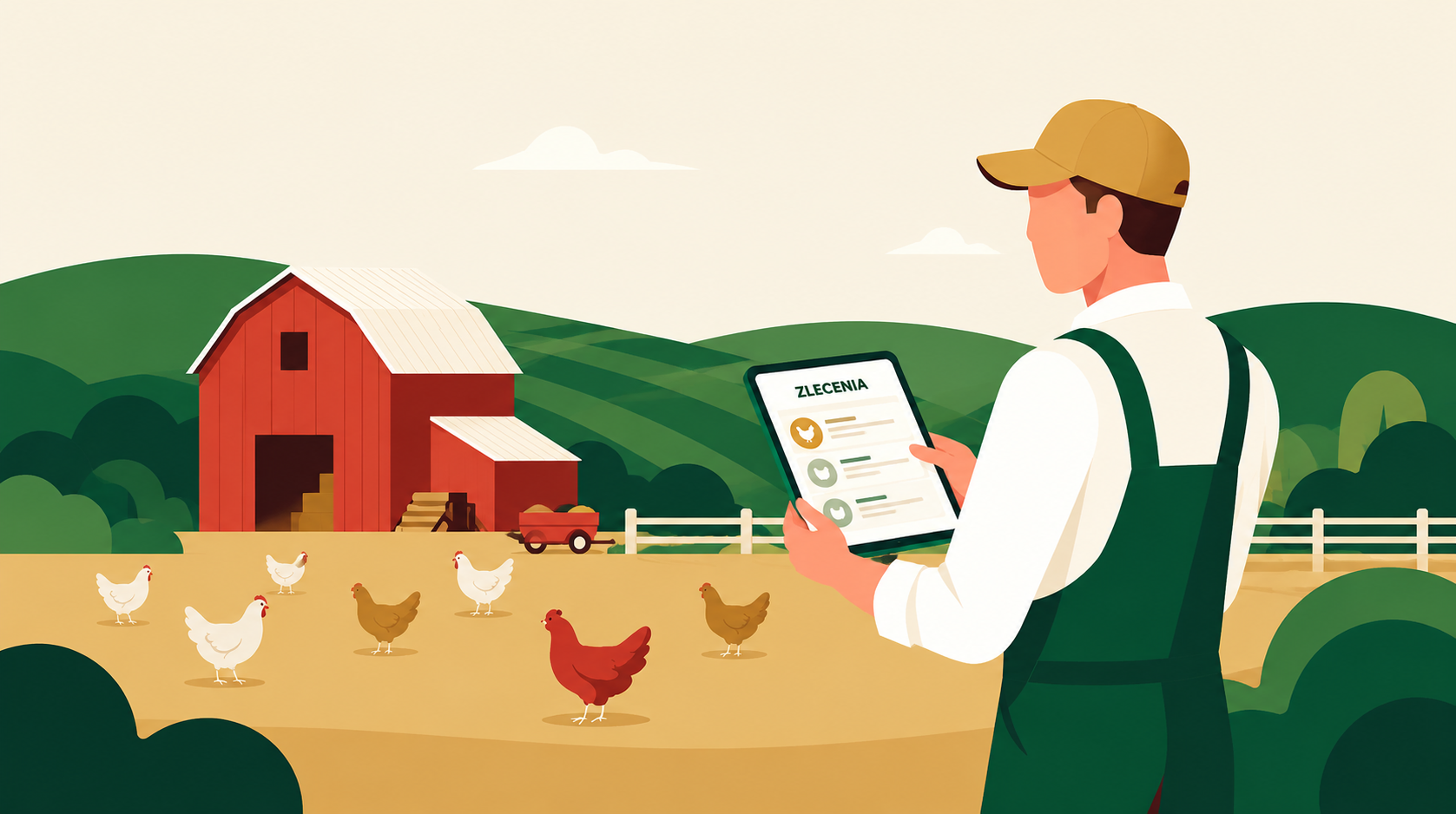
A flock record is a document where the farmer notes everything that happens in the house: how many birds were placed, how many died, how much feed was used, which medicines were given and what weight the birds reached at each check. Without it you cannot meaningfully judge whether a cycle went well or compare it with the previous one. The question is not whether to keep a flock record, but how.
Paper and pen — simple, but enough?
A paper flock record needs no electricity, no phone and no internet. A notebook and pen are all you need. For many farmers, especially those with one small house, this has worked for years and still works. This guide does not say paper is bad — it says when its limits start costing more than the savings are worth.
How do the two solutions differ day to day?
The difference is simple: with paper you write, calculate manually and store physically. With a digital solution you enter data on your phone at the house, the programme calculates indicators automatically and keeps the history in the cloud. That is the core of it — the rest depends on the scale of your farm and how much time you want to spend on admin.
Drawbacks of paper and when paper is enough
Paper has real advantages — and real limits. Below is an honest list of both.
Advantages: cheap and simple
A notebook and pen cost very little. There is nothing to learn, no subscription, no need for a phone or coverage inside the house. For one small house where everything is visible at a glance, paper is perfectly adequate — especially when one person manages it and remembers every cycle.
Drawback: easy to lose or damage
A poultry house is a damp, dusty place. Notebooks get wet, pages stick together, entries fade. Fire, flooding, simple misplacement — and data from several cycles disappears forever. There is no backup. If a departing employee kept the notebook, the knowledge of previous cycles often leaves with them.
Drawback: totals must be calculated by hand
Mortality percentage, feed per bird, FCR — all of these need to be calculated manually, usually at cycle closure. Arithmetic errors are easy to make. Spotting a trend mid-cycle — for example that mortality is rising faster than in the previous week — is very difficult because there is no chart or alert.
Drawback: no history in one place
Comparing the current cycle with the previous one means leafing through several notebooks. With more than one house, keeping a consistent history becomes very hard. During a vet inspection or audit it is difficult to gather all documents from the past months quickly.
When paper genuinely is enough
One house, a few thousand birds, one farmer who remembers everything, no need to report to a bank or integrator, no requirement to share data electronically with a vet. If all these conditions hold — paper is a fair option and there is no reason to change it by force.
The hidden cost of paper
Time spent totalling figures and transcribing data into summaries at cycle end is a real cost. If it takes one to two hours per cycle and there are six cycles a year, that is over ten hours of work annually — plus errors that can lead to wrong decisions on medicine doses or feed adjustments.
What a digital solution adds — and when it is worth switching
A poultry house management programme is not for everyone — but where it fits, it makes a real difference. Here is what you actually gain.
Entry from your phone, data in the cloud
You enter mortality and feed consumption standing in the house, directly on your phone. Data saves immediately — no transcribing, no losing notes from your pocket. The backup is safe even if your phone breaks. Several people (for example the farmer and an employee) can enter data at the same time, each from their own device.
The programme calculates indicators automatically
Mortality percentage, daily weight gain, FCR (feed per kg of gain), average weight — the programme calculates these automatically as you go. You do not need to calculate anything by hand or wait until cycle end to see how things are going. Arithmetic errors disappear.
History of many cycles in one place
Comparing the current cycle with the previous one or with last year's results takes seconds. You can check whether mortality in the same week has risen year on year or whether water consumption is off the norm. That is knowledge paper cannot provide without hours of searching.
Easy export for the vet and filing to IRZplus
A cycle report can be emailed to the vet, and the flock-change reports to IRZplus DlaFerm.pl can send for you automatically — if you want, because the choice is yours; you can also report them yourself in the ARiMR portal. During a sanitary inspection all documents are in one place and can be shown in seconds from a phone or computer screen.
Alert on unusual results
If water consumption suddenly rises or mortality exceeds a threshold, the programme can send a notification. There is simply no alert mechanism in a paper notebook. An early warning gives you time to act before the problem deepens.
Drawbacks of the digital version — honestly
You need a phone or tablet and at least occasional coverage to sync data to the cloud. There is also a cost — usually a monthly or annual subscription. It requires learning the software, although simple programmes take about an hour to master. If you have one small house and no need to report externally, the investment may not pay off.
When to stay with paper and when to switch to a digital flock record
An honest answer depends on farm scale, number of people and external requirements. Below are specific situations.
Paper: one small house, one person
If you run one house with a few thousand birds, you enter data yourself and you do not need to report to anyone or show documents quickly — paper is a sensible option. Costs are minimal, error risk is acceptable. Keep old notebooks in a dry place though.
Digital: more than one house
When you have two or more houses, especially with different stocking densities and cycles at different times, managing paper notebooks becomes cumbersome. A digital programme gives a view of all houses at once and lets you compare results across buildings.
Digital: a team or employees
If different people are entering data, paper very easily leads to chaos — different handwriting, missing entries, different interpretations of fields. A programme enforces a consistent format and shows who entered what and when.
Digital: integrator or bank requirements
More and more poultry integrators and banks granting farm loans expect cycle summaries in electronic form. A paper notebook will not meet this requirement. If you plan to develop your farm and seek financing, switching to digital records early makes sense.
Digital: you want to compare cycles and improve results
If you want each cycle to be better than the last — less feed, fewer deaths, better FCR — you need historical data in a form you can review quickly. Paper makes that difficult. Details on which indicators to track are in the guide on digital broiler flock records.
Paper as a supplement — the hybrid approach
Some farmers use both: a notepad in the house for entries during the day, then transfer to the programme in the evening. This is a compromise — it keeps things simple on site but provides a digital history. The drawback is double entry, which takes time and doubles the risk of error.
The most common mistakes when choosing and keeping a flock record
Several decisions farmers often regret — whether they chose paper or a programme.
Buying expensive software without trialling it
Before signing up for an annual subscription, check that the programme works on your phone, that the interface is understandable and that it has the features you actually need. Most programmes offer a free trial — use it on a live cycle, not on sample data.
Keeping the record irregularly
A flock record is only valuable when you enter data every day. Batch entries once a week mean you lose information about exactly when mortality rose or when birds stopped drinking. This applies to both paper and a programme.
Ignoring data after the cycle closes
Many people keep a record to meet a formal requirement and never go back to the data. The value of records lies in comparing cycles — what went better, what went worse and why. Without analysis the record is only a cost in time, not a tool for improving results.
Switching to digital without training employees
If an employee enters the data and you only read the reports, make sure they know how to enter correctly — especially what bird age in days means, how to distinguish a dead bird from a culled one and how to record feed consumption. Wrong data in a programme is worse than missing data on paper, because it looks convincing.
Frequently asked questions about digital and paper flock records
Is a paper flock record required by law?add
Veterinary regulations and biosecurity rules require flock records to be kept, but they do not specify paper vs digital. What matters is that the documentation is complete, legible and available during inspections. A digital version meets these requirements just as well as paper — and is often easier to present in full during an audit.
How much does a digital flock record programme cost?add
Cost depends on the programme and the number of houses. Simple apps range from a few dozen to a few hundred euros or equivalent per year. DlaFerm.pl offers a free account with basic record-keeping functions — you can see whether it fits your farm before committing to a paid plan.
What is FCR and does a programme need to calculate it?add
FCR (Feed Conversion Ratio) is a measure of feed efficiency — how many kilograms of feed are used to produce one kilogram of live weight gain. The lower the FCR, the more efficiently the bird converts feed to meat. A programme calculates FCR automatically, eliminating manual calculation and giving a live view of how the cycle is going — no need to wait until it closes.
Does a digital flock record work without internet in the house?add
Most programmes allow offline data entry — on a phone with no coverage — and sync to the cloud when a connection becomes available. Check this before choosing a programme: it is an important feature on farms with poor coverage. DlaFerm.pl supports offline mode.
How do I transfer data from a paper notebook to a programme?add
Most farmers start fresh — they enter historical data only for the last few cycles, just enough for comparison. Transcribing years of back data is rarely worthwhile. Focus on getting the current cycle fully into the programme and fill in historical data gradually when you have time.
Can one programme handle several houses at once?add
Yes — in a good farm management programme each house is a separate unit with its own cycle history. You can compare results between houses, see all current cycles on one screen and export reports per house or combined. This is one of the main reasons farmers with several buildings switch to digital records. More on capabilities in the guide on poultry farm management software.
Try a digital flock record for free
Want to see how digital records work in practice? Create a free account and start with your first cycle — no credit card, no commitment.
Phone
+48 796 258 151