Artificial intelligence in poultry farming — what it actually does
Artificial intelligence consists of computer programmes that learn to recognise patterns from large amounts of data. On a poultry farm it can analyse flock sounds, camera footage or sensor readings — but to work, it needs data. We explain plainly: what already works, what is still in research, and where to start.
verifiedFrom the team that has organised work on poultry farms for years.
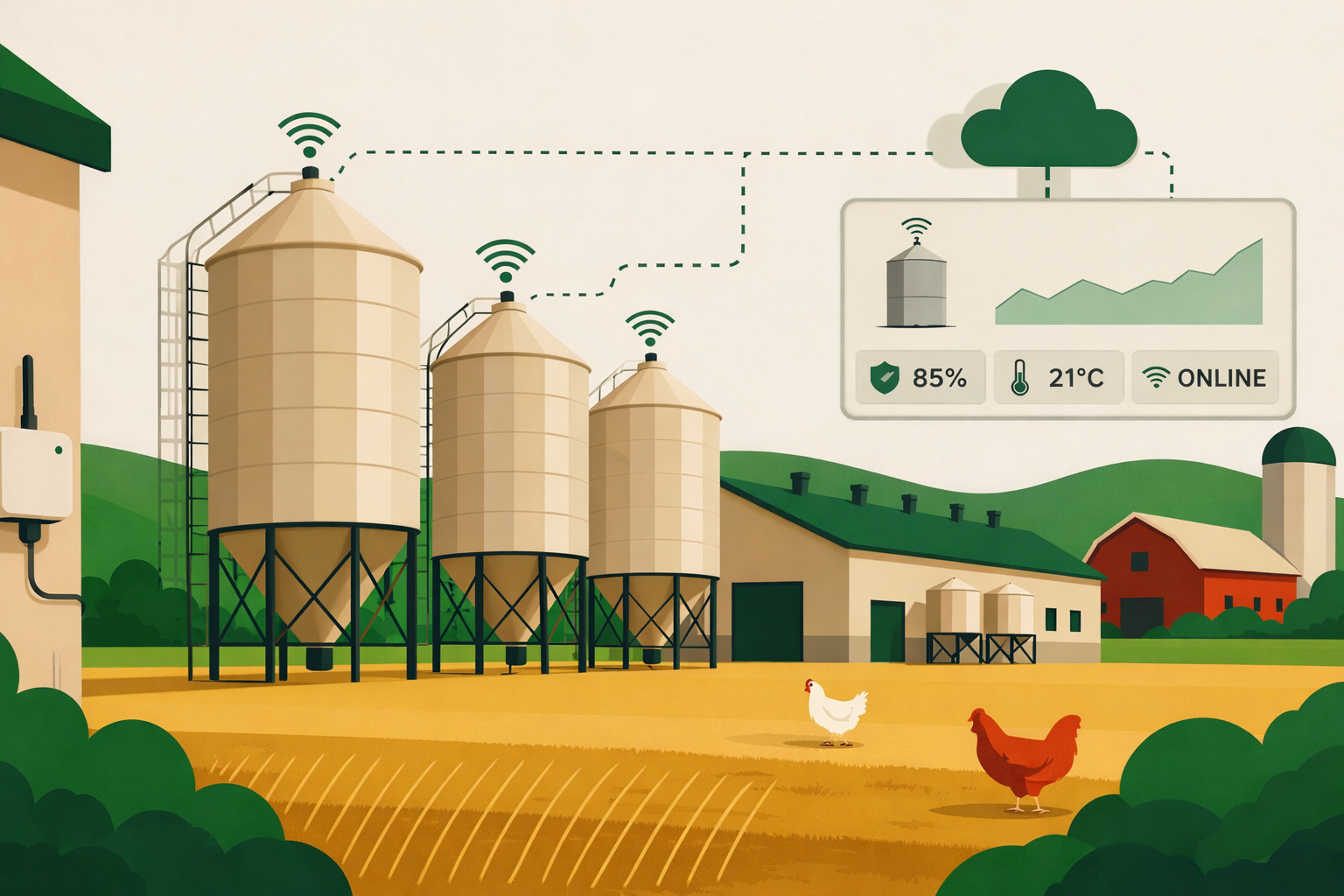
Artificial intelligence is not magic. It consists of computer programmes that learn from examples — just as a person learns to recognise that something smells off from repeated experience. A computer learns to recognise patterns (for example what a healthy flock sounds like versus a sick one) by analysing thousands of recordings or sensor readings. The more data, the more accurate the recognition.
Why does AI need data from the farm?
A computer programme can learn to recognise respiratory disease by sound — but only if someone first collected thousands of recordings of healthy and sick flocks and labelled which was which. On the farm this means that without regularly collecting data from sensors, cameras and flock records, no programme has anything to learn from or to analyse. Data is the foundation, not an option. More on flock monitoring in the guide on sensors and flock monitoring.
What works today and what is still in research?
Some AI solutions for poultry are already commercially available and operational on real farms — we describe these clearly as working. Others are at the research or pilot stage and may become widely available in a few years — we indicate these with the words "in research". We make no promises about things that do not yet exist.
What artificial intelligence is and what it needs
Three things to understand before you start looking for AI solutions for your farm.
AI is pattern recognition
Artificial intelligence learns what data looks or sounds like under normal conditions versus when something is wrong. Example: a programme listens to a flock for thousands of hours and then alerts when sounds start resembling recordings associated with reports of respiratory disease. It does not "think" — it recognises a pattern.
Without data, AI does not work
A programme can only recognise patterns in what has been measured and recorded. If a farm does not measure temperature, water consumption, feed levels or keep flock records — there is no data for AI to learn from or analyse. Data is the foundation, not an option.
AI is a support tool — not a replacement for the farmer
AI programmes give suggestions and alerts, but the farmer always makes the decision. No system will turn off the heating for you or call the vet — it sends an alert that you need to receive and assess. The best results come to farms that combine good data with the ability to respond quickly.
What AI does on a poultry farm
Four main application areas — for each we indicate whether the solution is already available or still in research.
Flock sound analysis (works today)
Microphones installed in the house record flock sounds around the clock. Software analyses the recordings and looks for patterns typical of coughing or changes in sounds associated with respiratory disease. When it detects an anomaly, it sends an alert to the farmer. Commercial systems of this type are already operating on broiler farms in Western Europe — mainly in large integrators. This is one of the more advanced and tested AI applications in poultry production.
Camera image analysis (partially available)
Cameras combined with software can track bird distribution and movement. The programme learns what uniform distribution of a healthy flock looks like versus clusters of birds (a signal of temperature or ventilation problems) or birds that are lame or stationary (a possible health issue). Some functions are already commercially available; others — particularly recognising lameness in individual birds — are still in the research and pilot phase. Related: early disease detection in poultry.
Feed and water consumption forecasting (in development)
Based on historical data from feed silo sensors and water flow meters, a programme can learn the typical consumption pattern for a given cycle and flock age. When consumption deviates from the pattern — rising too fast or falling — the system alerts the farmer. Solutions of this type are in the pilot and early commercialisation phase. Today you can collect this data with feed silo monitoring — the data you collect now will be the foundation for AI systems in the future.
Early disease detection from multiple sensors (in research)
The most advanced concept: combining data from temperature, humidity, CO₂, water and feed consumption sensors, and even sound and image, in a single system that detects disease earlier than any single measurement. Such systems exist as research projects and pilots on selected farms in Europe — but they are not yet available as a ready product for a typical farm. You build the foundation today by implementing sensor integrations.
No data, no AI — what to measure right now
To benefit from AI in the future — or for any system to give you useful suggestions today — the farm must regularly collect data. Here are the three types of data that matter most.
Environmental sensor data
Temperature, humidity, CO₂ and ammonia measured at regular intervals and recorded automatically. These are the data on which a programme can detect that conditions are deviating from normal before the farmer notices. The longer you collect, the better the patterns available for analysis. Details: sensors and flock monitoring.
Feed and water consumption data
Feed silo level sensors and water flow meters allow daily consumption to be tracked. Deviations from the typical pattern are often the first signal of a health problem — sick birds eat and drink less. This is one of the simplest and most reliable flock condition indicators available without cameras or microphones. More: feed silo monitoring.
Flock records — mortality, weight, observations
Sensor data is one thing, but a programme also needs to know what happened with the flock: when there was mortality, what the bird weights were, when the farmer observed symptoms and which ones. Keeping flock records is not bureaucracy — it is building a knowledge base on which any machine learning relies. Without this layer, sensor data is incomplete.
What AI cannot do and what to avoid
A few common beliefs about artificial intelligence that do not match how AI actually works on a farm.
Myth: "AI will know what to do on my farm by itself"
A programme does not know your farm unless someone collected and labelled data from your farm specifically. AI systems learn from data — the more your farm differs from those the system was trained on (different breed, different house, different climate), the less accurate its suggestions. AI deployment always requires a learning period on data from the specific farm.
Myth: "I will buy an AI system and no longer need to check the flock"
AI is a tool that supports observation — not replaces it. An alert from the system must be assessed, checked visually and acted upon. The system can be wrong (false alarm or a miss), and responsibility for the flock always rests with the farmer. Farms that achieve the best results with AI are those where the farmer treats alerts as a signal to check — not as a ready diagnosis.
Myth: "AI is for large farms — it does not apply to me"
The biggest barrier to AI on a farm is not size — it is lack of data. Farms that start measuring and recording temperature, feed and water consumption, and flock records today are better prepared for AI than large farms that do not. Scale helps but is not a prerequisite at the data collection stage.
Myth: "AI will detect disease without any sensors"
Sound analysis needs a microphone. Image analysis needs a camera. Feed consumption forecasting needs a silo level sensor. Every AI application depends on specific devices collecting data. Without physical sensors, there is nothing to analyse.
Frequently asked questions about AI on a poultry farm
What is artificial intelligence and how does it work on a poultry farm?add
Artificial intelligence consists of computer programmes that learn to recognise patterns from large datasets. On a poultry farm this can mean a programme listening to flock sounds (and learning to distinguish a healthy flock from a sick one), tracking camera footage, or analysing sensor data. The programme does not think — it recognises a pattern matching those it saw during training.
Can AI detect poultry disease earlier than a human?add
In the case of sound analysis — yes, to a degree. A system listening to a flock around the clock can notice a subtle change in sounds faster than a farmer visiting the house a few times a day. However, AI provides a warning signal, not a diagnosis — assessment and decisions always come from the farmer or vet. Sound analysis systems for poultry operate commercially on selected farms today; systems combining multiple data sources are in research.
What data do I need to collect for AI to work on my farm?add
The foundation is three types of data: environmental sensor data (temperature, humidity, CO₂), feed and water consumption data (silo level sensors, flow meters) and flock records (mortality, weights, farmer observations). The longer you collect and the more accurately you record, the more a system will have to analyse.
Is flock sound analysis already working or is it still the future?add
Sound analysis is one of the more advanced AI applications in poultry production that already works commercially — mainly in large integrators in Western Europe. Systems of this type analyse flock sounds around the clock and alert on changes characteristic of respiratory disease. Availability for a typical independent farm is limited and depends on the supplier.
Will AI replace the farmer and the vet?add
No. AI is a tool that supports observation and decisions — not replaces them. A programme sends an alert; the farmer assesses the situation and decides what to do. The vet makes a diagnosis. No existing system makes decisions autonomously in place of a human — and it should not, because the farmer is responsible for the flock.
Where do I start if I want to prepare my farm for AI?add
With collecting data. Implement temperature and humidity sensors, install feed silo level monitoring and keep regular flock records. These data are useful right now — they help you respond to deviations — and will be the foundation for AI systems when they become more widely available. You do not need to buy any AI system to start.
Sources & resources
- linkVranken E. et al. — A review of the Internet of Things for smart agriculture and precision poultry farming (2020), Biosystems Engineering
- linkVandermeulen J. et al. — Sound analysis to monitor poultry welfare (2016), Computers and Electronics in Agriculture
- linkAydin A. — Using 3D vision sensor technology and machine learning for lameness detection in broiler chickens (2017), Journal of Dairy & Poultry Research
Start collecting data from your farm today
Feed silo monitoring and environmental sensor integrations — data that is useful right now and that will prepare your farm for AI systems. Create a free account or write to us.
Phone
+48 796 258 151