Newcastle Disease (ND) — symptoms, reporting and control zones
Newcastle Disease (ND) is one of the most dangerous viral poultry diseases in the world. Learn how to recognise symptoms in your flock, how it differs from avian influenza, and what you must do if you suspect it.
verifiedFrom the team that has organised work on poultry farms for years.
What is Newcastle Disease?
Newcastle Disease (ND) is a highly contagious viral disease of poultry and many other bird species. It is caused by the Newcastle Disease Virus (NDV) of the family Paramyxoviridae — hence the alternative name paramyxovirus infection of poultry. ND is a notifiable disease in Poland, and farmers are required to report any suspicion to the Veterinary Inspection service. At the international level, ND must be notified to WOAH (formerly OIE).
How does the ND virus spread?
NDV is spread primarily by the airborne route (aerosols and dust from droppings and feathers), through direct contact with infected birds, and indirectly via contaminated equipment, clothing, vehicles and feed. Wild waterfowl and migratory birds — especially cormorants and gulls — can act as a reservoir and introduce the virus to a farm from outside. The virus can survive in the environment for several weeks at low temperatures.
Newcastle Disease symptoms in poultry
Symptoms depend on the virus pathotype (lentogenic, mesogenic, velogenic) and the bird species. In the velogenic form — the most dangerous, most commonly seen in epizootic outbreaks — the following signs are observed: a sudden drop in egg production, respiratory signs (coughing, rattling, laboured breathing), greenish diarrhoea, nervous signs (twisted neck — torticollis, trembling, wing and leg paralysis), swelling of the head and neck tissues, and sudden deaths. Mortality in an unvaccinated flock can reach 100%.
ND vs avian influenza (HPAI) — key differences
The symptoms of ND and HPAI (highly pathogenic avian influenza) can look very similar — both viruses cause mass mortality and nervous signs. The key difference is the causative agent: ND = paramyxovirus NDV, HPAI = influenza A virus (subtypes H5, H7). A definitive distinction requires laboratory testing (PCR). If either disease is suspected, the farmer’s response is identical: immediately notify the district veterinary officer and halt all flock movements. Read more: Avian influenza (HPAI) and Farm biosecurity.
Mandatory reporting and ND control zones
Any suspicion of Newcastle Disease must be reported immediately to the district veterinary officer (PLW). Once an outbreak is confirmed, the competent authority establishes a protection zone and a surveillance zone around the farm. In these zones, movement of poultry and hatching eggs is banned, enhanced biosecurity is mandatory, and flocks must be tested. Zone dimensions derive from Commission Implementing Regulation (EU) 2021/605 and decisions of the Chief Veterinary Officer. Current ND outbreaks: ND Outbreak Map.
Newcastle Disease symptoms in a poultry flock
Symptoms can appear suddenly and escalate within 24–48 hours. Any deviation from normal flock behaviour should be treated as an alarm signal.
Sudden drop in egg production
Hens stop laying or production falls by 50–100% within 1–2 days. Eggs may be misshapen, soft-shelled or shell-less. This is often the first sign of ND in a laying flock.
Respiratory signs
Coughing, rattling, wheezing, laboured breathing. Birds stand with beaks open and breathe with effort. Respiratory signs are especially pronounced in broiler chicks and turkeys.
Diarrhoea (green)
Watery, greenish or yellowish diarrhoea resulting from intestinal damage caused by the virus. Accompanied by rapid dehydration and weakening of the flock.
Nervous signs
Twisted neck (torticollis), muscle tremors, paralysis of wings and legs, circling movements. Nervous signs are characteristic of the velogenic form and indicate involvement of the central nervous system.
Head and neck swelling
Cyanosis and swelling of the tissues around the eyes, head and neck. Nasal and ocular discharge may accompany this. Especially visible in turkeys and waterfowl.
Mass mortality
Mortality can reach 100% in unvaccinated birds infected with a velogenic strain. Deaths can precede the appearance of obvious clinical signs.
How to protect your flock from Newcastle Disease
Biosecurity and vaccination are the two pillars of ND protection. Neither method gives 100% assurance without the other.
Protective vaccination
Vaccination is the most effective way to reduce losses when the flock is exposed to the virus. In Poland, both live and inactivated vaccines authorised by a veterinarian are available. Read more: Vaccination against ND.
Biosecurity — physical barrier
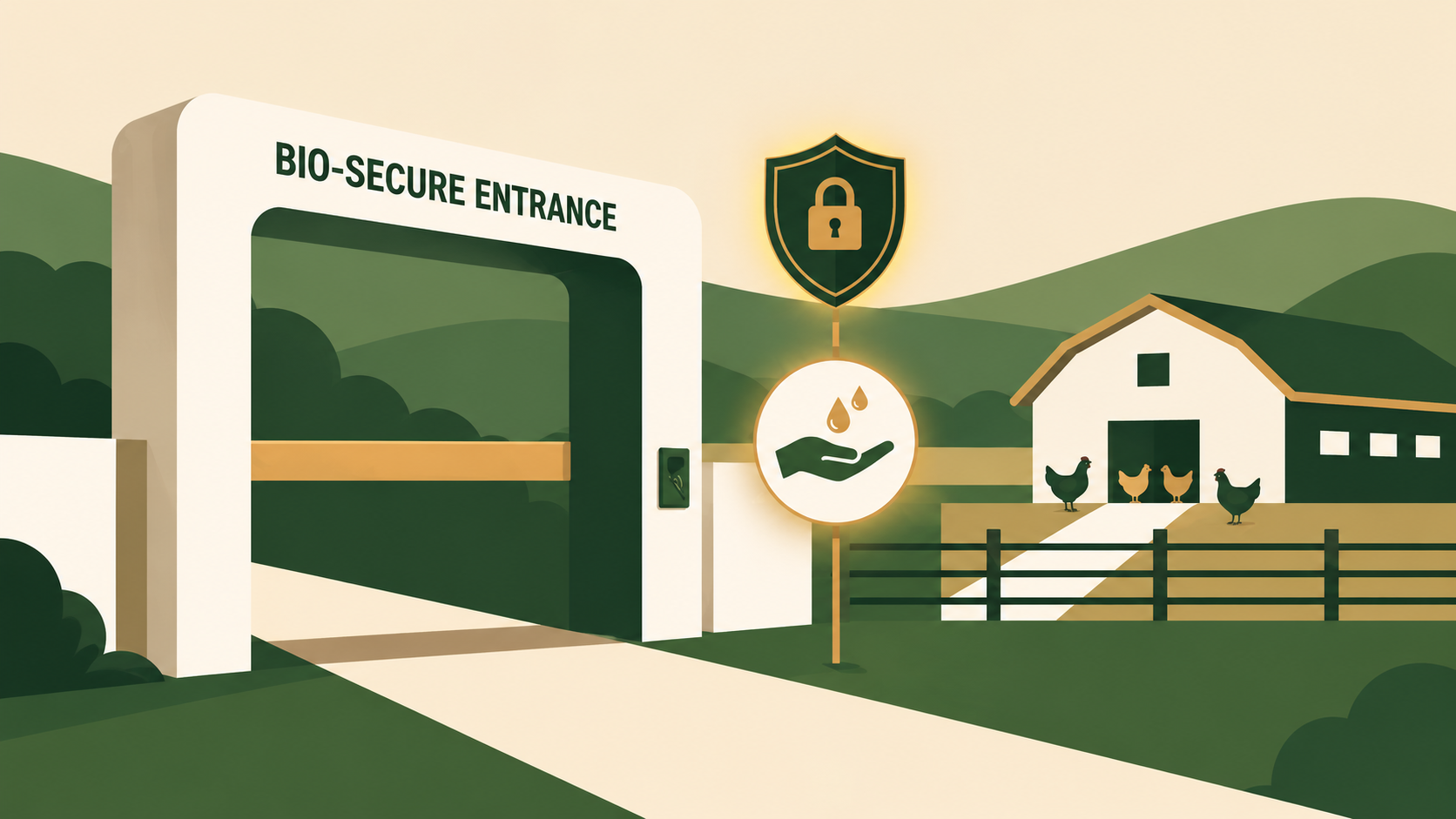
Preventing wild birds from entering poultry houses (mesh on ventilation openings), disinfecting entry points, changing clothing, and controlling access. NDV is inactivated by disinfectants based on formaldehyde, hypochlorites and quaternary ammonium compounds.
Transport and equipment control
Vehicles entering the farm must have wheels and cabs disinfected. Crates, cages and other equipment used with birds must be decontaminated between flocks. This is critical when serving multiple farms.
Quarantine of new birds
Every new batch of poultry must be isolated for a minimum of 21 days. During this period, watch for signs of disease. This also applies to birds returning from markets, shows and other farms.
Frequently asked questions about Newcastle Disease (ND)
What is Newcastle Disease (ND)?add
Newcastle Disease (ND) is a highly contagious paramyxovirus infection of poultry caused by NDV. It presents with respiratory, nervous and digestive signs and can cause mass mortality. ND is a notifiable disease in Poland and worldwide.
How does ND differ from avian influenza (HPAI)?add
Both diseases can produce similar signs — mass deaths, respiratory distress and nervous disorders. They differ in the causative agent: ND is caused by paramyxovirus NDV, HPAI by influenza A virus (H5/H7). A definitive distinction requires a PCR test at a veterinary laboratory.
What are the first symptoms of ND in hens?add
The earliest signs are a sudden drop in egg production, coughing, rattling and lethargy. Within 24–48 hours, green diarrhoea, nervous signs (twisted neck, trembling) and mass deaths may appear. Any rapid deterioration in flock condition requires immediate contact with a veterinarian.
Is ND dangerous for humans?add
NDV poses no serious risk to humans. Occasionally it can cause conjunctivitis (avoid touching your eyes after contact with sick birds), but it does not cause severe illness in healthy adults. It is not a zoonotic disease of epidemic significance for humans.
What should I do if I suspect ND on my farm?add
Immediately notify your district veterinary officer (PLW). Halt all movement of birds, eggs and people to and from the farm. Do not remove dead birds until the Inspection arrives. Isolate the affected flock. Failure to report is an offence.
Where can I check current ND outbreaks in Poland?add
Current Newcastle Disease outbreaks in Poland are published by the Chief Veterinary Inspectorate (GIW) and on the DlaFerm.pl map at /mapa/nd. Data is updated as each outbreak is confirmed.
Sources & resources
Protect your flock with DlaFerm.pl
Want to see the live ND outbreak map or have a question about farm biosecurity? Write to us.
Phone
+48 796 258 151