Poultry farm disease prevention programme — 5 pillars
Prevention is cheaper and more effective than treatment. A good prevention programme is not a one-off action but a permanent system built on five pillars: biosecurity, vaccination, nutrition, monitoring and documentation.
verifiedFrom the team that has organised work on poultry farms for years.
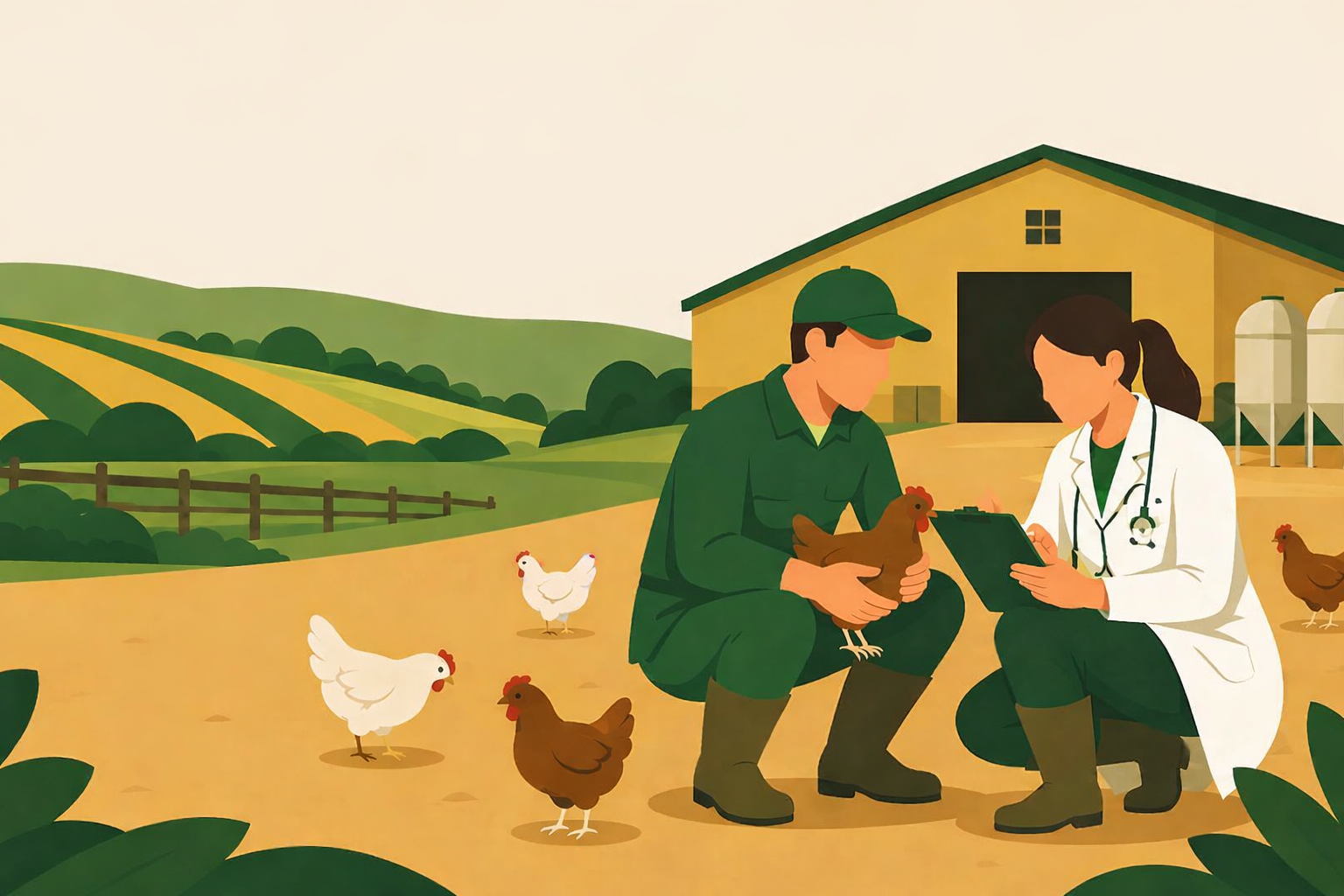
On a poultry farm, disease can destroy an entire production cycle in a matter of days. Treatment is costly, requires drug withdrawal periods, and comes with mortality losses. That is why farmers focused on results invest in prevention — actions that keep disease out or catch it so early it does not spread through the flock.
Why is prevention cheaper than treatment?
The cost of a vaccine or a sound biosecurity programme is a fraction of the cost of medication, mortality losses, reduced growth and sales problems. A prevention programme is drawn up with the farm veterinarian — they know the local disease risks and can tailor the plan to the specific species and conditions. The programme should be reviewed after each production cycle.
Five pillars are a system, not a to-do list
Each pillar reinforces the others. The best vaccine is useless if pathogens enter through weak biosecurity. The best biosecurity cannot replace monitoring that catches disease before it spreads. All five must work simultaneously.
Production and health monitoring — 5 pillars of disease prevention
Each pillar plays a distinct role in protecting the flock. Together they form a system that works at farm level, not just for individual birds.
Pillar 1: Biosecurity — the clean-dirty boundary
Biosecurity covers all actions that block pathogens from entering the farm or moving between sections. In practice: a clear boundary between clean and dirty zones, a sanitary lock at the hall entrance (clothing and footwear change, hand disinfection), vehicle and delivery control, pest control (rodents carry pathogens), and restricting access by outsiders. See the guide on poultry farm biosecurity for details.
Pillar 2: Vaccination — a plan agreed with the vet
A vaccination plan is the primary tool for protecting against viruses that cannot be treated — only prevented. The plan should account for regional threats (e.g. Newcastle disease, Gumboro disease, infectious bronchitis, avian influenza) and be agreed with the farm vet. A vaccine only works when given correctly, at the right time and by the right method (water, spray, eye drops). See the guide on poultry vaccination against avian influenza.
Pillar 3: Feed and water — healthy gut means immunity
A bird receiving quality feed matched to its age and species, plus clean uncontaminated water, is naturally more resistant to disease. The gut is the centre of poultry immunity — nutritional disturbances (poor feed quality, contaminated water, deficiencies) weaken the gut barrier and make infections easier. Regularly testing water and feed for bacteria, mould and mycotoxins is worthwhile. Water consumption details are in the guide on broiler water consumption.
Pillar 4: Monitoring — watching birds and numbers every day
Monitoring means daily observation of the flock and tracking key figures: mortality, feed and water consumption, body weight and flock uniformity, bird behaviour. A sudden drop in water consumption — particularly a decrease — is often the first disease signal before visible symptoms appear. Regular weighing and comparison with the growth curve for the genetic line is equally important. Digital monitoring tools are described in the guide on digital broiler flock record.
Pillar 5: Documentation — record everything to spot trends
Documentation means recording everything that happens in the flock: treatments, vaccinations, mortality, environmental conditions (temperature, ventilation), weighing results, feed and veterinary product deliveries. Why? To see trends and react early — if mortality rises in week three every cycle, you can only see that in records. Documentation is also a legal requirement (treatment records, drug withdrawal periods). Details in the guide on treatment records and withdrawal periods.
What to monitor daily and what to do with it
Daily monitoring is not a complex procedure — it is a few simple observations made at a set time. Below are the most important indicators.
Water consumption — the first disease signal
Birds drink a lot and regularly — a healthy broiler consumes roughly 1.5–2 times more water than feed (the water-to-feed ratio increases with age). A drop in water consumption of 10–15% with no obvious cause (e.g. temperature change) is an alarm signal. A rise can also indicate a problem — for example excessively high temperature or kidney disease. A water meter at each hall entrance is one of the simplest and cheapest early warning systems.
Mortality — collect and count daily
Some mortality in a production cycle is unavoidable, but it should remain at a steady, low level. A sudden rise in mortality — especially if the birds show similar signs — is a reason to contact the farm vet immediately. Collect dead birds daily at a set time and record the count. Total mortality across the cycle for broilers is indicatively below 3–4% (depending on genetics and conditions).
Weighing and flock uniformity
Regular weighing (weekly or fortnightly) allows actual growth to be compared with the growth curve for the genetic line. Flock uniformity (how much birds differ in weight) is an indicator of feeding quality and environmental conditions. Large weight differences within a flock can signal problems with feed access, disease, or poor conditions in part of the hall.
The most common mistakes in prevention programmes
A few mistakes that stop a prevention programme from working as it should.
Programme without the vet
A prevention programme drawn up without a vet is a programme without a disease risk assessment. The vet knows the local disease situation, can order tests, and will select the right vaccines. The farmer alone cannot make that assessment. A vaccination plan not tailored to local threats may protect against what does not threaten the farm while missing what actually does.
Biosecurity only on paper
Beautifully written procedures that nobody follows in practice do not protect the flock. Entering the hall without changing footwear even occasionally is enough for pathogens to find their way to the birds. Biosecurity must be a habit — daily, unchanging, followed by everyone who enters the farm.
Reacting only when mortality is already high
Disease usually gives signals before birds start dying — changes in flock behaviour, a drop in water or feed consumption, changes in droppings. A farmer who acts only when symptoms are visible and mortality is already high loses time that could have been used for effective treatment or limiting spread.
Documentation only for inspections, not for yourself
Records treated as a regulatory requirement are filled in carelessly and bring no benefit to the farmer. Yet it is precisely regular and accurate records that reveal patterns — for example that mortality always rises in week three, or that results are poorer after a particular chick supplier or season. These patterns are invisible without data.
Frequently asked questions about poultry farm prevention programmes
What is a prevention programme on a poultry farm?add
It is a planned set of actions designed to prevent disease or catch it at a very early stage. The programme covers biosecurity, a vaccination plan, feeding and watering rules, daily flock observation (monitoring) and record-keeping. It is drawn up with the farm vet and reviewed after each production cycle.
Is a prevention programme required by law?add
Some elements of the programme are legally mandatory — for example, treatment records and compliance with drug withdrawal periods. Certain biosecurity and monitoring requirements for poultry also apply under animal disease legislation. Moreover, EU Regulation 2019/6 (in force since 28 January 2022) bans the routine, preventive use of antibiotics — an antibiotic must not compensate for poor housing, hygiene or management. That is a further reason to build the farm on biosecurity, welfare, vaccination and good management rather than on a routine medicine. Voluntarily implementing a full prevention programme is, above all, in the farmer's own interest — it reduces costs and improves results.
How often should the prevention programme be updated?add
At least once a year or after each production cycle — especially if the regional disease situation has changed (new outbreaks), the chick supplier has changed, the genetic line is different, or production results have shifted. The vet should be informed of any significant change on the farm and adjust the plan accordingly.
How do I know if monitoring is working?add
Monitoring is working when you catch changes in the flock before visible disease signs appear — for example when you notice a drop in water consumption of around ten per cent and act before birds start dying. A good test is keeping an observation log and regularly comparing current indicators (mortality, water, feed, weight) with previous cycles and standards for the genetic line.
What should I do if disease appears despite a good prevention programme?add
Contact the farm vet immediately and review all elements of the programme together — whether biosecurity is really being followed, whether vaccines are being given correctly, whether new threats have emerged in the region. Sometimes disease occurs despite a good programme because environmental stressors (heat stress, poor ventilation) weaken bird immunity and reduce vaccine efficacy.
Must documentation be kept in paper form?add
The regulations do not prescribe a specific format — paper or electronic is acceptable as long as it is legible and contains the required information (e.g. treatment details, veterinary product, dose and withdrawal period). Electronic flock records — such as those available in DlaFerm.pl — make trend analysis easier and are always at hand, but the choice of format is up to the farmer.
Run your prevention programme in DlaFerm.pl
Want to track mortality, water consumption, vaccinations and flock records in one place? Create a free farm account or write to us.
Phone
+48 796 258 151