Poultry welfare payments: the ARiMR eco-scheme step by step
Welfare payments for poultry compensate farmers who go beyond minimum standards — lower stocking density, litter access and other requirements. Find out who can apply, what variants exist for broilers and laying hens, and what records you must keep.
verifiedFrom the team that has organised work on poultry farms for years.
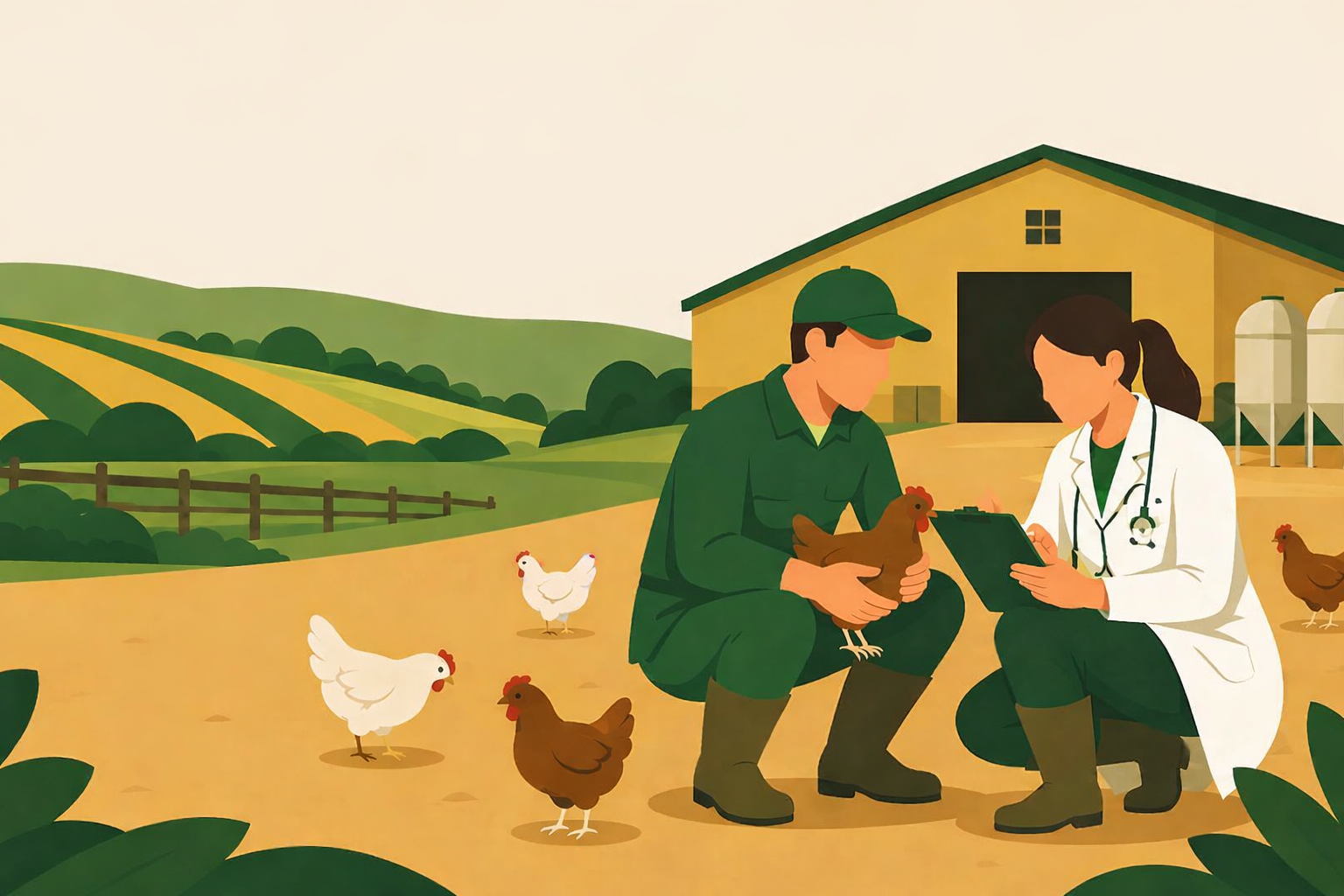
What is a welfare payment for poultry?
A welfare payment for poultry is financial support paid to farmers who voluntarily commit to keeping birds to higher standards than the legal minimum. In Poland this mechanism operates under the Strategic Plan for the Common Agricultural Policy (CAP) 2023–2027, implemented by the Agency for Restructuring and Modernisation of Agriculture (ARiMR). Specific rates and conditions can change each year — always check the current information on the ARiMR website.
Who can apply for a welfare payment?
Any farmer engaged in agricultural activity who keeps poultry — broiler chickens or laying hens — and meets the requirements of the chosen eco-scheme variant can apply. The farmer must be registered in the ARiMR animal identification and registration (IRZ) system and hold a producer identification number. The application is submitted annually as part of the direct payment application (area application) through the eWniosekPlus app.
Eco-scheme variants for poultry
The CAP Strategic Plan includes welfare variants specifically for poultry — separate for broiler chickens and laying hens. Each variant specifies concrete requirements covering maximum stocking density (birds per m² of usable floor area), access to litter, environmental enrichment (e.g. perches, windows) or access to outdoor space. The requirements go beyond Council Directive 2007/43/EC (for broilers) and applicable rules for laying hens. Detailed variant descriptions and current rates are published by ARiMR — check them before applying, as they may change. Indicative rates for 2026 (always check the current terms with ARiMR): about PLN 14.15 per bird for laying hens (stocking up to 7 birds/m² and access to perches), about PLN 0.2 per bird for broilers (up to 30 kg/m² and at least 6 hours of darkness per day), and about PLN 3.0 per bird for turkeys (up to 50 kg/m² and at least 8 hours of darkness).
When and how to submit the application?
The welfare declaration is submitted as part of the area application to ARiMR — usually between March and May each year (the exact deadline is set by the minister responsible for agriculture). The application is completed in the eWniosekPlus app available on the ARiMR website. The farmer declares the species, number of birds and the welfare variant they commit to. Late submission results in a reduction or loss of payment.
Record-keeping and documentation obligations
A farmer participating in the welfare payment must maintain compliance with the variant conditions throughout the year and keep the required documentation. This includes: flock records (stocking density, placements, slaughter, mortality), veterinary treatment and withdrawal documentation, confirmation of environmental parameters (where required) and a welfare improvement plan (if required by the variant). Some of these data are also required by the IRZplus poultry system. DlaFerm.pl allows you to keep flock records and veterinary documentation in one place — making it easier to prepare for inspections.
Welfare can be measured
Poultry welfare is not just a feeling — it is a set of numbers that can be recorded and presented at an inspection. The most important indicators include: gait score, which shows how freely birds move; footpad dermatitis (FPD), the degree of damage to toe pads caused by wet litter; hock burn, resulting from prolonged contact with poor-quality litter; and stocking density, measured in kilograms per square metre. Each parameter describes a specific aspect of housing conditions and appears in inspection documents. For detailed scoring scales and measurement methods, see the pages on individual welfare indicators — what matters here is that these are numbers, not opinions.
Key requirements of poultry welfare variants
Requirements differ by species and chosen variant — below are the most common elements a farmer must maintain throughout the year of commitment.
Reduced stocking density
Every poultry welfare variant requires maintaining a lower stocking density than national law permits. The exact threshold (in kg/m² or birds/m²) is set out in the variant description — verify the current value with ARiMR before committing.
Access to litter
Birds must have permanent access to dry, loose litter covering the entire usable floor area. Litter must be regularly topped up and replaced to meet welfare requirements. For litter management guidance see: Litter management in the poultry house.
Environmental enrichment
Depending on the variant, requirements may include perches, platforms, pecking objects or natural daylight. Lighting requirements — including the duration of the light cycle — must be maintained and may be inspected. More: Broiler lighting programme.
Flock registration and records
The farmer must continuously update flock records in the IRZplus system. These data (placements, slaughter, mortality, flock count) are the basis for stocking density verification during ARiMR inspections. Related guide: Flock records / IRZplus.
Welfare improvement plan
Some variants require a document describing the steps the farmer is taking to improve bird living conditions. The document must be current and available for inspection on demand.
ARiMR checks and inspections
ARiMR carries out administrative checks (verification of submitted data) and on-site inspections (farm visits). Identified irregularities may result in reduction or repayment of the welfare payment. Keep your documentation up to date throughout the year of commitment.
How to manage welfare documentation in practice
Good documentation is essential in the event of an inspection — here are four areas to focus on throughout the year.
Stocking density and flock movement records
Record every placement, slaughter, sale and mortality in real time. DlaFerm.pl organises these data to IRZplus requirements and, if you want, sends the flock-status reports to IRZplus for you automatically — and lets you check the current stocking density and cycle history at any moment.
Treatment and withdrawal documentation
Every drug administration — dose, withdrawal period, end date — must be recorded. ARiMR inspectors may request these records when verifying welfare conditions.
Environmental parameters and lighting
If the variant requires a specific light cycle or temperature, keep a log of these parameters. A lighting programme aligned with the chosen variant makes it easier to stay compliant throughout the cycle.
Inspection readiness
All documents (flock records, veterinary documentation, welfare improvement plan) should be accessible in one place — preferably in digital form. DlaFerm.pl collects this data and allows it to be exported to show the inspector.
Frequently asked questions about poultry welfare payments
What is the poultry welfare eco-scheme?add
The poultry welfare eco-scheme is a voluntary commitment by the farmer to keep birds in conditions better than the legal minimum, for which ARiMR pays an annual welfare payment. It covers lower stocking density, access to litter and environmental enrichment. The conditions and rates are set under the CAP Strategic Plan.
How much is the poultry welfare payment?add
Rates change each year and are set by the Ministry of Agriculture and Rural Development — always confirm the current amounts with ARiMR. As an indication for 2026, figures of about PLN 14.15 per bird are quoted for laying hens (stocking up to 7 birds/m² and access to perches), about PLN 0.2 per bird for broilers (up to 30 kg/m² and at least 6 hours of darkness per day) and about PLN 3.0 per bird for turkeys (up to 50 kg/m² and at least 8 hours of darkness). Treat these as indicative — check the exact conditions and rates directly on the ARiMR website.
Do I need to submit a separate application for the welfare payment?add
No — the declaration to participate in the welfare eco-scheme is part of the annual area application submitted through eWniosekPlus. The area application is usually submitted between March and May. Late submission results in a reduction of the payment.
Does the payment apply to both broilers and laying hens?add
Yes — the CAP Strategic Plan provides variants for both broiler chickens and laying hens (including floor-housed hens). Each species and housing system has separately defined requirements. See the ARiMR website for details.
What records must I have ready for an ARiMR inspection?add
For an inspection you should have: flock records (placements, slaughter, mortality, current count), veterinary treatment documentation, evidence that environmental requirements are met (e.g. light cycle, stocking density) and — if required — a welfare improvement plan. DlaFerm.pl lets you collect and export all of this data.
How does DlaFerm.pl help with welfare requirements?add
DlaFerm.pl lets you keep flock records, register treatments and withdrawal periods, and monitor current stocking density — and if you want, it sends the flock-status reports to IRZplus for you automatically. This means you have inspection-ready documentation to hand and can continuously verify that you are meeting the conditions of your chosen welfare variant.
Do I need to measure gait score and FPD to receive the welfare payment?add
The eco-scheme requirements do not oblige farmers to measure gait score or FPD themselves — these indicators are primarily used by the industry and inspectors to assess flock-level bird condition. However, they are indirectly linked to the conditions you must meet: correct stocking density and dry litter are the same factors that limit footpad damage and walking problems. By keeping stocking density records and logging litter condition, you have evidence at an inspection that conditions were appropriate.
Sources & resources
- linkARiMR — eco-schemes and welfare payments (CAP Strategic Plan)
- linkMinistry of Agriculture and Rural Development — CAP Strategic Plan 2023–2027
- linkEURCAW-Poultry — European Reference Centre for Animal Welfare for Poultry (materials also in Polish)
- linkCouncil Directive 2007/43/EC — minimum standards for the protection of chickens kept for meat production
- linkGov.pl — eWniosekPlus: application for direct payments
Manage your welfare documentation with DlaFerm.pl
Have a question about flock records or want to see how DlaFerm.pl supports welfare compliance? Write to us.
Phone
+48 796 258 151