Farm management system vs sensors only — what you really need
Sensors measure. A management system understands. These are not the same — but each loses part of its value without the other. In this article we honestly explain what sensors alone give you, what a management system adds, and when it is really worth connecting them.
verifiedFrom the team that has organised work on poultry farms for years.
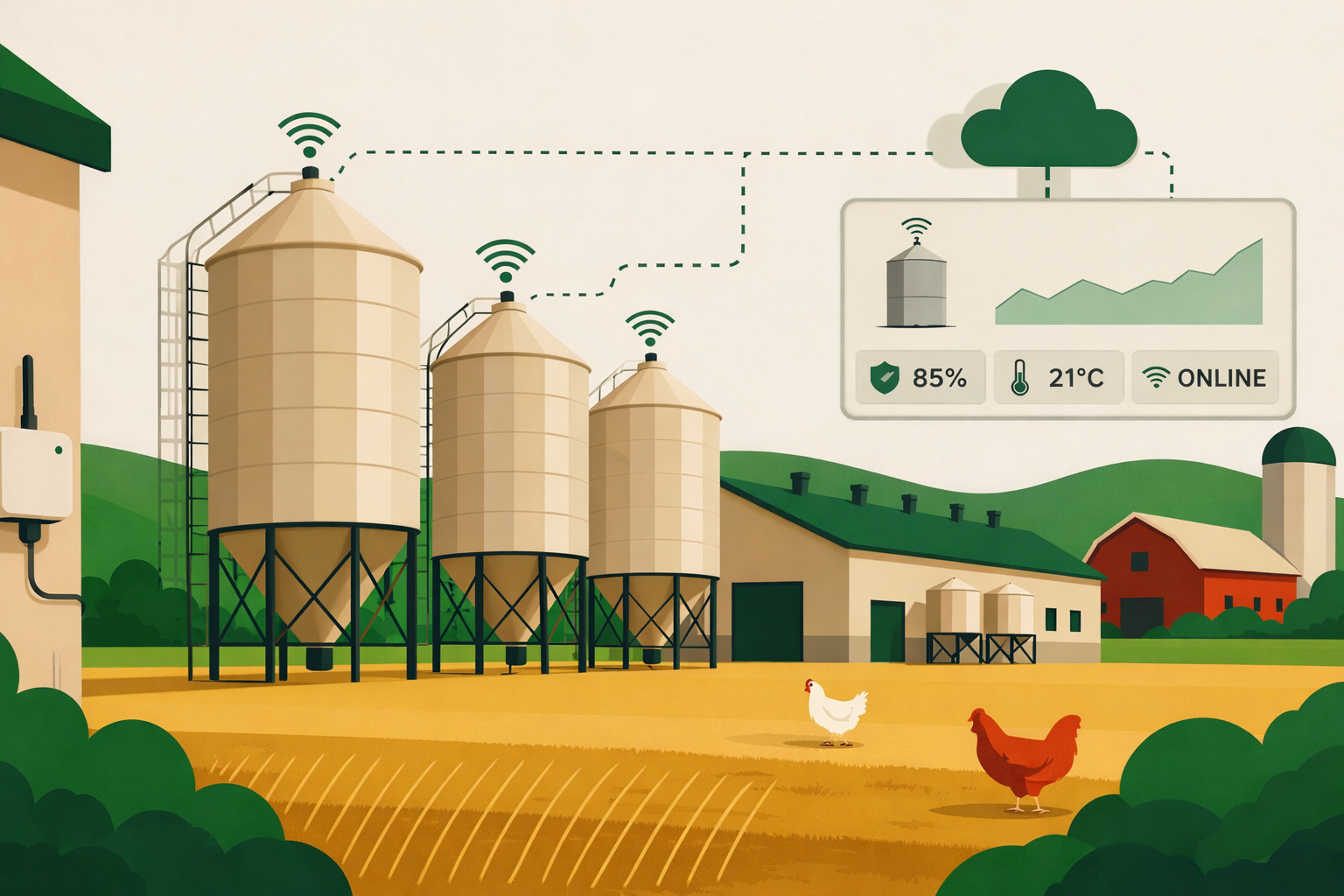
More and more farms have sensors — house temperature, silo fill level, water consumption. This is a positive development: sensors warn about problems and allow faster response. But farmers often ask: is a sensor alone enough, or do I also need some kind of management system? The answer depends on the scale of the farm and what you want to do with the data.
What is the difference between a sensor and a management system?
A sensor is a device that measures one thing — temperature, feed level, humidity — and sends a reading. On its own it does not know how many birds you have, how many have died, how old the flock is or what your contracts with the integrator say. A farm management system is software that collects sensor data and links it to the flock record, treatment log, feed consumption, settlement records and alerts — in one place. This gives the measurement meaning: not just "temperature is 32°C" but "temperature is 32°C, the flock is 18 days old, water consumption is falling — this may be a health issue." You can read more about what a management system does in practice in the article poultry farm management software.
Where do the conclusions in this article come from?
The article is based on experiences of farmers who use both standalone sensors and integrated systems, as well as on documented features of farm management systems. There is no single right answer for everyone — we aim to show when each option makes sense.
What sensors alone give you — and where they fall short
Sensors are a valuable tool. It is worth knowing what they are genuinely good for and where their capabilities end without a management system to support them.
Live reading and threshold alerts
This is the greatest strength of a standalone sensor. If the house temperature drops below 20°C in the middle of the night, the sensor sends an alert to your phone — before you walk in the next morning and find losses. Similarly, a silo fill sensor warns you that, for example, 20% remains — you have time to order a delivery. This is real value, independent of any management system. More on silo monitoring in the article feed silo monitoring.
Data scattered across separate apps from different manufacturers
A temperature sensor from one brand, a feed sensor from another, a climate controller from a third — each has its own app. To see the full picture of the day, you have to check several places. This is inconvenient and easy to miss something. Sensors on their own do not talk to each other or to the flock record.
No flock or production context
A sensor knows that water consumption today is 10% lower than yesterday. But it does not know that the flock is 21 days old and has just passed the peak water consumption growth phase — and that this may be normal. A management system links the reading to flock age, headcount and batch history to assess whether a deviation is a problem.
No records, settlement calculations or cross-batch history
Standalone sensors do not keep treatment records, do not count mortality, do not remember feed consumption per batch, and do not show trends from previous production cycles. If you want to compare whether the spring batch is doing better than the winter one, you have to do it manually in a spreadsheet.
What a farm management system adds
A management system is the "brain" that understands sensor data in the context of production. Here is what it specifically brings to farm operations.
One view of all data — sensors, flock, settlements
A management system collects sensor data and links it to the flock record, treatment log, feed consumption and settlement calculations. Instead of three apps you have one screen. You see simultaneously that temperature is normal, the flock is 28 days old, water consumption is falling and the previous batch had a similar issue at the same stage — that is the context that allows you to make a decision. And the flock-change reports to IRZplus the system can file for you — automatically and optionally, if you want, with no logging into the ARiMR portal. Details on sensor integrations in the article IRZ+ and sensor integrations.
History and trends across batches
The system remembers every production cycle: feed consumption, mortality, final results, house conditions. You can compare batch to batch and see whether any change — chick supplier, feeding programme, temperature — affected results. Without this, history stays in the farmer's head or scattered across spreadsheets.
Alerts in flock context, not just raw thresholds
A good management system can warn not only "temperature dropped below threshold" but also "water consumption is 15% lower than expected for a flock of this age" — because it knows the age and size of the flock. This is the difference between an alert that is always the same and one that takes into account what is happening with a specific flock.
Sensors and system together — senses and brain
Sensors are the farm's senses: they supply raw data. The system is the brain: it understands the data and prompts action. Together they form a whole that is more than the sum of its parts.
The sensor supplies numbers; the system gives them meaning
The sensor says: "water consumption is 80 litres per hour." The system says: "for a flock of 18,000 birds aged 22 days this is 12% too low — in the last batch a similar drop preceded a health problem 2 days later." That is the value of the combination. This is why sensors and a management system work best together. Details on flock monitoring in the article poultry flock sensors and monitoring.
Sensor data flows automatically into the flock record
Instead of manually transcribing readings, the system pulls data from sensors and appends it to the batch record automatically. This saves time and eliminates transcription errors. With a large number of batches and houses this makes a real difference in the daily work of the farmer or production manager.
The climate controller as both sensor and part of the system
A house climate controller is itself a combination of sensor and regulator. A good management system retrieves data from the controller and shows the history of temperature, humidity and ventilation in the context of the full batch — not just the last few hours. More on controllers in the article climate controllers in poultry houses.
Common misconceptions when choosing between sensors and a management system
A few beliefs worth re-examining before you make an investment decision.
Belief: "I have sensors, so I have monitoring"
Sensors are one monitoring tool — but farm monitoring is more than a temperature reading and alerts. Full monitoring also includes feed consumption, water, mortality and flock results over time. A measuring device alone does not provide this.
Belief: "a management system will replace sensors"
It works the other way around: a management system does not replace sensors — it needs them. Without automatic sensor readings, the system relies on manual data entry by the farmer, which is tedious and error-prone. Sensors and a management system are complementary tools, not alternatives.
When sensors alone genuinely suffice
On a very small farm with one or two houses, where the farmer is always close by and keeps simplified records, a sensor network with an alert app may be sufficient. Investment in a full management system starts to pay off at a larger scale, with multiple data sources and a need to analyse results across batches.
Buying sensors without a plan for the data
There are farms with sensors whose data nobody reads — because it goes to an app the farmer checks once a month. Before you invest in sensors, it is worth knowing who will read the data, how often and what they will do when an alert appears. A sensor without a response procedure is an expense without a return.
Frequently asked questions about sensors and farm management systems
Is a sensor network alone enough to manage a poultry farm?add
On a small farm with one or two houses it may be enough, if the farmer actively monitors alerts and keeps records manually. At a larger scale, with multiple data sources and a need to track results across batches, sensors alone are no longer sufficient — flock context, history and links to settlement records are missing.
What is a farm management system and how is it different from a sensor app?add
A sensor app shows readings and alerts from one device or one brand. A farm management system is software that collects data from many sources — sensors, controllers, manual entries — and links it to the flock record, treatment log, feed consumption and settlements. It gives a complete picture of the batch in one place, rather than several separate apps.
Do poultry house temperature sensors require a management system?add
No — a sensor works on its own and sends alerts regardless of whether you have a management system. But temperature sensor data gains value when the system links it to flock age and the history of previous batches: then you see not just the current temperature, but whether it is appropriate for the current stage of rearing.
Does a management system replace a climate controller?add
No. The climate controller regulates temperature, ventilation and humidity in the house — it is a separate device. A management system can pull data from the controller and display it in the context of the full batch, but it does not replace the controller as a device that controls house conditions.
What does sensor integration with a management system look like in practice?add
In practice it means the management system automatically pulls readings from sensors — temperature, silo fill level, water consumption — and attaches them to the batch record. No manual transcription needed. The method of integration depends on the type of sensor and system; some use standard protocols (e.g. LoRaWAN), others use direct manufacturer connections. Details on integrations in the article IRZ+ and sensor integrations.
Is it worth investing in a management system on a small farm?add
It depends on the number of houses, the number of batches per year and how much time manual records and settlements take you. If you have one house and simple production, a sensor network with alerts may be enough. If you have several houses, multiple employees and integrator contracts requiring documentation, a management system will pay back faster through time savings and better results control.
Sources & resources
Connect your sensors with a management system in DlaFerm.pl
Want to see how integrating temperature sensors, silos and a climate controller looks in practice? Create a free farm account or write to us.
Phone
+48 796 258 151