Turkey house requirements — equipment and microclimate
A turkey is a heavy bird that spends many weeks in the house — the building must give it strong ventilation, dry litter underfoot, water and feed at an adjustable height, and a warm start. We have gathered everything a turkey house must provide in one place, with links to detailed guides for the specifics.
verifiedFrom the team that has organised work on poultry farms for years.
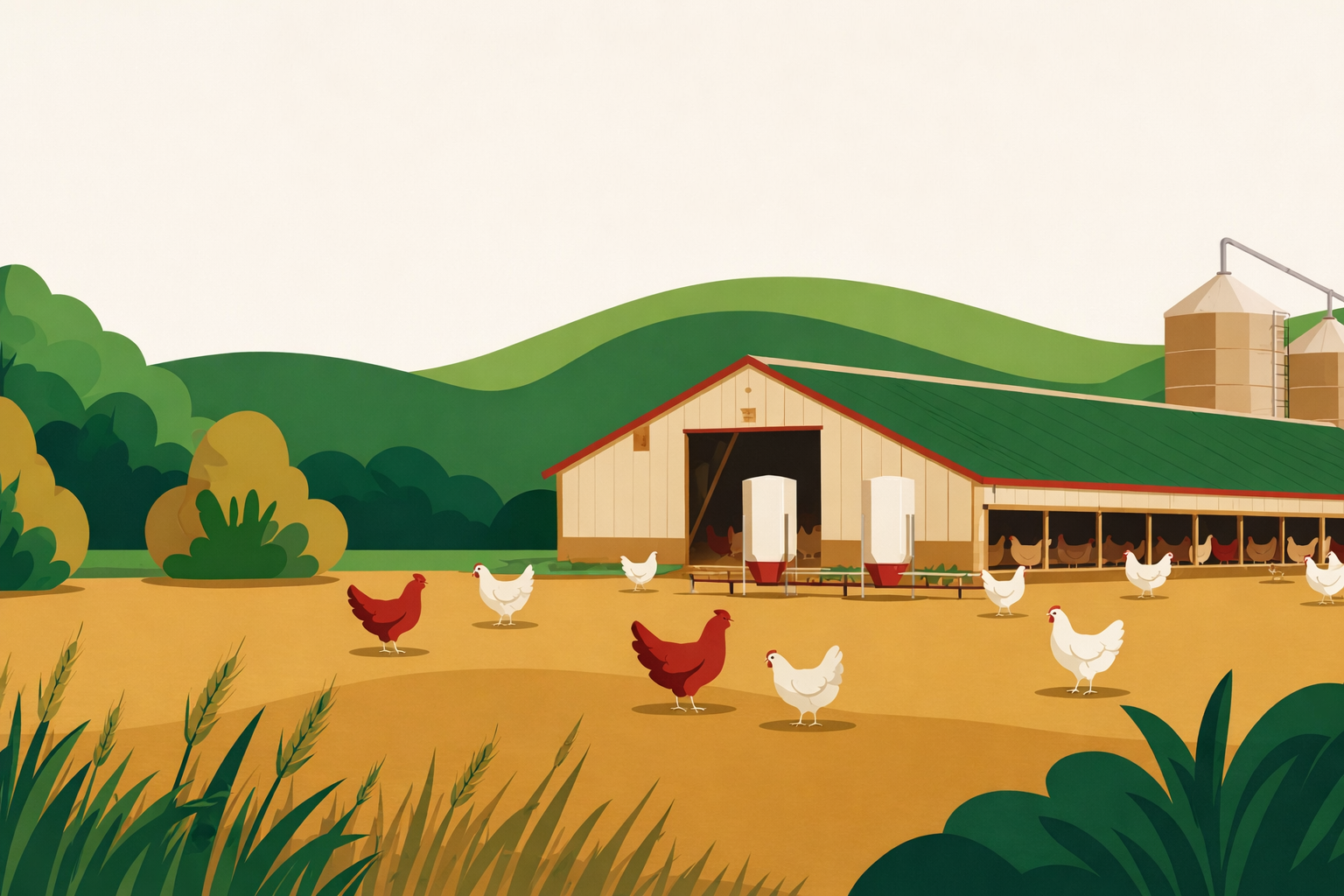
A turkey differs from a broiler in two ways that change the house requirements: it is much heavier and stays in the house longer. Large birds produce a lot of heat, moisture and ammonia, so ventilation must be stronger and dry litter is an absolute priority. The whole rearing process is covered in the guide on turkey farming; treat this page as a checklist for house equipment and microclimate.
How does a turkey house differ from a broiler house?
Turkey poults need a higher starting temperature than broilers and depend even more on warmth in the first days. Later, as the birds grow to a dozen or more kilograms, removing heat and moisture becomes key — hence the emphasis on efficient ventilation. Drinkers and feeders must be raised as the birds grow, and the litter must stay dry to protect the foot pads (FPD, foot-pad dermatitis). We cover the early weeks separately in turkey brooding.
Where do the numbers in this guide come from?
Target parameters (temperature by age, humidity, air exchange, birds per drinker and feeder, stocking) follow the Aviagen Turkeys and Hybrid Turkeys guides, and on welfare we draw on IZ-PIB materials. These are indicative values* — a starting point, not a fixed norm. Actual settings depend on the line, the sex (toms are much heavier than hens), the season and the specific house.
What to check when planning and preparing a turkey house
- 1
Strong ventilation for large birds
Turkeys are large birds that produce a lot of heat, moisture and ammonia, so ventilation must be more powerful than in a broiler house. In winter, minimum ventilation doses fresh air and removes moisture and ammonia without chilling the flock; in summer the house needs a large airflow to carry off the excess heat from heavy birds. The sizing and setting rules (shared across poultry) are in the guide on house ventilation.
- 2
Heating and pre-heating the house (preheating)
Turkey poults need a higher starting temperature than broilers, so the house must have spare heating power and be warmed in advance — together with the litter and floor (this is pre-heating). A cold floor chills the delicate poults from below and spoils the start. We have gathered the target temperatures by bird age in a table: temperature in a turkey house — table.
- 3
Drinkers and feeders — height and number per bird
A turkey grows from a small poult into a bird of a dozen or more kilograms, so drinkers and feeders must have height adjustment and be raised continuously with the birds — water and feed should be at back height. The number of drinking and feeding points per bird is set so each has easy access and no queues form. We have gathered the specific norms separately in turkey drinkers and feeders — norms, and we cover the drinking lines themselves in drinking lines in the house.
- 4
Dry litter and foot-pad protection (FPD)
In turkeys, dry litter is not cosmetic — it is leg health. Wet, caked litter leads to foot-pad dermatitis (FPD) and lameness, which lower welfare and carcass quality. Litter is kept dry and friable through good ventilation, leak-free drinking lines and ongoing management. We cover the rules in managing litter in the house.
- 5
Lighting and the light programme
Turkeys need a bright start so poults quickly find water and feed, then a programme with dark phases that orders the daily rhythm and supports a calm flock. The house must have even, dimmable lighting. We describe a ready programme and its phases in the guide on a light programme for turkeys.
- 6
Space, stocking and climate control
Heavy birds need more room than broilers — stocking (kg per square metre) is set so the birds can move freely, which protects the legs and the litter. Everything is tied together by a climate computer controlling heating, fans and inlets, with alarms (temperature, power failure, ventilation failure). More on stocking: turkey stocking density, and on the automation: house climate controllers.
Target parameters in a turkey house
Four groups of values the house should hold. Indicative figures* from the Aviagen Turkeys and Hybrid Turkeys guides.
Temperature by age
The start for turkey poults is higher than for broilers (roughly about 35–37°C* in the zone under the heat source on day 1), then temperature is lowered gradually with age. More telling than the thermometer is bird behaviour: evenly spread = good. Full values in the turkey temperature table.
Relative humidity 50–70%
Target about 50–70%*. Too dry — dust and irritated airways; too humid — wet litter, higher ammonia and a risk of foot-pad dermatitis (FPD). Humidity is controlled mainly by ventilation and heating.
Ventilation: minimum and maximum
Minimum (winter) ventilation doses fresh air and removes moisture and ammonia even in frost. Maximum (summer) ventilation must carry off large amounts of heat from heavy birds — capacity scales higher than in a broiler house, to flock weight and stocking.
Litter and stocking
Dry, friable litter (e.g. shavings, chopped straw) — its condition is the litmus test of the microclimate and the basis of healthy foot pads. Stocking (kg per square metre) is set lower than for broilers, because the birds are heavier and need space. Related: managing litter and turkey stocking density.
The most common mistakes in turkey house equipment and microclimate
These mistakes regularly spoil flock results and leg health — worth ruling out at the house planning stage.
Ventilation too weak for large birds
Ventilation sized like a broiler’s will not keep up with the heat and moisture of heavy turkeys — temperature rises, litter gets wet and ammonia climbs. Scale ventilation capacity to flock weight and stocking. Rules: house ventilation.
Starting temperature too low
Placing turkey poults into a house warmed like a broiler’s gives a weak start — poults need a higher temperature and a warm floor. Warm the house and litter in advance to the values in the table: temperature in a turkey house — table.
Drinkers and feeders at a fixed height
Drinking and feeding lines that do not rise with the birds force large turkeys to stoop or spill water — the result is wet litter, poorer feed access and FPD risk. Adjust height continuously. Norms: turkey drinkers and feeders — norms.
Wet litter and neglected foot pads
Leaks from the drinking lines, weak ventilation and stocking that is too dense turn litter into a wet layer that damages the foot pads (FPD) and leads to lameness. Keep the litter dry and the stocking right. More: managing litter in the house and turkey stocking density.
Frequently asked questions about turkey house requirements
How does a turkey house differ from a broiler house?add
Turkeys are much heavier and stay in the house longer, so they need stronger ventilation (more heat, moisture and ammonia to remove), a higher starting temperature for poults, and height-adjustable drinkers and feeders raised with the birds. Dry litter also matters more — leg foot-pad health depends on it. The whole rearing process is covered in the guide on turkey farming.
What temperature should there be in a turkey house?add
At the start, turkey poults need a higher temperature than broilers (roughly about 35–37°C* in the zone under the heat source on day 1), and then it is lowered gradually with age. The figures are indicative per the Aviagen Turkeys and Hybrid Turkeys guides — always read bird behaviour. We have gathered the full values in a table: temperature in a turkey house — table.
How many drinkers and feeders should there be per turkey?add
The number of drinking and feeding points per bird is set so each has easy access to water and feed without queues, and line height is adjusted as the birds grow. We have gathered the specific norms and how to set the height separately in turkey drinkers and feeders — norms.
Why is dry litter so important in turkey farming?add
In turkeys, wet, caked litter leads to foot-pad dermatitis (FPD) — painful lesions on the soles of the legs that lower welfare and carcass quality. Litter is kept dry through good ventilation, leak-free drinking lines and the right stocking. The rules are in the guide on managing litter in the house.
What ventilation does a turkey house need?add
Turkeys are large birds producing a lot of heat and moisture, so ventilation must be more efficient than in a broiler house. In winter, minimum ventilation removes moisture and ammonia without chilling the flock; in summer the house needs a large airflow to carry off the excess heat. Capacity scales to weight and stocking. Sizing rules: house ventilation.
What stocking density is right for turkeys?add
Turkeys are heavier than broilers, so stocking (kg per square metre) is set lower, so the birds have room to move freely — this protects the legs and keeps the litter in better condition. Sex matters, as toms grow to a higher weight than hens. Details: turkey stocking density.
Why does a house need a climate controller and alarms?add
A climate computer uses temperature, humidity and CO₂ sensors to drive heating, fans and inlets, keeping a stable microclimate without constant manual work. Alarms (temperature, power failure, ventilation failure) plus backup power or safety flaps save the flock when something fails — with heavy, heat-sensitive turkeys, a ventilation failure in hot weather is especially dangerous. More: house climate controllers.
Keep an eye on turkey house microclimate in DlaFerm.pl
Want temperature, humidity and ventilation status in one place? DlaFerm.pl integrates with climate sensors and controllers and warns you before house conditions run out of control. Create a free farm account or write to us.
Phone
+48 796 258 151