Spiral feed augers — feed from the silo straight to the pans
A spiral feed auger is the heart of the feeding system: it moves feed from the silo to the pans across the whole house, evenly and without your help. Thanks to it the birds always have full pans, and you save hours of hand-spreading. We explain how the different conveyor types work, how to choose capacity and diameter, and what to watch out for during installation and use so the feed does not crumble on the way.
verifiedFrom the team that has organised work on poultry farms for years.
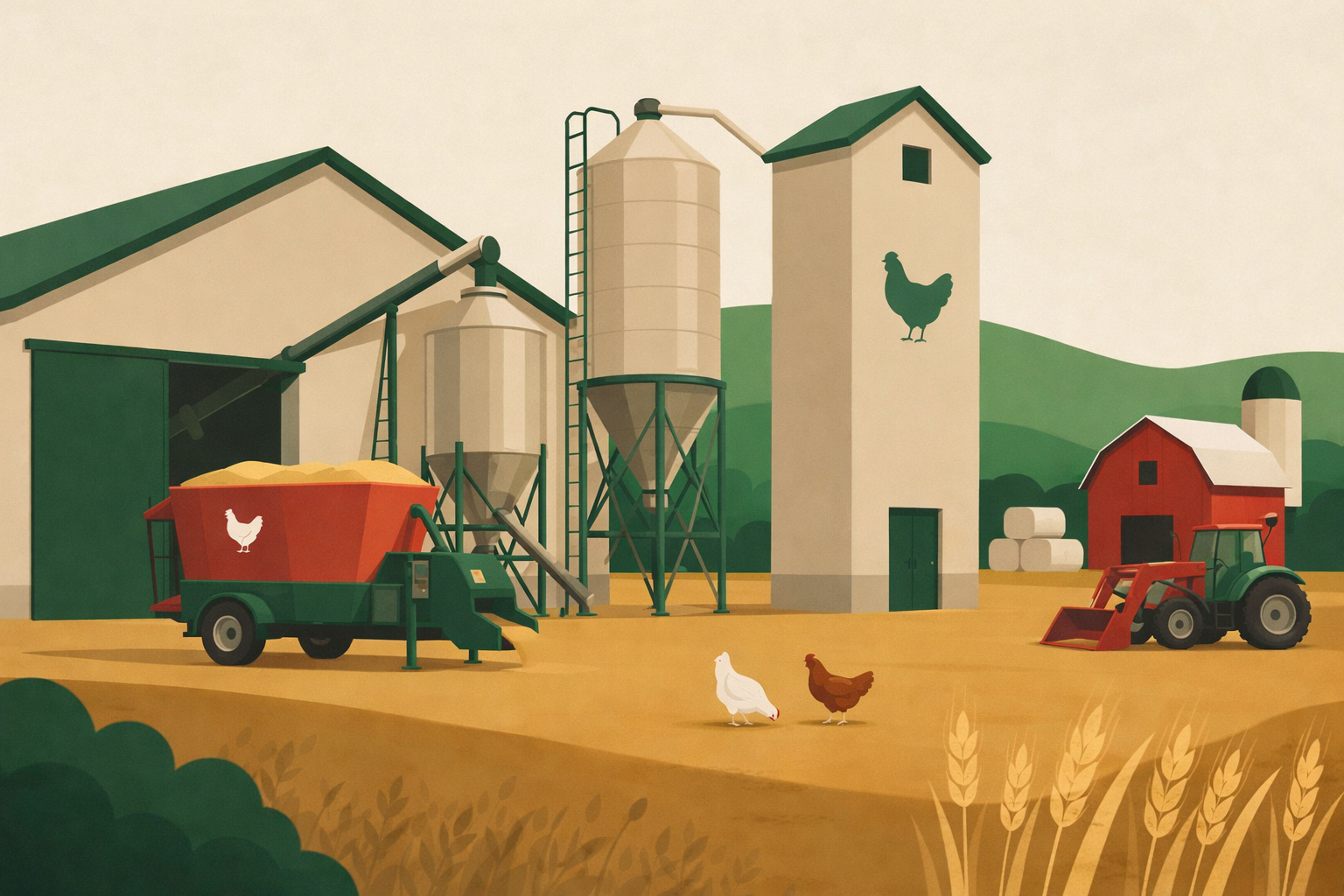
What a spiral feed auger is
A spiral feed auger is a feed transport system that moves feed from the outside silo to the pans inside the house. The heart of it is a rotating spiral (a coreless auger) enclosed in a tube — as it turns, it pushes the feed along the whole feed line. It delivers tonnes of feed to the birds with no hand-carrying or spilling. On one side the conveyor connects to the silo, and on the other it distributes feed along the pan lines running the full length of the house.
Its role on the farm: even feeding and less work
A good conveyor gives three things: even feeding (every pan fills the same, so the birds grow uniform), labour saving (no hand-feeding several times a day) and order on the farm (less spilled feed means fewer rodents and fewer losses). In broiler fattening, where every gram of gain counts, even feed distribution translates directly into a uniform flock and a better result. It is basic house equipment without which larger production is hard to run.
Where and when it is used
Spiral feed augers are used wherever feed travels from the silo to the pans: in broiler fattening, in rearing and laying-hen production, and with turkeys, ducks and geese. They work both in a small house with one pan line and in a large building with several parallel lines. The feed can be ready-made (from a mill) or home-mixed — whether you compare home-mixed vs ready-made feed or not, the conveyor brings it from the silo to the spot. With home-mixed feed it is worth setting the feed recipe so it flows well through the auger.
Why it matters for the flock result
An underrated detail: the conveyor affects the quality of the feed itself. A poorly chosen or worn auger crushes the pellet and separates the mix into fractions (segregation), so some birds get only dust and others the coarser particles. The result is an uneven flock and worse feed use. So feed transport is not “just a tube with an auger" but a part that must match the recipe and be checked regularly. Feed use is best tracked digitally in a digital Flock Card.
Spiral feed auger — what it is and how it works
From the system types, through the operating principle and key parameters, to installation and the link with the silo and controller. Six things worth understanding before you choose a feeding system.
Types: coreless auger and disc system
The most popular layout is the coreless auger (a spiral in a tube) — simple, cheap and good for most loose feeds and pellets. The second type is the chain-and-disc system: a chain with little discs runs along the line, pulling the feed and metering the dose precisely into the pans. The auger handles long single lines better; the disc system gives very even filling of many pans at once.
Operating principle: the spinning auger pushes feed
A motor at the end of the line turns the spiral enclosed in a tube. Each turn of the spiral, as it rotates, moves the feed a bit further — like the thread of a screw. Feed drops into the tube under the silo, travels along the house and pours into successive pans to the end of the line. When the last pan fills, a sensor stops the motor, so the system does not over-feed or waste power.
Key parameters: capacity and diameter
The two most important parameters are capacity (how many kilograms of feed per hour the line moves) and the spiral/tube diameter. The more birds and the longer the line, the higher the capacity needed so the pans at the end fill as fast as those at the start. The diameter must suit the feed type — too small chokes coarser pellet, too large on a short line is a needless cost. Capacity is matched to the bird count and house length.
Where and when to use each type
The coreless auger is a good choice for broilers and smaller houses — cheap to buy and service. The disc system is used where very even, controlled feeding matters, e.g. in breeder flocks or precise layer feeding. With home-mixed feed, more variable in structure, the auger is often handier because it is less fussy when the recipe changes.
Installation and link with the silo and lines
The conveyor starts under the silo outlet (via the silo feeder) and ends at the end of the house. The pan lines are hung on winches so they can be raised for cleaning and lowered to the birds’ height. The right slope and a simple route are key — the fewer bends and rises, the less crushing and fewer breakdowns. The number of lines and pans follows from the stocking density and the floor area.
Link with the controller and level sensor
A feed level sensor sits at the end of the line — when the last pan is full, it signals to switch the motor off. The controller (often the same house climate computer) can count run time and feed use. Paired with feed silo monitoring you know how much feed is left in the silo and when to order a delivery — without climbing a ladder to look inside.
Selection, costs and servicing of the conveyor
Capacity is matched to the flock, not the other way round — and that is not the last decision. Six things to think through so the conveyor serves for years and does not spoil feed quality.
Matching to bird count and number of lines
The starting point is stocking and area: how many birds, how long the house, how many pan lines. From that follow the needed capacity (kg/h) and the spiral diameter. Too weak a conveyor cannot keep up and the end pans are half empty; too strong is a needless cost of purchase and power. The pans per bird and line spacing are matched to the species — different for broilers, layers or turkeys.
Costs — purchase, power and servicing
The cost is the conveyor itself (motor, spiral, tubes, pans, winches), installation, and the running power and parts. The coreless auger is cheaper to buy and repair than a disc system, but it is still a multi-year investment. When counting profitability, remember that labour saving and lower feed losses pay back faster than it seems — especially at higher stocking density.
Servicing and auger wear
The spiral is a wear part — over time it rubs against the tube, especially on bends and with hard pellet. A worn spiral moves feed worse and crushes it more. Check the motor, bearings, tension and coil condition regularly; replace the spiral when wear shows. Clean the tubes of feed residue between batches so it does not mould or block the flow. It is worth logging the service plan just like flock records.
Effect on feed quality: crushing and segregation
Any transport crushes pellet a little, but a poor route, a worn spiral or too high a speed crush it heavily. Dust forms and the mix separates into fractions (segregation) — birds at the start of the line get something different from those at the end. The result: an uneven flock and worse health. Match the diameter and speed to the recipe, and with home-mixed feed check the feed recipe for structure so it flows well.
Common installation and operating mistakes
The most frequent slips are: too long a line for one motor (hungry pans at the end), an over-complex route with many bends (crushing and breakdowns), a missing or badly set level sensor (feed spilling on the floor), and a neglected auger service. A separate mistake is choosing the conveyor “by eye" without counting stocking and length — so calculate the parameters before buying, not after.
When it pays off
A spiral feed auger pays off practically always above a few hundred birds — hand-feeding such a flock means hours of work a day and big feed losses. The larger the scale, the faster the automation pays back. In a very small, backyard flock, hand pans are enough. Base the decision on real feed use and work time — and you have that data at hand when you keep a digital Flock Card, and DlaFerm.pl can file your flock records in IRZplus for you — automatically, if you want.
Frequently asked questions about spiral feed augers
How does a spiral auger differ from a chain-and-disc system?add
A spiral feed auger moves feed with a rotating spiral (a coreless auger) in a tube — it is simple, cheap and good for long single lines. The chain-and-disc system pulls feed with a chain of little discs and meters the dose precisely, giving very even filling of many pans at once. The auger more often goes to broilers and smaller houses, the disc system where very controlled feeding matters.
What conveyor capacity should I choose?add
Capacity (kg/h) is matched to the bird count and line length. The more birds and the longer the house, the higher the capacity, so the end pans fill as fast as those at the start. Too weak a conveyor cannot keep up and leaves hungry pans; too strong is a needless cost. It is best to calculate the parameters before buying based on stocking and area, rather than choosing by eye.
Does the conveyor crush the feed?add
Any transport crushes pellet a little, but with a well-chosen, healthy spiral it is small. Heavy crushing comes from a worn spiral, too high a speed or a complex route with many bends. Dust and mix segregation then form, which hurts flock uniformity. So the diameter and speed are matched to the recipe, and the spiral is replaced when wear shows.
How does the conveyor connect to the silo?add
The conveyor starts under the silo outlet, where the silo feeder feeds feed into the auger tube. From there the feed travels along the house to successive pans. At the end of the line a level sensor switches the motor off when the pans are full. Paired with silo monitoring you know how much feed is left and when to order a delivery, without climbing a ladder to look inside.
How often should a spiral feed auger be serviced?add
The spiral is a wear part, so it is worth checking the motor, bearings, tension and coil condition regularly and cleaning the tubes of feed residue between batches. A worn spiral, when wear shows, must be replaced, because it moves feed worse and crushes it more. It is good to keep the service plan as a record, like flock records, so you do not miss the dates.
When does a conveyor pay off?add
A spiral feed auger pays off practically always above a few hundred birds, because hand-feeding such a flock means hours of work a day and sizeable feed losses. The larger the scale, the faster the automation pays back. In a very small, backyard flock, hand pans are enough. Base the decision on real feed use and work time, which you have at hand when you keep digital flock records.
Stay on top of feed and flock with DlaFerm.pl
You have an auger and a silo, but count feed use on paper? DlaFerm.pl brings flock documentation together in one place: digital Flock Card, feed use and IRZplus records at hand. Create a free farm account and keep feeding under control.
Phone
+48 796 258 151