Home-mixed vs ready-made feed — which pays off
Feed is the largest cost on a poultry farm, so the choice between home-mixed feed (blended on site from premix and grain) and ready-made (purchased, complete) feed really weighs on the result. We compare both approaches criterion by criterion: cost per kg, quality and repeatability, raw-material control, labour, recipe flexibility and the risk of errors. At the end we suggest what to choose at your scale.
verifiedFrom the team that has organised work on poultry farms for years.
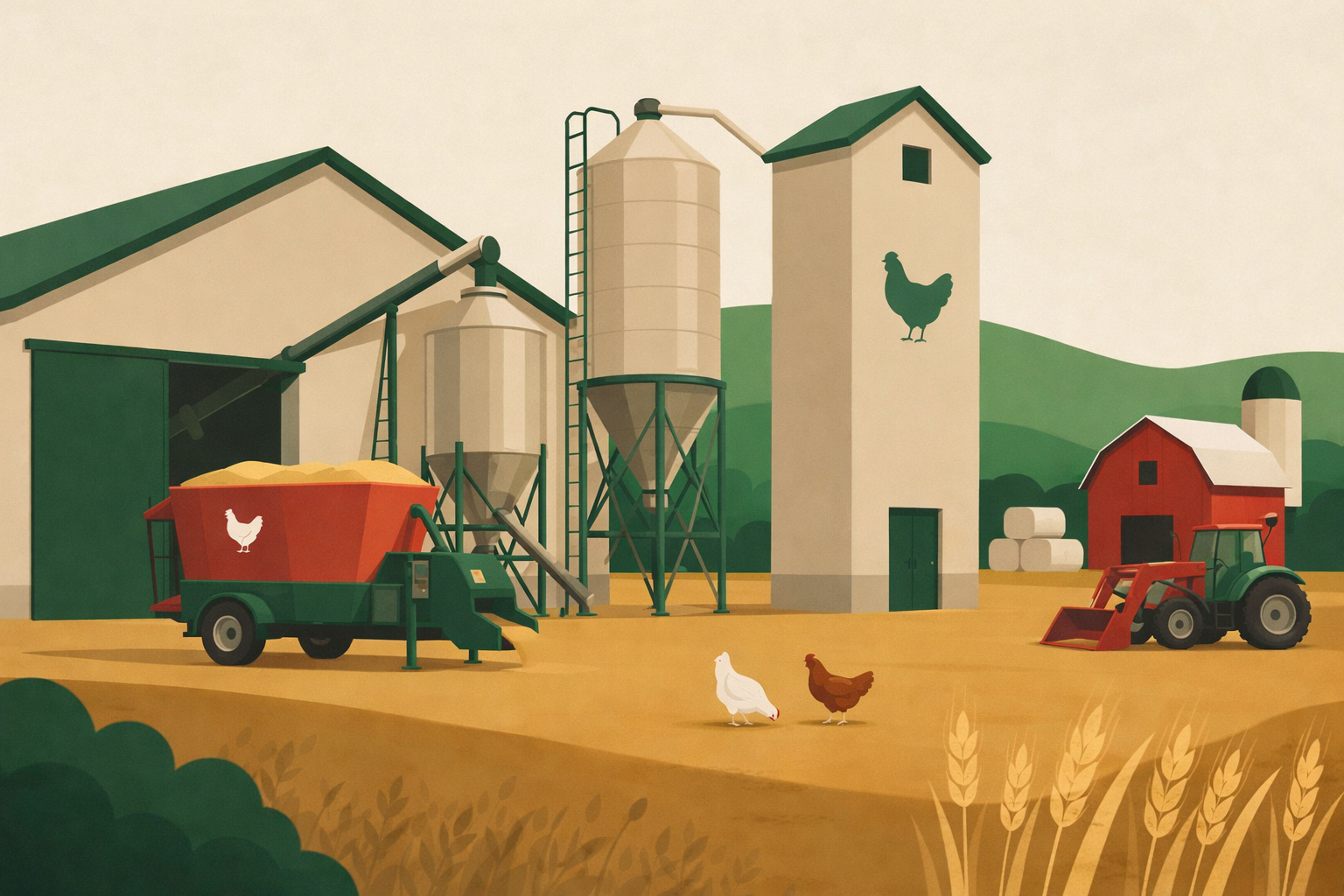
Home-mixed vs ready-made — what it really means
Home-mixed feed is feed you blend on the farm: you buy a premix (a concentrate with vitamins and minerals) and grain components — wheat, maize, soybean meal — and combine them to a recipe. Ready-made feed is a finished complete product bought from a feed mill, where everything is already balanced and mixed. These are two different feeding strategies, not “better and worse” feed. Before you choose, it is worth understanding how a feed recipe is calculated and what makes up the cost of 1 kg of live weight.
Why this choice weighs so much on the result
Feed is usually 60–70% of the cost of producing live weight, so even a few cents’ difference per kilogram adds up to large sums over a cycle. But it is not only the price of the bag that counts — so do weight gain, flock health and repeatable results. Cheap feed that balances poorly can end up costing more than dearer but well-formulated feed. That is why we compare both approaches in the categories that really decide profitability, not just the price per tonne.
Quality and balance — where it is easy to slip up
Complete feed from a reliable producer is balanced to the nutritional norms of a given species and rearing phase. When you mix it yourself, you are responsible for making sure protein, energy, amino acids and minerals match the broiler feeding norms. It is doable, but it takes knowledge, a good premix and raw-material control. A starting point is often a feed recipe calculator, which helps build a formula for your production goal.
A risk you do not see in the price
With home-mixed feed you take on part of the risk that the mill carries with ready-made feed: grain quality (moisture, moulds, mycotoxins), microbiological cleanliness (e.g. salmonella), mixing accuracy and batch repeatability. These are real threats, because a contaminated or badly balanced batch of feed can ruin a whole flock. So the “home-mixed or ready-made” decision is also a decision about how much control and responsibility you want to take on — and whether you have the equipment and procedures for it.
Calculate both options with DlaFerm.pl
It is best not to decide by feel but to calculate. In DlaFerm.pl you build a recipe and compare the cost of 1 kg of home-mixed feed with the price of ready-made, then set the results against the real consumption on the flock recorded in the digital Flock Card. So you see not just the price of the bag but how feed translates into weight gain and the cost of live weight. You can create a farm account for free and calculate the recipe in the app.
Home-mixed vs ready-made — criterion by criterion
We line up both approaches in six categories that really decide the profitability and safety of feeding. For each criterion we name how home-mixed feed compares with ready-made.
Unit cost of feed (per kg)
Home-mixed: usually cheaper per kilogram, especially if you have your own grain — you mainly pay for the premix and components, without the mill’s margin and the cost of transporting a finished product. Ready-made: dearer per kilogram, because the price includes the recipe, production, quality control and logistics. You can calculate the gap in the feed recipe calculator and the impact on live weight in the cost of 1 kg of live weight.
Balancing and quality/repeatability
Home-mixed: quality depends on your recipe, premix and accuracy — repeatable with a good workshop, drifting batch to batch when you make mistakes. Ready-made: balanced to the broiler feeding norms and repeatable batch after batch, because the producer keeps watch over it. This is the biggest advantage of ready-made feed — a sure, stable composition without your work on the balance.
Raw-material control and safety
Home-mixed: full control over what goes into the mix, but also full responsibility for grain quality — moisture, moulds, mycotoxins and microbiological cleanliness (e.g. salmonella) are all on you. Ready-made: the mill takes on the raw-material risk, with testing and procedures, so you get a product of confirmed quality. Here ready-made wins on safety, home-mixed on the transparency of the composition.
Labour and equipment (mixing plant)
Home-mixed: needs space, time and equipment — silos, a grinder and a mixer, plus spiral feed conveyors to move the feed. That is an investment and extra work with every batch. Ready-made: no mixing — you order, and the feed is delivered in bulk to a silo or in bags. Ready-made saves labour and the capital for equipment; home-mixed requires that effort, but it spreads over many cycles.
Recipe flexibility
Home-mixed: a lot of freedom — you can adjust the composition to the rearing phase, raw-material prices or the flock’s needs and react quickly to changes. That is an asset when you know how to balance. Ready-made: you pick from ready types (starter, grower, finisher), with no way to fine-tune the composition for a specific flock. Home-mixed gives flexibility, ready-made the convenience of proven, ready variants.
Risk of feeding errors
Home-mixed: the risk is on your side — an error in the recipe, inaccurate mixing or a bad premix batch can lower gains or harm the flock. Ready-made: the risk of a balancing error drops almost to zero, because the producer keeps the composition right. This is the key difference for beginners: ready-made forgives a lack of experience, home-mixed punishes mistakes but rewards knowledge with a lower cost.
Home-mixed or ready-made — when each pays off
There is no single right answer — the choice depends on scale, access to grain, species and your experience. Here are six situations and our recommendation on how to approach the decision.
Small scale — usually ready-made feed
With a small flock, investing in silos, a grinder and a mixer does not pay off, and the risk of a balancing error is high. For a backyard and a small commercial farm, ready-made complete feed is the safest choice — a sure composition without your own equipment. The saving per kilogram is too small to beat the cost and risk of mixing yourself.
Large scale and own grain — home-mixed feed
At large stocking densities a few cents per kilogram add up to significant sums over a year, so mixing on site starts to pay off. If you have your own grain, the advantage grows — you mainly pay for the premix. Then the investment in a mixing plant and spiral feed conveyors pays off, and the cost of 1 kg of feed really drops compared with ready-made.
Species and rearing phase
Flocks that are very demanding nutritionally (e.g. fast-growing broilers in the starter phase) leave a small margin for error, so ready-made, precisely balanced feed can be safer. Where the requirements are gentler, good results on a home mix are easier to achieve. Always refer the composition to the broiler feeding norms for the given phase, whichever path you choose.
Hybrid model — premix plus own grain
The most common compromise is not “either–or” but a hybrid model: you buy a good premix (concentrate) and add your own grain to it according to a recipe. Then part of the balance is kept by the premix producer while your cost is lower than with fully ready-made feed. This is a good way into home mixing before you move to full recipe self-reliance.
Common mistakes with home-mixed feed
The most common traps are: saving on the premix and throwing off the balance, using moist or mouldy grain (mycotoxins), inaccurate batch mixing and a lack of microbiological control (salmonella). Each of these errors can wipe out the whole saving, and even worsen the result compared with ready-made feed. If you mix yourself, treat raw-material control and mixing-plant hygiene as seriously as the recipe itself.
Recommendation — calculate, do not guess
Make the decision on numbers: set the cost of 1 kg of home-mixed feed (premix plus components) against the price of ready-made and refer it to the cost of 1 kg of live weight, not just to the price of the bag. Experience, equipment and access to grain shift the result toward home-mixed; their absence — toward ready-made. Record consumption and results in the IRZplus flock records and the Flock Card, so the comparison rests on your own data.
Frequently asked questions about home-mixed and ready-made feed
Is home-mixed feed cheaper than ready-made?add
Per kilogram, usually yes — especially if you have your own grain and mainly pay for the premix, without the mill’s margin and the cost of transporting a finished product. But the lower price of the bag is not everything: weight gain and repeatability count too. Badly balanced home-mixed feed can end up dearer per kilogram of live weight than dearer but well-formulated ready-made feed. So compare the cost of 1 kg of live weight, not the feed price alone.
What is complete feed?add
Complete feed is a finished mixture that on its own covers the bird’s whole requirement at a given stage — protein, energy, amino acids, vitamins and minerals. Nothing needs to be added to it except water. It is bought from a feed mill as starter, grower or finisher, matched to the species and rearing phase. It is the opposite of a concentrate (premix), which only becomes feed once combined with your own grain.
What equipment do I need to mix feed on the farm?add
To mix your own feed you need space for raw materials (silos or a store), a grinder to break down grain, a mixer to combine the components and a transport system, e.g. spiral feed conveyors to deliver the feed to the house. It is an investment that pays off at a larger scale. On a small farm such equipment usually does not pay off, and ready-made feed is often the better choice.
With home-mixed feed, am I at risk of salmonella or mycotoxins?add
That risk exists, because with home mixing you are responsible for raw-material quality. Moist or mouldy grain can contain mycotoxins, and a lack of mixing-plant hygiene encourages microbiological contamination, including salmonella. That is why raw-material control, dry and clean storage and equipment hygiene are key. With ready-made feed the mill takes on this risk, running tests and quality procedures.
What is the hybrid model in poultry feeding?add
The hybrid model is a compromise between home-mixed and ready-made feed: you buy a ready premix (a concentrate with vitamins, minerals and additives) and combine it with your own grain according to a recipe. Part of the balance is then kept by the premix producer, while you lower the cost compared with fully ready-made feed. It is a popular way into home mixing before a farm moves to full recipe self-reliance.
How do I calculate which pays off more for me?add
Line up two numbers: the cost of 1 kg of home-mixed feed (premix plus components and any mixing cost) and the price of 1 kg of ready-made feed. Then refer both options to the cost of 1 kg of live weight, allowing for the gains and feed consumption recorded on the flock. DlaFerm.pl lets you build a recipe, calculate the cost of 1 kg and set it against the real consumption from the Flock Card, so you decide on your own data rather than a hunch.
Compare home-mixed and ready-made feed with DlaFerm.pl
Want to know whether it pays you more to mix feed on site or buy it ready-made? Build a recipe, calculate the cost of 1 kg and set it against the real consumption from the Flock Card. Create a free farm account and compare both options in the app.
Phone
+48 796 258 151