Broiler welfare — what it means on the farm
Broiler welfare is not a poster slogan but a set of things you can measure and improve: healthy feet, a sound gait, dry litter, the right stocking density and a dark night. We explain in plain language which indicators and thresholds apply to the meat chicken (under Directive 2007/43/EC and the EFSA opinion) and how to keep on top of them day to day.
verifiedFrom the team that has organised work on poultry farms for years.
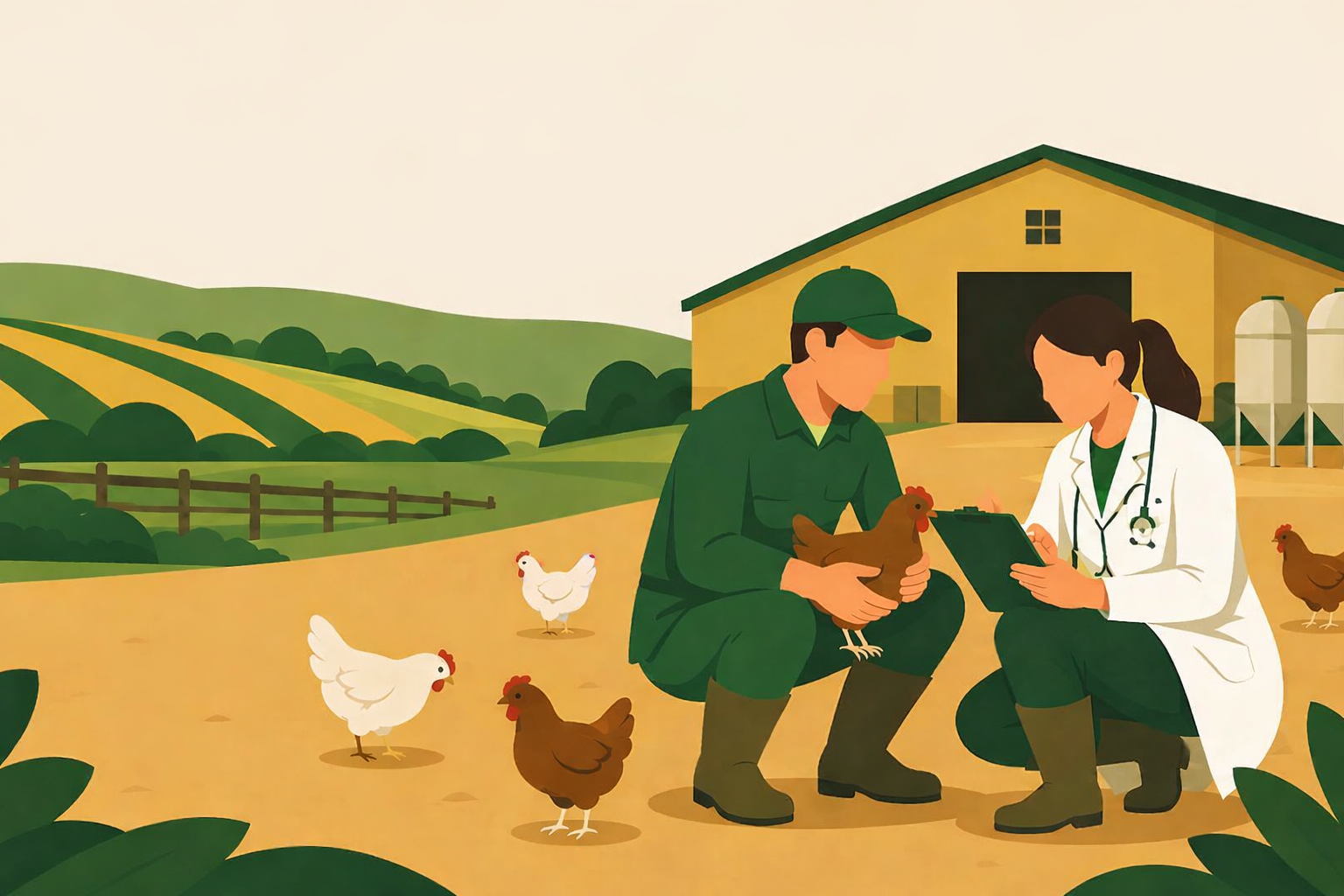
Broiler welfare is simply the conditions in which a bird can live, eat, drink, move and rest normally, without pain or excessive stress. Put plainly, it is the classic “five freedoms” translated into the broiler house: freedom from hunger and thirst, from discomfort (dry litter, good temperature), from pain and disease, from fear, and freedom to behave normally (scratching, pecking, resting). Welfare pays off — birds in good condition grow better, suffer fewer losses and yield better at slaughter. The whole production cycle is covered in the guide on broiler farming.
Where do broiler welfare rules and indicators come from?
The legal basis is Council Directive 2007/43/EC on the protection of chickens kept for meat production, implemented in Poland by the relevant ministerial regulation. It sets the stocking limits and the duty to monitor indicators. The scientific side — which indicators best describe a bird’s state — is organised by the European Food Safety Authority (EFSA) in its opinion on broiler welfare. General indicators for all poultry are in the guide on poultry welfare indicators; here we focus narrowly on the meat chicken. Importantly, the figures in the EFSA opinion are scientific recommendations, not binding law: in its 2023 opinion EFSA recommends, among other things, a much lower density (around ≤11 kg/m²), slower growth (≤ about 50 g/day), an ammonia concentration below 15 ppm, dry litter and raised platforms. Directive 2007/43/EC still permits 33–39 kg/m² (up to 42 kg/m² when the conditions are met) — so treat the EFSA thresholds as a direction of travel, not the current legal limit. The European Union has announced a revision of its animal-welfare rules, but the work is running behind schedule and the final shape of the new requirements is not yet settled — it is worth following the European Commission’s updates.
Why does the fast-growing broiler have its own challenges?
A modern broiler reaches slaughter weight in about 5–6 weeks. Such rapid growth loads the legs and heart, so in broilers welfare shows up most in mobility (gait score) and in leg condition (hock burn and footpad dermatitis). The heavier and faster-growing the bird, the more dry litter, the right density and a lighting programme with a dark night matter — because these decide whether the bird moves willingly or lies on wet litter and burns its legs.
How to manage broiler welfare in practice
- 1
Start with the litter — it is the foundation of leg welfare
Dry, friable litter is the simplest route to healthy feet and a sound gait. Wet or capped litter damages the skin on the footpads (footpad dermatitis) and causes hock burn. Check the litter by hand every day: it should be loose, not sticking into clumps. React to wet patches under drinker lines and air inlets. Details in the guides on litter management in the house and wet litter — causes and effects.
- 2
Keep stocking within the legal and programme limits
Overstocking means more manure on the same floor area, faster wet litter and less room to move. Directive 2007/43/EC sets three levels: 33 kg/m² (basic), 39 kg/m² (with documentation and good indicators) and 42 kg/m² (maximum, after approval). Welfare programmes often require even lower, around 30 kg/m². How to convert the limit into a bird count is shown in the guide on broiler stocking density.
- 3
Run a lighting programme with night-time darkness
A broiler needs a night break — the directive requires at least 6 hours of darkness per 24 hours, including at least one uninterrupted dark period of at least 4 hours (apart from the first and last days of the cycle). Darkness lets the birds rest, regulates feed intake and limits leg disorders. Light control and example schedules are in the guide on broiler house lighting programme.
- 4
Monitor welfare indicators and record the results
Welfare is not judged by eye — it has to be counted. Record mortality daily, score the gait regularly on a sample of birds, check plumage cleanliness and litter moisture, and collect footpad dermatitis scores from the plant after slaughter. Temperature and humidity need daily checks too — see temperature and humidity in the house and broiler house ventilation. Records are the basis of the audit and a condition for keeping a higher stocking density.
- 5
Act quickly when indicators deteriorate
A worsening indicator is a signal, not a verdict. Rising mortality, a poorer gait, dirty feathers or wet litter mean something in the environment is failing — usually ventilation, drinking water or stocking. Find the moisture source, ventilate the house, fix the drinker lines and, if needed, reduce stocking in the next cycle. Above 33 kg/m², repeated poor results can mean a duty to lower density. The ARiMR welfare payment for broilers (indicatively about PLN 0.2 per bird for 2026) is tied to, among other things, stocking up to 30 kg/m² and at least 6 hours of darkness — check the current rates and terms with ARiMR. More on subsidies and requirements in the guide on poultry welfare — subsidies.
Measurable broiler welfare indicators and their thresholds
Four groups of indicators used to measure meat-chicken welfare. Indicative thresholds* — exact values depend on the programme, the buyer and national rules.
Footpads (footpad dermatitis / FPD)
Lesions and discolouration on the underside of the feet come from contact with wet litter. They are scored after slaughter, usually on a footpad (FPD) scale from 0 (healthy skin) to 2 (deep lesion). A low average FPD score in a flock shows the litter was dry and the density right. A high one is the first proof that leg welfare slipped. More in footpad dermatitis — broiler footpad quality.
Hocks (hock burn) and gait score
Hock burn is dark discolouration on the bend of the leg, again from wet litter. Gait score rates mobility, usually on a 0–5 scale: 0 is a bird walking freely, higher values mean growing difficulty walking. The practical goal is as many birds as possible in the low categories (0–1) and as few as possible with a clear problem moving.
Mortality and losses
Daily losses and total cycle mortality are a hard indicator of flock health. Indicatively, a good result is total mortality of a few percent per cycle*, but the pattern matters too: a sudden spike in losses flags a problem (disease, ventilation, drinker failure) faster than the total alone. Record losses daily — it is a welfare documentation requirement and the basis for stocking decisions.
Environment: stocking, light, litter
On-bird indicators go hand in hand with environmental requirements. Stocking under 2007/43/EC: 33 / 39 / 42 kg/m² depending on the programme level. Light: at least 6 h of darkness per 24 hours, including at least 4 h of continuous darkness. Litter: dry, friable, available across the whole area accessible to birds. Plus environmental enrichment (e.g. perches, bales, pecking material) that encourages movement and natural behaviour.
Mistakes that lower broiler welfare
A few errors come up repeatedly at audits — worth knowing before they show in the results and the footpad scores.
No night-time darkness “for growth”
The temptation to light almost around the clock to raise feed intake ends in worse leg welfare and a breach of the rules. A broiler without a night break does not rest, lies down more and burns its legs. The directive requires at least 6 h of darkness per 24 hours, including at least 4 h continuous — this is not optional, it is a condition. See broiler house lighting programme.
Judging welfare by eye without records
Without numbers you cannot tell whether things are better or worse, and the auditor has nothing to check. You must record mortality, score the gait on a sample and collect footpad scores from the plant. Missing documentation is not only an inspection risk — it also means losing the basis to keep a higher stocking density (39 or 42 kg/m²).
Ignoring wet litter
Wet litter is the most common cause of poor footpads and hock burn. It often returns through leaking drinkers, weak ventilation or overstocking. The longer you delay, the worse the FPD scores after slaughter. The diagnosis of causes is in wet litter — causes and effects.
A bare house with no enrichment or room to move
Birds in a house with no enriching elements and with too high a density move less, which shows in gait and leg condition. Simple enrichment (perches, straw bales, pecking material) and the right density encourage activity. Density alone is not enough — see broiler stocking density.
Frequently asked questions about broiler welfare
What does broiler welfare mean in practice?add
It is the conditions in which a bird can eat, drink, move and rest normally, without pain or excessive stress — the “five freedoms” translated into the broiler house. In practice it is measured with concrete indicators: footpad condition (footpad dermatitis), hock burn, gait score, mortality and plumage cleanliness, plus the environment: stocking density, the lighting programme and litter quality.
How many hours of darkness per day must broilers have?add
Directive 2007/43/EC requires at least 6 hours of darkness per 24 hours, including at least one uninterrupted dark period of at least 4 hours — except in the first and last days of the cycle. Darkness lets the birds rest and supports leg health. Details and schedules are in the broiler house lighting programme guide.
What are gait score and hock burn?add
Gait score rates how well a bird moves, usually on a 0–5 scale, where 0 is a free gait and higher values mean growing difficulty walking. Hock burn is dark discolouration of the skin on the bend of the leg, caused by contact with wet litter. Both indicators reflect leg condition and whether the litter and density were right.
What are the broiler stocking limits and how do they affect welfare?add
Directive 2007/43/EC sets three levels: 33 kg/m² (basic), 39 kg/m² (with welfare documentation and good indicators) and 42 kg/m² (maximum, after approval by the veterinary authority). The higher the density, the faster litter gets wet and the harder it is to keep healthy feet and a sound gait. Welfare programmes often require even lower (around 30 kg/m²). Conversions: the broiler stocking density guide.
What is environmental enrichment for broilers?add
These are simple elements that encourage natural behaviour and movement: perches or platforms, straw bales, pecking material, sometimes more space. Movement improves leg condition and gait score, and natural behaviour (scratching, pecking) reduces stress. Enrichment is part of welfare required by many programmes and increasingly expected by buyers.
How is this page different from the welfare subsidies page?add
This page explains what broiler welfare is and how to measure it: indicators, thresholds and environmental requirements under Directive 2007/43/EC and the EFSA opinion. The money side — welfare payments and how to qualify — is covered in a separate guide on poultry welfare subsidies, and the set of general indicators for all poultry is in the poultry welfare indicators guide.
Sources & resources
- linkCouncil Directive 2007/43/EC laying down minimum rules for the protection of chickens kept for meat production (eur-lex.europa.eu)
- linkEFSA — scientific opinion on broiler welfare (scientific recommendations) and animal welfare topic (efsa.europa.eu)
- linkEURCAW-Poultry — European Reference Centre for Animal Welfare for Poultry (materials also in Polish) (eurcaw-poultry-sfa.eu)
Keep welfare records in DlaFerm.pl
Want a digital flock record, a mortality log and welfare indicator results in one place — ready for the audit? Create a free farm account or write to us.
Phone
+48 796 258 151