Broiler diseases — what affects the flock and at what age
A broiler lives a short life — it usually grows to slaughter in 35–42 days — so diseases appear in predictable age 'windows'. This page is a map: it shows what most often threatens a broiler in the first days, during rapid growth, and which leg and heart problems come from the growth rate itself. Each disease is only outlined, with a link to a dedicated guide.
verifiedFrom the team that has organised work on poultry farms for years.
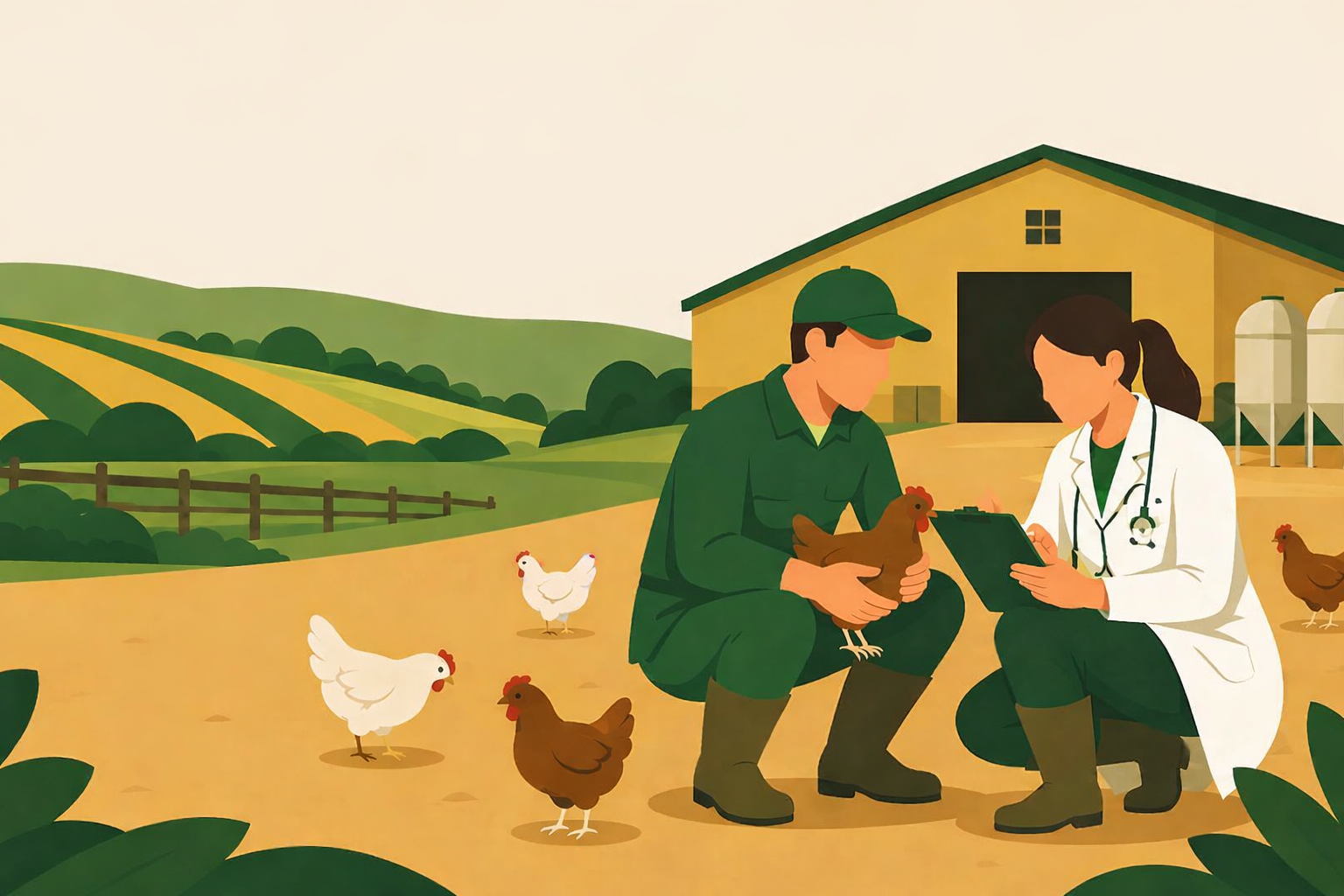
A broiler is a meat chicken bred for fast growth. Most health problems have their typical age 'window': some diseases threaten the chick in the first week, others the flock during the fastest growth, and yet others at the end of the cycle when the bird is heavy. This page is a hub: it gathers the key broiler diseases in one place and points to detailed guides. The whole production is covered in the broiler farming hub, and a symptom-by-symptom table is in poultry diseases — symptom table.
Why does a broiler get sick differently from a slow-growing hen?
A broiler grows very fast — muscle and body mass gain faster than the heart, lungs and legs can keep up. That is why broilers, more than slow-growing hens, develop metabolic and locomotor problems: sudden death syndrome (SDS), ascites (fluid in the abdomen from heart overload) and leg deformities. Add to that the infectious diseases common to all poultry, but in a broiler they have less time to develop and hit the whole flock's result faster. Good farm biosecurity limits most infectious outbreaks.
Where does this information come from?
The symptom descriptions and age windows are based on textbook and public knowledge: the MSD Veterinary Manual (Poultry section), materials from the Polish veterinary inspectorate and EFSA assessments. Specific drug doses, diagnosis and treatment are always set by a veterinarian — this page does not replace a visit. Each disease is treated briefly with a link to a separate guide; the point here is a quick orientation of 'what and when' may threaten a broiler.
How to spot a disease in the flock and respond correctly
- 1
Observe the flock daily and count dead birds
The earliest signs of disease are: listless birds, huddling, drinking and eating less, a change in the colour and consistency of droppings, wheezing, lameness, a sudden rise in the number of dead birds. Record the daily mortality — a sudden spike is one of the most important alarms. Early disease detection based on a drop in water and feed intake also helps, before symptoms are visible to the naked eye.
- 2
Separate sick birds and do not spread the infection
Where possible, separate suspect and clearly sick birds from the rest, and remove dead birds promptly into a closed container. Handle healthy flocks before sick ones, change clothing and disinfect footwear between houses — these are elements of farm biosecurity. If a notifiable disease is suspected (e.g. high, sudden mortality and nervous signs), do not delay the next step.
- 3
Call a veterinarian — immediately for notifiable diseases
Diagnosis and treatment are set solely by a veterinarian; giving drugs 'by guesswork' makes things worse and complicates the withdrawal period. Some diseases must not be treated on your own — if avian influenza (HPAI) or Newcastle disease (ND) is suspected, you are legally obliged to notify the official veterinarian without delay. These are notifiable diseases — reporting is an obligation, not a choice.
- 4
Give drugs exactly as prescribed and watch the doses
Give drugs only as the vet has written: the right product, dose, route and duration. An unfinished course encourages relapses and microbial resistance. Every drug has a withdrawal period — the time during which the meat must not go to slaughter. The rules are explained in drug withdrawal periods in poultry.
- 5
Record everything in the treatment log
Every drug administration must be noted: date, product, dose, number of birds treated and the end of the withdrawal period. This is a legal requirement and the basis for safe slaughter. Instead of loose notes, keep a treatment and withdrawal-period log in one place — then the withdrawal end date calculates itself and inspections go smoothly.
The most common broiler diseases by period
Four age 'windows' with their typical threats. Each disease has a separate guide — here only an outline and a link.
First days of life
In week 1 the most common are: navel and yolk sac inflammation (omphalitis — infection of an unhealed navel, 'wet navels', bellies full of unabsorbed yolk) and colibacillosis (E. coli infection, often secondary to poor hatchery or transport conditions). Symptoms: listless chicks huddling under the heater, eating poorly, raised early mortality. Details: poultry colibacillosis.
Growth period (about weeks 2–5)
Mid-cycle, coccidiosis dominates — an intestinal parasite peaking usually at weeks 3–5 (bloody or watery droppings, listlessness, poorer growth). Respiratory diseases follow: CRD/mycoplasmosis (chronic, wheezing, nasal discharge) and secondary colibacillosis. Guides: coccidiosis in broilers, CRD/mycoplasmosis in poultry, salmonella on a poultry farm.
Metabolic and locomotor problems
This is the 'price' of fast growth — more common in broilers than in slow-growing hens. Sudden death syndrome (SDS — birds die suddenly, often on their back, in good condition), ascites (fluid in the abdomen from heart overload, more common in winter with poor ventilation), leg deformities and lameness, and footpad dermatitis — lesions on the footpads from wet litter. Read: footpad dermatitis — broiler footpad quality and wet litter — causes and effects.
Notifiable diseases (controlled by the authorities)
The most dangerous and compulsorily reported: avian influenza (HPAI — highly pathogenic, massive sudden mortality, nervous and respiratory signs) and Newcastle disease (ND). On suspicion you do not treat on your own — you immediately call the official veterinarian. Guides: avian influenza (HPAI), Newcastle disease (ND) — symptoms.
The most common mistakes in broiler disease prevention
A few mistakes recur on many farms — worth knowing before you place the next flock.
Treating 'by guesswork' without a vet
Giving antibiotics without a diagnosis is a common mistake: the wrong course does not help, wastes money, encourages bacterial resistance and complicates the withdrawal period. Many broiler diseases share similar signs (listlessness, diarrhoea, poorer feeding), so without testing it is easy to target the wrong cause. Leave diagnosis and drug choice to the veterinarian.
Weak biosecurity between flocks
Most infectious outbreaks enter the farm 'on boots', in feed, with rodents and wild birds or on unwashed equipment. No disinfection mats, shared clothing for several houses and skipping cleaning between cycles are asking for trouble. The basics are in the farm biosecurity guide.
Ignoring wet litter and ventilation
Wet litter is not cosmetic — it directly raises the risk of coccidiosis, colibacillosis and footpad dermatitis (foot lesions), and poor winter ventilation favours ascites. Damp, caked litter is one of the earliest signs that something is wrong. The causes are in wet litter — causes and effects.
Reacting only when mortality rises
By the time the number of dead birds rises, the disease is already advanced. An earlier signal is a drop in water and feed intake — often 1–2 days before visible symptoms. Watching these figures daily (or early disease detection from sensors) gives time to react before the problem reaches the whole flock.
Frequently asked questions about broiler diseases
What diseases do broilers most often suffer from?add
In the first days: navel inflammation (omphalitis) and colibacillosis. During the growth period (about weeks 2–5): coccidiosis, CRD/mycoplasmosis and secondary colibacillosis. Because of fast growth, metabolic and locomotor problems are also common: sudden death syndrome (SDS), ascites, leg deformities and footpad dermatitis (foot lesions). Notifiable diseases stand apart: avian influenza (HPAI) and Newcastle disease (ND). Each is covered in a dedicated guide — see poultry diseases — symptom table.
At what age is a broiler most at risk of coccidiosis?add
The peak of coccidiosis in broilers usually falls at weeks 3–5 of life, during the fastest growth. It is an intestinal parasite — it shows as bloody or watery droppings, listlessness and poorer growth. Prevention relies on a coccidiostat programme and dry litter. Details in the coccidiosis in broilers guide.
What are sudden death syndrome and ascites in broilers?add
They are metabolic problems caused by the broiler's fast growth rate. Sudden death syndrome (SDS) is the sudden death of a bird in good condition, often lying on its back — the heart cannot keep up with the growing body mass. Ascites is fluid building up in the abdomen from heart overload and lack of oxygen, more common in winter with poor ventilation. Both are favoured by too-fast growth and a poor microclimate — which is why a calm growth curve and good ventilation matter.
When am I obliged to report a disease to the official veterinarian?add
Immediately on suspicion of a notifiable disease (controlled by the authorities) — in a broiler this is above all avian influenza (HPAI) and Newcastle disease (ND). Warning signs are sudden, mass mortality, nervous and respiratory signs, and a sharp drop in feed and water intake. You must not treat on your own then — reporting is a legal obligation. More: avian influenza (HPAI) and Newcastle disease (ND).
How can I reduce disease risk on a broiler farm?add
Prevention gives the most: tight biosecurity (disinfection mats, handling healthy flocks before sick ones, protection from rodents and wild birds), dry litter and good ventilation, a vaccination and coccidiostat programme agreed with the vet, and daily flock observation. Early detection of drops in water and feed intake also helps. The basics are in farm biosecurity, and early warning in early disease detection.
Can I slaughter broilers right after treatment ends?add
Not straight away — every drug has a withdrawal period, the time during which the meat must not go to slaughter until drug residues drop to a safe level. The withdrawal is counted from the last administration and must be recorded. The rules are explained in drug withdrawal periods in poultry, and how to keep records in treatment and withdrawal-period log.
Manage flock health in DlaFerm.pl
Want a treatment log, withdrawal periods and a digital flock record in one place, plus early warning of drops in water and feed? Create a free farm account or write to us.
Phone
+48 796 258 151