Worm infections in broilers: gut parasites, symptoms and prevention
Worm infections are invasions of parasitic worms in the digestive tract — mainly nematodes: the roundworm, the caecal worm and hairworms. In broilers raised in a short cycle they are rarer than in free-range birds, but wet and reused litter raise the risk. Learn how to recognise them, how to prevent them and how to keep treatment records.
verifiedFrom the team that has organised work on poultry farms for years.
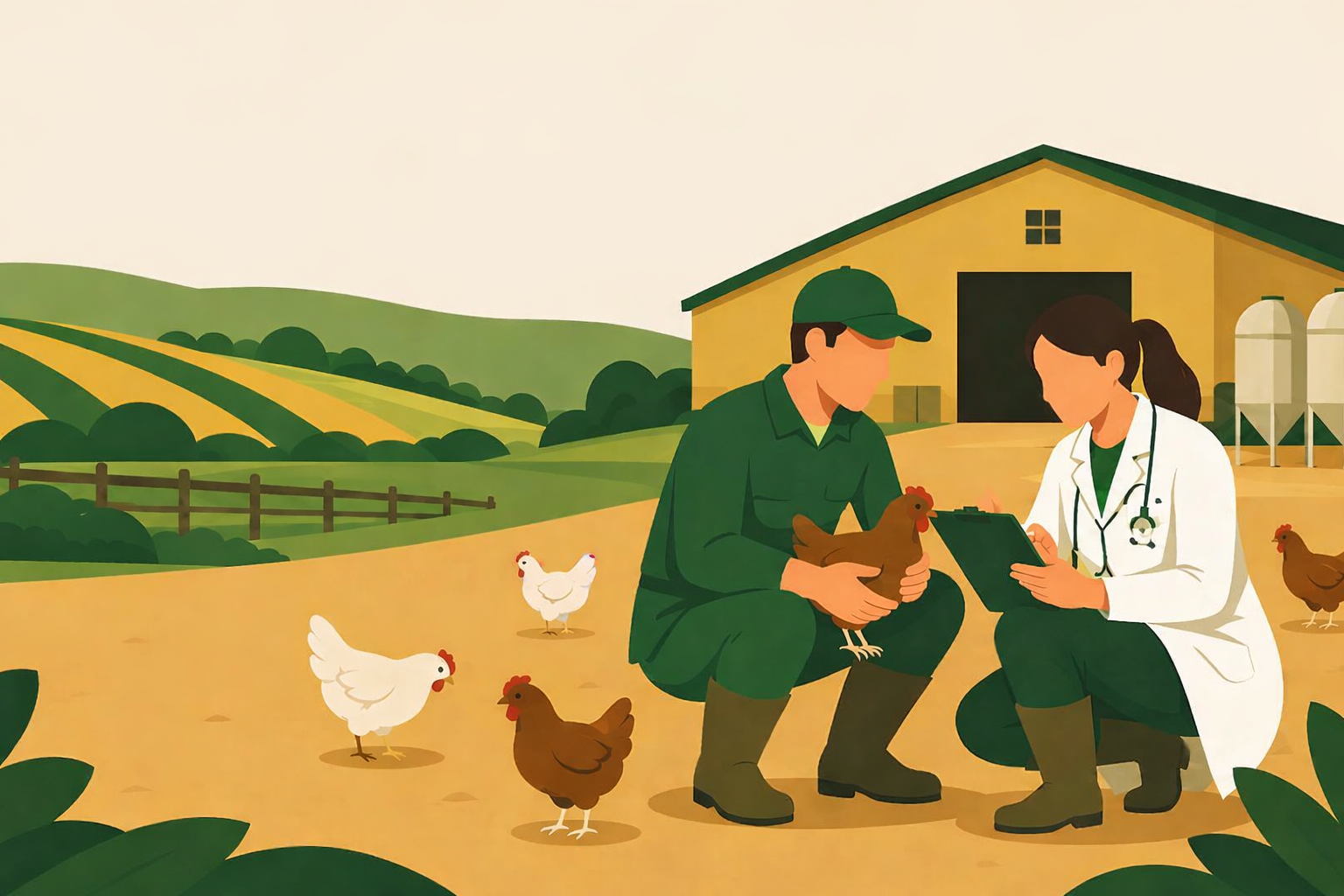
What are worm infections in broilers?
Worm infections are parasitic diseases caused by worms living in the bird’s digestive tract. In poultry the most important are nematodes (roundworms): the large roundworm (Ascaridia galli) in the small intestine, the caecal worm (Heterakis gallinarum) in the caeca, and the small but dangerous hairworms (Capillaria). The parasites feed on intestinal contents, damage the mucosa and compete with the bird for nutrients. The infection spreads by the faecal-oral route: parasite eggs shed in droppings contaminate the litter and are ingested by healthy birds. More on rearing: Broiler farming.
Why are worm infections rarer in broilers but still important?
Broilers grow in a short cycle (usually a few weeks) and are kept on litter in a closed house, without constant access to a range or soil. For this reason the parasite’s full life cycle — from egg to an adult worm able to lay eggs — often fails to complete before slaughter. That is why heavy worm infections are rarer in broilers than in free-range hens, layers or extensively kept birds. The risk, however, rises clearly where litter is reused between flocks, stays wet, or where between-cycle hygiene is poor. Overview of other diseases: Broiler diseases.
How do worm infections affect production results?
Even a moderate worm burden worsens body-weight gain and raises the Feed Conversion Ratio (FCR — kilograms of feed per kilogram of gain), because parasites consume some of the nutrients and the damaged gut absorbs them less well. The flock develops diarrhoea and non-uniformity: some birds grow more slowly and weight differences between birds increase. Every FCR deterioration is a measurable cost for the farmer. In extreme cases a heavy roundworm burden can cause mechanical intestinal obstruction, when a large mass of worms balls up and blocks the gut lumen.
How to recognise worm infections?
Symptoms of worm infections are often non-specific — poorer growth, diarrhoea and flock non-uniformity may also have other causes. A reliable diagnosis rests on faecal examination, which measures the number of parasite eggs per gram (the McMaster method), and on post-mortem of dead birds, during which adult worms can be seen directly in the intestine. Hairworms are especially treacherous: their eggs are tiny and easily missed, while the infection can be more harmful than the worm count would suggest. Table of typical symptoms: Poultry diseases — symptom table.
Worm infections, hygiene and litter
The key to limiting worm infections in broilers is hygiene between flocks and dry litter during the cycle. Parasite eggs mature (become infective) in a warm, moist environment, so wet or reused litter favours infection. Breaking the parasite cycle requires thorough cleaning, drying and — where needed — replacing the litter before a new flock, together with biosecurity that limits the introduction of eggs from outside. More on managing the substrate: Poultry house litter — management and Poultry farm biosecurity.
How worm infections affect the flock and results
Each of these signals should prompt the farmer to test the droppings and consult a veterinarian.
Poorer body-weight gain
Parasites consume some of the nutrients and the damaged gut absorbs them less well. Slower growth with unchanged feeding is a common, early signal of worm infections.
Worsening FCR
A rising Feed Conversion Ratio (FCR — kg of feed per kg of gain) on the same feeding programme may point to an intestinal parasite burden.
Diarrhoea and wet litter
A gut irritated by worms produces looser droppings and wets the litter. Wet litter in turn favours maturation of parasite eggs and sustains the infection.
Flock non-uniformity
Some birds grow more slowly, so weight differences between birds increase. A non-uniform flock is harder to manage and lowers the result of the whole placement.
Risk of intestinal obstruction
With a heavy roundworm burden (Ascaridia galli) a large mass of worms can ball up and mechanically block the gut lumen — a life-threatening condition for the bird.
Hidden hairworm infection
Hairworms (Capillaria) are tiny and their eggs are easily missed. Even so, they can severely damage the mucosa and worsen flock condition out of proportion to their number.
How to prevent worm infections and how to act when infection is suspected
Effective prevention combines between-flock hygiene, dry litter, biosecurity and treatment only on veterinary advice.
Cleaning and drying between flocks
Thoroughly removing droppings, washing and drying the house and — where needed — replacing the litter before a new flock breaks the parasite’s life cycle. This is the single most important element of worm prevention in broilers. Details: Poultry house litter.
Dry litter during the cycle
Parasite eggs mature in moisture, so keeping litter dry and friable lowers the risk of infection. Checking leaking drinkers, good ventilation and the right stocking density all help — see Broiler stocking density.
Biosecurity, rodents and insects
The caecal worm and some other parasites can be carried by rodents and insects, and eggs may be brought in on footwear and equipment. Effective rodent control, insect reduction and biosecurity lower parasite pressure. More: Poultry farm biosecurity.
Diagnostics: faecal exam and post-mortem
Diagnosis rests on faecal examination with the parasite egg count per gram (the McMaster method) and on post-mortem of dead birds. The result lets the vet assess the scale of infection and the need for treatment. Contact a vet: Veterinarian.
Deworming only on veterinary advice
The antiparasitic drug, dose and timing are not chosen on your own. The decision is made by a veterinarian based on diagnostics, and every administration requires observing the withdrawal period before slaughter. Routine deworming in broilers is used judiciously.
Treatment records and withdrawal
Every administration of an antiparasitic drug must be recorded: date, drug, dose, route and withdrawal period. DlaFerm.pl lets you keep these records digitally and available during inspection. More: Treatment records and drug withdrawal.
Frequently asked questions about worm infections in broilers
What are worm infections in broilers?add
They are invasions of parasitic worms in the digestive tract, mainly nematodes: the roundworm (small intestine), the caecal worm (caeca) and hairworms. The parasites damage the gut and worsen growth and feed conversion. The infection spreads through eggs shed in droppings into the litter.
Do broilers often get worm infections?add
Less often than free-range birds and layers, because the short rearing cycle and litter housing often prevent the parasite from completing its full life cycle before slaughter. The risk does, however, rise with reused or wet litter and poor between-flock hygiene.
How do I recognise worm infections in the flock?add
Symptoms are often non-specific: poorer growth, diarrhoea and flock non-uniformity. A reliable diagnosis comes from a faecal exam with the parasite egg count per gram (the McMaster method) and from post-mortem of dead birds, which reveals adult worms. Hairworms are tiny and easily missed.
Can I deworm broilers myself?add
No. The antiparasitic drug, dose and timing are chosen by a veterinarian based on diagnostics, and every administration requires observing the withdrawal period before slaughter. Incorrect use can expose the farmer to legal consequences and leave residues in the meat.
How do I prevent worm infections in broilers?add
The most important measures are cleaning and drying the house between flocks, dry litter during the cycle, biosecurity, and rodent and insect control. These measures break the parasite’s life cycle and reduce infection pressure in the new flock.
How does DlaFerm.pl help with worm infections?add
DlaFerm.pl enables digital treatment and withdrawal records — legally required documentation for every administration of a product. The Flock Card lets you track FCR and daily weight gain, making it easier to spot the drop in results typical of a parasite burden.
Sources & resources
- linkMSD Veterinary Manual — Helminthiasis in Poultry (Ascaridia, Heterakis, Capillaria)
- linkNational Veterinary Research Institute — PIWet (Puławy)
- linkChief Veterinary Inspectorate Poland — information for poultry farmers
- linkKRD-IG — Polish Poultry Council Industry Chamber
- linkWOAH — World Organisation for Animal Health
Keep treatment records with DlaFerm.pl
Want to see how the Flock Card and withdrawal records work for deworming? Write to us or create an account.
Phone
+48 796 258 151