Pullet rearing — from chick to point of lay
Rearing a future layer covers the whole period from chick placement to roughly 16–18 weeks of age — that is, before the hen lays a single egg. It is a completely different world from a broiler: here it is all about slow, controlled growth, an even flock and preparing the bird for the start of lay. We walk you through the feed phases, the body-weight curve, flock uniformity and the lighting programme up to transfer to the laying house.
verifiedFrom the team that has organised work on poultry farms for years.
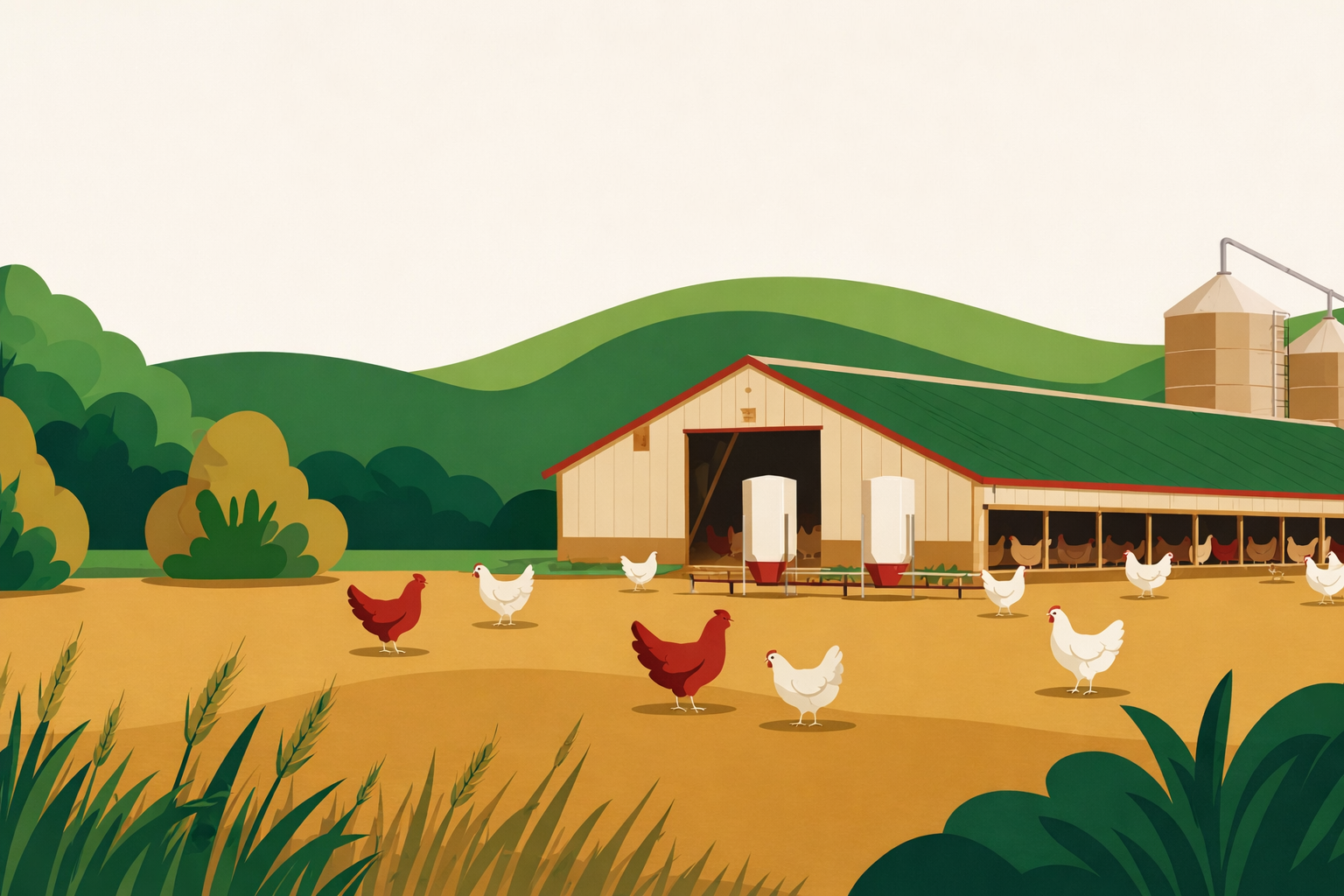
Good rearing decides the whole future laying period. How you lead the hen through the first weeks sets her weight, flock evenness and whether she starts laying at the right time and keeps egg production going for many months. Mistakes from the rearing period cannot be made up later in the laying house. The broader picture is in the hub on layer farming, and here we focus on rearing alone — from chick to the start of lay.
How does pullet rearing differ from a broiler?
A broiler grows fast and finishes rearing in 5–6 weeks at a slaughter weight of 2–3 kg. A future layer is exactly the opposite: she should grow slowly and evenly, reaching a body weight of only ~1.3–1.5 kg* by around 16–18 weeks. We do not want fast gain — we want a bird of the right weight, with a well-developed digestive tract and an even flock, ready only then to take light stimulation and begin laying. That is why feed, light and growth rate are run completely differently than in broiler rearing.
Where do the numbers in this guide come from?
Body weights, growth curves, feed phases and lighting programmes are given as indicative figures* based on layer breed management guides — Lohmann (LSL/Brown), Hy-Line and ISA. Exact values depend on the genetic line, feed, season and house equipment. Treat them as a starting point and always check your breed’s guide and the birds’ response. We cover the differences between lines in the guide on layer breeds.
Pullet rearing step by step
- 1
1. Chick placement and brooding
Just as with a broiler, the first days are about warmth and a good start: a clean, disinfected house, bedded with dry litter and warmed up in advance. In the zone under the chicks (brooding, i.e. preheating under the chicks) around ~33–35°C*, lowering by ~2–3°C per week. The chick must quickly find lukewarm water and feed. The microclimate is covered in the guide on temperature and humidity in the house, and bedding management in litter in the house. The difference from a broiler starts already here: you are set up for a long, calm rear, not a sprint.
- 2
2. Starter phase (about weeks 0–6) — building frame and appetite
The first weeks use a starter feed — a nutrient-rich mix that builds the skeleton, feathering and a healthy digestive tract. The goal is not for the bird to be heavy, but to grow evenly and develop appetite. You watch body weight from now on: weigh samples of birds weekly and compare with the breed curve. If the flock is too light at the start, it is hard to make up later. Flock uniformity is covered in a separate guide on flock uniformity (CV).
- 3
3. Grower phase (about weeks 6–12) — slow, controlled growth
In the grower phase the bird should grow evenly along the body-weight curve — not too fast and not too slow. This is the heart of pullet rearing: here the body frame and the flock uniformity that will shape the whole laying period are formed. Grower feed is less concentrated than starter so the bird also builds digestive-tract capacity, not just fat. You weigh regularly and react to deviations from the curve. Feeding norms at every stage are collected in layer feeding norms.
- 4
4. Developer phase (about weeks 12–16) — finishing the body frame
The developer phase finishes building the body frame before lay. The bird still grows slowly and evenly, reaching the breed target weight at around week 16. This is a good moment to assess whether the flock is even and the weight matches the curve — because we are about to switch on light stimulation, and only a bird of the right weight responds well to it. How to recognise a well-developed young hen is covered in the guide on how to recognise a good layer.
- 5
5. Pre-lay feed and light stimulation (about weeks 16–18)
At the end of rearing you change two things at once. First you introduce a pre-lay feed, richer in calcium, to prepare the bird for eggshell production. Second you start light stimulation — gradually lengthening the light day, which is the signal to start lay. Earlier, during rearing, the light day was shortened or kept stable so as not to trigger lay too early. You only lengthen the light once the flock has reached its target weight. The rules of the lighting programme are covered in the guide on the house lighting programme (some rules apply to pullet rearing too).
- 6
6. Transfer to the laying house (about weeks 16–18)
You move the finished, even young hen to the laying house before she starts laying — most often around 16–18 weeks. The transfer is a stress, so you plan it so the bird has time to learn the new drinkers, feeders and nests before egg production begins. You make sure that in the new house the stocking, welfare and microclimate are ready for the start of lay — see layer stocking density, layer welfare and house requirements for layers.
Pullet rearing parameters — feed, weight, light, uniformity
Indicative values* from layer breed guides (Lohmann, Hy-Line, ISA) — always adjust to your breed’s guide and the birds’ response.
Feed phases
Feed is run in phases: starter (about weeks 0–6), grower (about weeks 6–12), developer (about weeks 12–16) and pre-lay (about weeks 16–18). Each phase is less concentrated than for a broiler — the aim is slow, even growth and digestive-tract development, not fast weight gain.
Body weight and curve
The target weight at around week 16 is indicatively ~1.3–1.5 kg* (lighter for white lines, heavier for brown). What matters most is that the bird follows the breed weight curve: not too heavy, not too light. This is a completely different goal from 2–3 kg of broiler liveweight in 6 weeks.
Lighting programme
During rearing the light day is shortened or kept stable so as not to trigger lay too early. You start light stimulation (lengthening the day) only at about weeks 16–18, once the flock has reached target weight. Light too early = premature start of lay and small eggs; too late = delayed production.
Flock uniformity
Uniformity is the share of birds close to the average weight — the more even the flock, the better and more compact the start of lay. It is measured by the coefficient of variation (CV). Uniformity is built throughout rearing: through even access to feed and water and regular sample weighing.
The most common pullet rearing mistakes
These mistakes come up repeatedly on farms — they usually bite only at the start of lay, when nothing can be fixed.
Treating a pullet like a broiler — growing too fast
The most common mistake is pushing the bird for weight like a broiler. An overfed, too-heavy young hen has trouble with laying, fattening and health. A pullet should grow slowly and evenly along the breed curve, reaching a moderate weight of ~1.3–1.5 kg* only at about weeks 16–18. The goal is an even flock, not heavy birds — see how to recognise a good layer.
No regular weighing or curve control
Without weekly sample weighing you fly blind — you do not know whether the flock is following the weight curve. You only notice a deviation at the start of lay, when nothing can be fixed. Weighing and comparison with the breed curve are the earliest sign that feed, water or microclimate need correcting. Norms are collected in layer feeding norms.
Wrong light stimulation — too early or too late
Lengthening the light day before the flock reaches target weight triggers premature lay and small eggs, and even health problems. Late stimulation, in turn, delays production. You lengthen the light only once the birds are ready by weight — the rules are covered in the guide on the house lighting programme.
An uneven flock — neglected uniformity
An uneven flock (some birds too light, some too heavy) starts lay in a drawn-out way and gives uneven eggs. Uniformity is built throughout rearing: through even access to feed and water, the right stocking and sorting out weaker birds. How to measure and improve it is covered in flock uniformity (CV).
Frequently asked questions about pullet rearing
How long does pullet rearing take?add
Rearing a future layer takes roughly up to 16–18 weeks of age, that is until the bird is ready to start laying. That is much longer than the 5–6-week broiler rearing. After this period the young hen is transferred to the laying house and light stimulation begins. The whole farming is covered in the hub on layer farming.
What are the feed phases in pullet rearing?add
Most often four: starter (about weeks 0–6) builds the skeleton and appetite, grower (about weeks 6–12) drives slow, even growth, developer (about weeks 12–16) finishes the body frame, and pre-lay feed (about weeks 16–18) prepares the bird for egg production, including more calcium. Feeding norms are collected in the guide on layer feeding norms.
What weight should a pullet reach at 16 weeks?add
Indicatively* around ~1.3–1.5 kg, depending on the genetic line (white hens are lighter, brown ones heavier). More important than the exact figure is matching the breed’s weight curve and flock uniformity. A bird that is too heavy or too light starts lay worse. Always check your breed’s guide — differences are covered in the guide on layer breeds.
When should you start light stimulation in a future layer?add
Light stimulation — lengthening the light day — is started only once the flock reaches target weight, usually around 16–18 weeks. Earlier, during rearing, the light day is shortened or kept stable so as not to trigger premature lay. Light too early gives small eggs and health problems, too late delays production. The rules: house lighting programme.
How does pullet rearing differ from broiler rearing?add
A broiler grows fast and finishes rearing in 5–6 weeks at 2–3 kg. A layer should grow slowly and evenly, reaching a moderate weight of ~1.3–1.5 kg* only at about weeks 16–18, and only then starts to lay. The feed phases, weight curve and lighting programme are different. A comparison with the broiler: broiler rearing.
Why is flock uniformity so important in rearing?add
Because an even flock starts lay compactly and gives more uniform eggs, while an uneven one starts in a drawn-out, uneven way. Uniformity is built throughout rearing: through even access to feed and water, the right stocking and regular sample weighing. How to measure it with the CV coefficient and improve it is covered in the guide on flock uniformity (CV).
Run pullet rearing in DlaFerm.pl
Want the weight curve, flock uniformity and rearing phases in one place? Create a free farm account or write to us.
Phone
+48 796 258 151