Layer house requirements — equipment and microclimate
A layer house differs from a broiler house — the bird lives in it for over a year and needs somewhere to lay eggs, somewhere to perch and somewhere to scratch. We have gathered in one place everything the layer house should provide: nests, perches, litter, drinking, feeding, egg collection, manure removal, light and ventilation. For the specifics we link to separate guides.
verifiedFrom the team that has organised work on poultry farms for years.
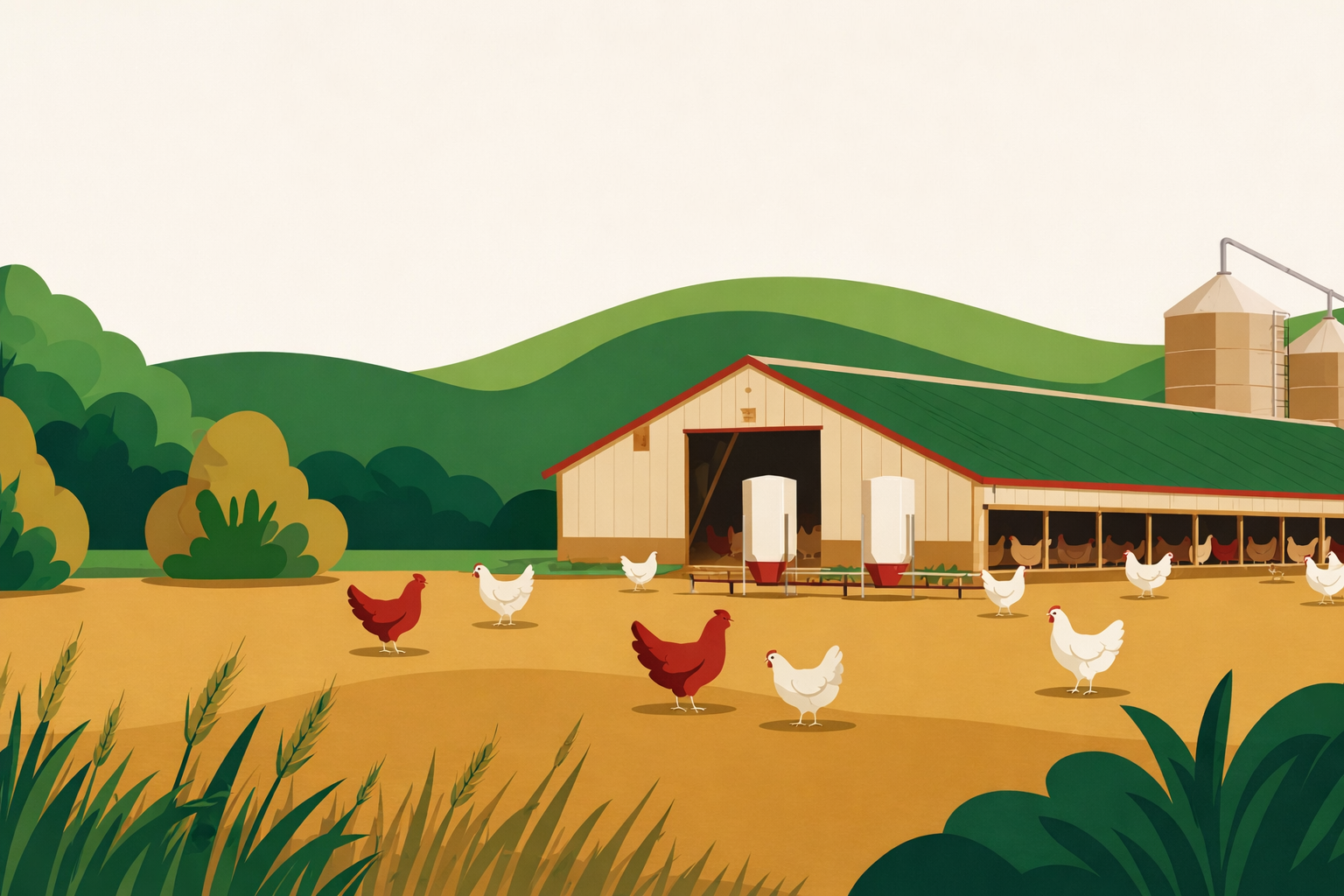
A laying hen spends long productive months in the house, so the building must meet quite different requirements than a hall for a fast-growing broiler. Besides water, feed and a good microclimate, the bird needs places to perform natural behaviours: nests for laying, perches for roosting and litter for scratching and dust-bathing. These decide welfare and egg quality. The whole rearing process is covered in the guide on laying hen farming.
How does this house differ from a broiler house?
In a broiler house what mainly counts is climate and even access to feed and water. A layer house adds living elements: nests the bird must reach easily, perches at the right height and a defined litter area. On top of that comes product logistics — an egg collection system (nest belts) and manure removal (manure belts under the aviary tiers). Which system you choose is compared in the guide on cage, barn and aviary systems.
Where do the numbers in this guide come from?
Indicative values* (nests per hen, perch length per bird, access to water and feed) follow the European Union Directive 1999/74/EC, which sets the minimum standards for keeping laying hens, and the Lohmann and Hy-Line breed guides. This is a starting point, not a fixed recipe — the actual equipment depends on the housing system, breed and flock size. This page is an overview of the whole; the details of each area are in separate guides linked in the text.
What to check when planning and equipping a layer house
- 1
Nests — number and access
Every hen must have easy access to a nest where it can lay an egg calmly. For individual nests a rough guide is about 1 nest per 7 hens*, and for group nests about 120 hens per 1 m² of group-nest area* (per Directive 1999/74/EC). Nests are arranged so they are evenly accessible, lined with a soft material and — in automatic systems — connected to a belt carrying the eggs out. Too few nests or badly set light leads to eggs laid on the floor. More on systems: egg collection systems.
- 2
Perches for roosting
Hens have a strong instinct to perch, especially at night. Directive 1999/74/EC requires perches without sharp edges and gives a rough minimum of about 15 cm of perch per hen*. Perches are mounted at the right height and at spacings that let the birds settle comfortably while not hindering cleaning. In an aviary system the perches are part of the tier structure — we describe it in the guide on the aviary system for layers.
- 3
Litter for scratching and dust-bathing
Part of the house area must be covered with litter, in which hens scratch and dust-bathe — basic behaviours that lower stress and improve plumage condition. The litter should be dry and friable; if it gets wet, ammonia rises and foot condition worsens. Directive 1999/74/EC requires access to suitable litter in alternative systems. The choice of housing system is compared in the guide on cage, barn and aviary systems.
- 4
Drinking and feeding at hen level
Drinking and feed lines are sized and set to the height of an adult hen, not chicks. Every bird must have constant, easy access to water and feed — for nipple drinkers and feed lines Directive 1999/74/EC gives minimum lengths and numbers of points per bird. Line height is adjusted so the bird drinks and eats in a natural posture. Water distribution details: drinking lines in the house; on feed and pan lines: poultry feeding systems.
- 5
Egg collection and manure removal
A layer house adds the logistics of two products. Eggs are collected by nest belts leading to a grading table or packing room, which reduces breakage and manual work — we compare them in the guide on egg collection systems. Manure in an aviary system is removed by manure belts running under successive tiers; frequent manure removal lowers ammonia and improves the microclimate. On belts and frequency: manure removal from the house.
- 6
Lighting, ventilation and ammonia control
Egg production is driven by light — the house must have even, dimmable lighting and the ability to darken so it can run a light programme matched to age and lay phase. Ventilation delivers fresh air and removes moisture and ammonia from the manure — with a long production cycle, ammonia control is crucial. A climate computer with sensors and alarms runs the control. More: house climate controllers.
Indicative equipment values for a layer house
Four groups of figures planning starts from. Indicative values* per Directive 1999/74/EC and breed guides.
Nests
Roughly about 1 nest per 7 hens* for individual nests, or about 120 hens per 1 m² of group nest* (per Directive 1999/74/EC). Nests should be easy to reach and evenly arranged to limit eggs laid outside them. Details: egg collection systems.
Perches
Roughly a minimum of about 15 cm of perch per hen*, without sharp edges, at a height and spacing that let the birds roost comfortably. In an aviary system the perches are part of the tier structure. Related: the aviary system for layers.
Drinking and feeding
Constant access to water and feed for every bird — minimum line lengths and numbers of points per hen are given by Directive 1999/74/EC. Lines are set to the height of an adult hen and adjusted during the cycle. Related: drinking lines in the house and poultry feeding systems.
Litter and area
A defined area of dry, friable litter for scratching and dust-bathing. Wetting litter is a signal that ventilation must improve or manure be removed more often. Choice of housing system: cage, barn and aviary systems.
The most common mistakes in layer house equipment
These mistakes regularly lower welfare and egg quality — worth ruling out at the building planning stage.
Too few nests or badly placed
Too few nests per hen or uneven placement leads to crowding, fighting over a nest and eggs laid on the floor (floor eggs). These eggs are dirtier and break more often. Plan nest numbers per the guidelines and ensure even access and light. Related: egg collection systems.
No perches or wrong height
Skipping perches or setting them too low or too close together denies hens natural roosting and increases stress and pecking. Mount perches without sharp edges, at the right height and spacing. In an aviary they are part of the structure: the aviary system for layers.
Wet litter and high ammonia
With a long production cycle manure quickly raises ammonia if ventilation is too weak and manure rarely removed. Wet litter worsens foot and plumage condition and raises disease risk. Keep up ventilation and frequent manure removal: manure removal from the house.
Drinking and feed lines set as for chicks
Leaving lines at the starting height or too few points per bird means uneven access to water and feed — some hens eat and drink less, which shows in lay. Adjust line height to the adult bird and check the number of points. More: drinking lines in the house.
Frequently asked questions about layer house requirements
How many nests should there be per hen?add
For individual nests a rough guide is about 1 nest per 7 hens*, and for group nests about 120 hens per 1 m² of group-nest area* — these are values from European Union Directive 1999/74/EC. Even nest placement and good lighting also matter, to limit eggs laid on the floor. We cover automating egg collection in the guide on egg collection systems.
Do hens need perches?add
Yes. Hens have a strong instinct to perch, especially at night, and Directive 1999/74/EC requires perches in alternative systems — a rough minimum of about 15 cm of perch per bird*, without sharp edges. Perches are mounted at the right height and at spacings that let them settle comfortably. In an aviary system they are part of the tier structure: the aviary system for layers.
Why do hens need litter for scratching?add
Scratching and dust-bathing are basic hen behaviours — they keep plumage in condition, lower stress and limit feather pecking. That is why part of the house area in alternative systems must be covered with dry, friable litter. When litter gets wet, ammonia rises, so ventilation must improve or manure be removed more often. We compare housing systems in the guide on cage, barn and aviary systems.
How are manure removed and eggs collected in a layer house?add
In modern systems eggs are collected by nest belts leading to a grading table or packing room, which reduces breakage and manual work, and manure in an aviary system is removed by manure belts running under successive tiers. Frequent manure removal lowers ammonia and improves the microclimate. Details: egg collection systems and manure removal from the house.
What lighting and ventilation do hens need?add
Egg production is driven by light, so the house must have even, dimmable lighting and the ability to darken, to run a light programme matched to the birds’ age. Ventilation delivers fresh air and removes moisture and ammonia from the manure — with a long production cycle, ammonia control is crucial. A climate computer with sensors and alarms runs the whole thing: house climate controllers.
How do layer house requirements differ from a broiler house?add
A broiler house is mainly a climate machine set up for fast, short rearing, where temperature and even access to water and feed count most. A layer house serves birds for over a year and adds living elements: nests, perches and a litter area, plus the logistics of eggs and manure. We cover broiler house climate requirements separately in the guide on broiler house requirements.
Sources & resources
- linkCouncil Directive 1999/74/EC — minimum standards for the protection of laying hens (eur-lex.europa.eu)
- linkLohmann Breeders — Management Guide (lohmann-breeders.com)
- linkHy-Line — Commercial Management Guides (hyline.com)
- linkIZ-PIB — National Research Institute of Animal Production, poultry recommendations (iz.edu.pl)
Keep an eye on layer house microclimate in DlaFerm.pl
Want temperature, humidity and ammonia level in one place? DlaFerm.pl integrates with climate sensors and controllers and warns you before house conditions run out of control. Create a free farm account or write to us.
Phone
+48 796 258 151