Laying hen stocking density — birds per m² by system
How many laying hens you may keep per square metre depends on the housing system. We explain in plain language the limits from EU Directive 1999/74/EC: enriched cages, the litter system and the aviary (up to about 9 hens per m² of usable area) and free range. We also explain the key difference between a floor square metre and usable area, where birds in an aviary use several tiers.
verifiedFrom the team that has organised work on poultry farms for years.
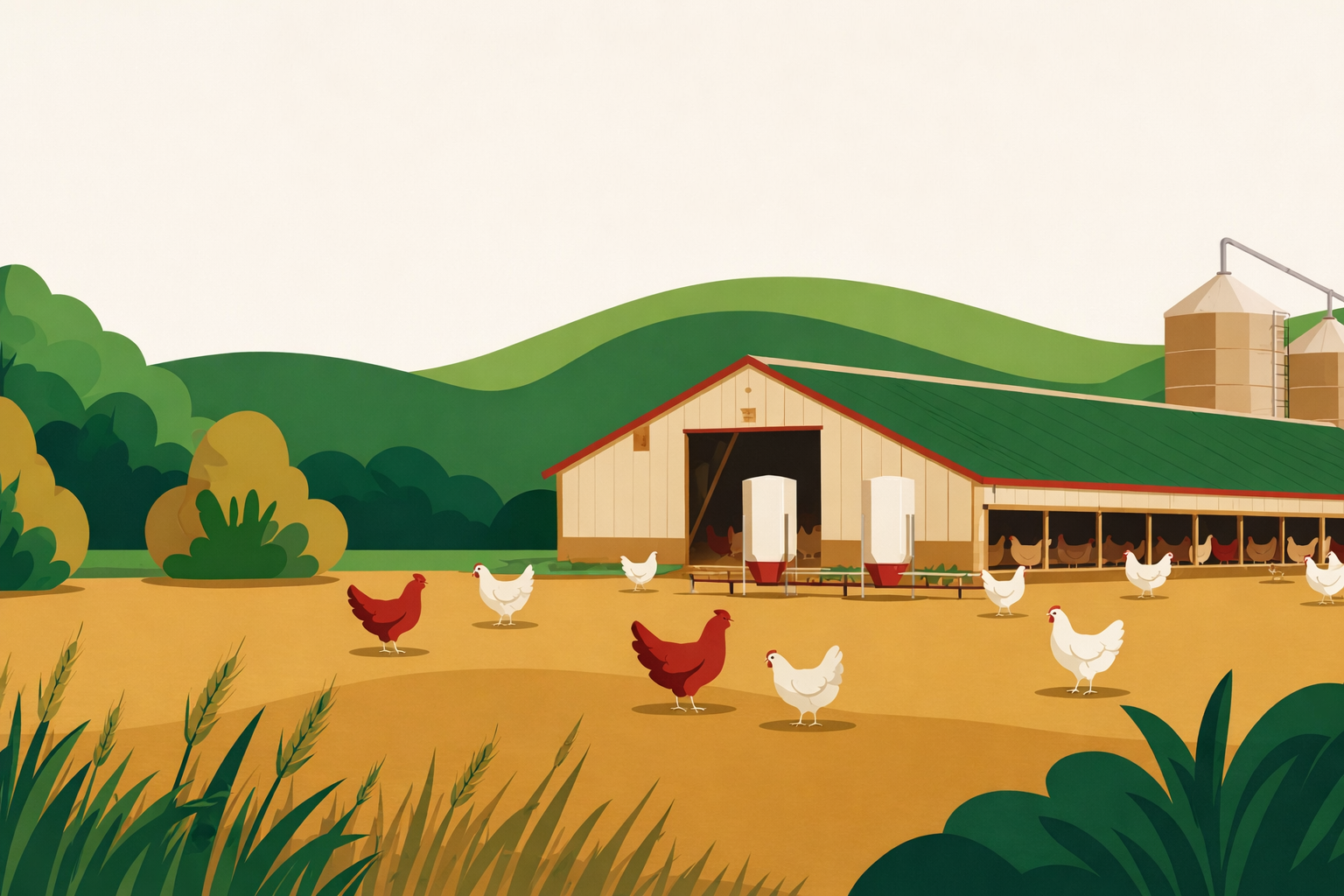
Stocking density is the number of laying hens per square metre. It is one of the most important parameters for welfare and production results — too high a density means worse air quality, more feather pecking, weaker shell quality and higher mortality. But the limits differ for each housing system, so there is no single figure ‘for layers’. The broader picture is in the hub on laying hen farming, and we compare the systems in the guide on cage, litter and aviary systems.
Why does stocking density depend on the housing system?
In enriched cages the birds have an allocated area per bird, a nest, a perch and a scratching area — the limit is given in cm² per hen. In the litter system and the aviary the birds walk across the whole house (and in an aviary also across the tiers), so the limit is given in hens per square metre of usable area. On free range the in-house density is the same as in the litter system, plus a requirement for daytime access to an outdoor range. Each system has its own rules under Directive 1999/74/EC.
Where do the numbers in this guide come from?
The limits come from Council Directive 1999/74/EC laying down minimum standards for the protection of laying hens, implemented in Poland by national legislation. The values given (cm² per bird, hens per m², metres of range) are indicative* and should always be confirmed against the current wording of the rules and the requirements of a welfare programme or egg buyer. Welfare topics are developed in the guides on poultry welfare — subsidies and poultry welfare indicators.
Laying hen stocking density — from system to bird count
- 1
1. Establish your housing system
First decide which system you keep your hens in, because everything else follows from it. In the European Union the permitted systems are: enriched cages (conventional battery cages have been banned since 2012), the litter system, the aviary system (multi-tier) and free range (litter or aviary housing with access to an outdoor range). Each has a different way of calculating stocking density. The systems are compared in the guide on cage, litter and aviary systems, and the aviary itself is covered in the laying hen aviary system.
- 2
2. Enriched cages — count in cm² per hen
In enriched cages the limit is given as the area for a single hen. Indicatively* each hen must have at least ~750 cm² of cage area, of which ~600 cm² is usable area (for free movement), with the rest being the nest and so on. On top of that come requirements for a perch, a nest and a scratching area per bird. This is the densest of the permitted systems, so ventilation and air quality matter especially here.
- 3
3. Litter and aviary — up to ~9 hens per m² of usable area
In the litter system and in the aviary the limit is a maximum of ~9 hens per m² of usable area (under Directive 1999/74/EC)*. The key phrase is ‘usable area’ — in an aviary you do not count only the house floor but the whole area the birds actually walk on, including the tiers (platforms). That is why an aviary fits more birds on the same floor square metre than simple litter housing — you add area vertically. The rules for counting tiers are covered in the guide on the laying hen aviary system.
- 4
4. Free range — in-house density as litter, plus the range
On free range the in-house density is the same as in the litter system (up to ~9 hens per m² of usable area*), but the birds must also have continuous daytime access to an outdoor range. The range is counted separately — indicatively* you must provide about 4 m² of range per hen. The range must be mostly covered with vegetation and equipped with shelters. This is not ‘extra birds per m²’ but a separate requirement for outdoor area.
- 5
5. Link stocking density to ventilation and welfare
The number of birds is not everything — at the maximum permitted density you need ventilation that keeps up with removing moisture, heat and ammonia. A house stocked too densely loses air quality faster, which encourages feather pecking and cannibalism and worsens lay rate and shell quality. So plan stocking together with ventilation, lighting and equipment (perches, nests). The indicators used to measure flock welfare are covered in the guide on poultry welfare indicators.
- 6
6. Check programme and buyer requirements
The directive limits are an upper bound — many welfare programmes and egg buyer contracts require a density lower than the legal maximum. Before stocking the house, check the terms of your programme or contract, because ‘the law allows it’ does not always mean ‘the contract allows it’. Subsidies and welfare requirements are developed in the guide on poultry welfare — subsidies.
Table: laying hen stocking density by housing system
Indicative limits* under Directive 1999/74/EC for four systems. Always confirm against the current rules and programme terms.
Enriched cages
Limit given per bird: indicatively* at least ~750 cm² of cage area per hen, of which ~600 cm² is usable area. Each cage must have a nest, a perch and a scratching area. Conventional battery cages have been banned in the EU since 2012. This is the highest-density system, so ventilation is key.
Litter system
A maximum of ~9 hens per m² of usable area*. The birds walk across the whole house, part of the area is litter for scratching, part may be slats over a manure pit. You count the area actually accessible to the birds, not the whole building footprint.
Aviary system (multi-tier)
Also up to ~9 hens per m² of usable area*, but you count the usable area including the tiers (platforms) the birds walk on. That is why the same floor square metre fits more birds than simple litter housing — while keeping the rules on spacing between levels.
Free range
In-house density as in the litter system (up to ~9 hens/m² of usable area*), plus continuous daytime access to an outdoor range — indicatively* about 4 m² of range per hen, mostly covered with vegetation and with shelters. The range is a separate area requirement, not extra birds per m² of floor.
The most common mistakes when planning layer stocking density
These mistakes come up repeatedly on farms — worth knowing before you stock the house.
Confusing floor m² with usable area
In an aviary the birds walk across several tiers, so the usable area is larger than the house floor alone. If you calculate stocking against floor metres only, you underestimate the permitted number of birds — or, calculating the other way, you could unknowingly exceed the limit for the real usable area. Always establish exactly what counts as usable area in your system — see the laying hen aviary system.
Stocking to the maximum with no ventilation headroom
Stocking a house to the upper limit without ventilation that keeps up ends in poor air quality: humidity and ammonia rise, the litter becomes wet, feather pecking appears. Maximum stocking demands maximum care over air exchange — plan the two together, not separately.
Skipping the range requirement in free-range housing
When you declare ‘free range’, the right in-house density is not enough — the birds must have real, daily access to an outdoor range of the correct area and equipment. Failing the range requirement is not just worse welfare but also a risk of losing the right to mark eggs as free range.
Ignoring feather pecking as a density signal
Feather pecking and cannibalism intensify with, among other things, too high a density, poor air quality and a shortage of feeder space. This is an early sign that the stocking or microclimate needs adjusting — not just ‘a question of flock temperament’. How to monitor welfare is covered in the guide on poultry welfare indicators.
Frequently asked questions about laying hen stocking density
How many laying hens can you keep per m²?add
It depends on the housing system. In the litter system and in the aviary the limit is indicatively* up to ~9 hens per m² of usable area (Directive 1999/74/EC). In enriched cages the limit is given differently — as at least ~750 cm² of cage area per hen (of which ~600 cm² is usable area). On free range the in-house density is as in the litter system, plus a requirement for access to an outdoor range (~4 m² per bird).
What is the difference between a floor m² and usable area?add
A floor square metre is the footprint area of the house. Usable area is the whole area the birds actually walk on — in an aviary it also includes the tiers (platforms) above floor level. That is why an aviary fits more hens on the same floor square metre than simple litter housing: you add area vertically. The ~9 hens/m² limit is calculated against usable area, not the floor alone. The details are in the laying hen aviary system.
What stocking density applies in enriched cages?add
Indicatively* each hen must have at least ~750 cm² of cage area, of which ~600 cm² is usable area for free movement; the rest is the nest and so on. On top of that come requirements for a perch, a nest and a scratching area per bird. Conventional (unenriched) battery cages have been banned in the European Union since 2012 — only enriched cages are allowed.
How much range is needed in free-range housing?add
The in-house density is the same as in the litter system (up to ~9 hens per m² of usable area*), and in addition each hen must have access to an outdoor range — indicatively* about 4 m² of range per bird. The range should be mostly covered with vegetation and equipped with shelters. This is a separate requirement for outdoor area, independent of the in-house density.
How does stocking density affect welfare and air quality?add
The more densely a house is stocked, the more moisture, heat and ammonia the birds produce per unit of area — and the harder it is for ventilation to keep up. Poor air quality and crowding encourage feather pecking and cannibalism and worsen lay rate and shell quality. That is why stocking is planned together with ventilation and equipment, and the flock is monitored with welfare indicators — see poultry welfare indicators.
Can a welfare programme require a lower stocking density?add
Yes. The limits in Directive 1999/74/EC are an upper bound. Many welfare programmes and egg buyer contracts require a density lower than the legal maximum to improve flock welfare. Before you stock the house, check the terms of your programme or contract — ‘the law allows it’ does not always mean ‘the contract allows it’. More on subsidies: poultry welfare — subsidies.
Plan stocking density in DlaFerm.pl
Want flock stocking and a digital flock record in one place? Create a free farm account or write to us.
Phone
+48 796 258 151