Large-scale poultry farming — commercial production at industrial scale
Large-scale farming is poultry production at industrial scale: several commercial houses, tens of thousands of birds, automation of feed, water and climate, and work within integration and contracts. We show, step by step, how to build and run a large commercial farm — from environmental permits, through automation, to smooth management of many flocks in one program.
verifiedFrom the team that has organised work on poultry farms for years.
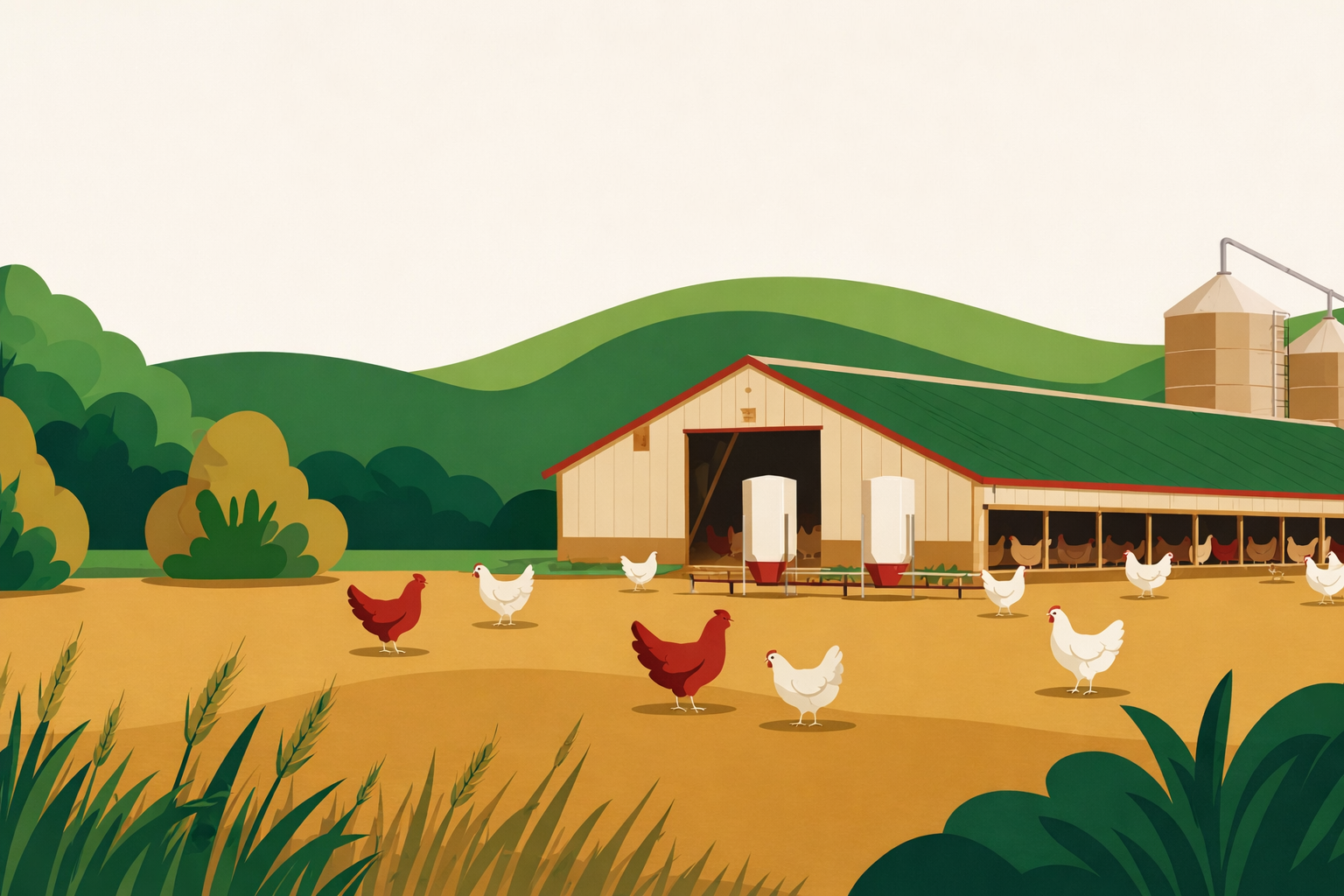
What large-scale (commercial) farming is
Large-scale farming, also called commercial farming, is poultry production for sale at industrial scale — not for your own needs, but for the market, slaughterhouses and contract buyers. Such a farm is usually several large houses with stocking counted in tens of thousands of birds, where everything has to run like a well-oiled machine. This is a completely different scale from a backyard poultry farm or farming for your own needs — here what counts is repeatable results, cost control and strict record-keeping. If you are just starting, it is worth first going through poultry farming step by step.
Automation — feed, water, climate
With large stocking you cannot do everything by hand. Feed travels from silos along feed lines straight to the feeders, water flows through closed drinking lines, and the climate is controlled by a computer. Climate controllers watch over temperature and humidity and switch on ventilation as the flock grows and needs more air. Well-set feeding systems and drinking lines, plus sensors and flock monitoring, decide whether the farm runs steadily or with constant downtime.
Integration and contracts
Many large farmers work within poultry integration — an integrating company supplies the chicks and feed, often also veterinary supervision, and collects the finished live birds at an agreed price. This reduces price risk and makes starting easier, but ties the farmer to a contract and technology requirements. The alternative is independent production, where you buy the chicks and feed yourself and find a buyer. Whichever model you choose, the hard indicators are key — FCR, EPEF and profitability — because they decide the financial result of every batch.
Environmental permits and the LU threshold
A large commercial farm is an investment subject to building and environmental regulations. The stocking size is converted into LU (livestock units), and once certain thresholds are exceeded a decision on environmental conditions may be required, and for the largest farms — an integrated permit. You also have to keep in mind the rules concerning neighbours and distance from buildings. Always check the exact thresholds and requirements in the current regulations and with the competent authority — in this guide we give them cautiously and only as guidance.
Many flocks and houses in one place with DlaFerm.pl
The more houses and flocks, the easier it is to miss something — a vaccination date, a drug withdrawal period, a registry report. DlaFerm.pl brings many flocks and houses together in one poultry farm management software: for each flock you keep a separate digital Flock Card, have flock records in IRZplus — and, if you want, file your flock-change reports to IRZplus automatically — and treatment and withdrawal records at hand, and see all houses in one view. Thanks to this you run even a dozen flocks without chaos and stay ready for an inspection at any time.
How to build a commercial farm — six stages
From the idea and permits, through construction and automation, to running many flocks. Here are six stages that lead from a plot of land to a working large-scale farm.
Business plan and choice of model
Start by working out how much you want to produce and in what model — whether within integration or on your own. Estimate the outlays, revenues and risks using our view of farming profitability and the guide on how much you can earn from poultry farming. At this stage you also decide on the species and production direction.
Land, permits and LU
Choose a location away from buildings and other farms, check the local zoning plan and the required decisions. Convert the planned stocking into LU and determine whether you need an environmental decision or an integrated permit. Take into account the rules concerning neighbours and the nitrate programme and fertilisation plan for managing the manure.
Building commercial houses
Design and build houses meeting the requirements for the given species: insulation, ventilation, heating, flooring and water supply. On larger farms several identical houses are planned to make managing production and flock changes easier. Already at this stage it is worth thinking about clean–dirty zones and biosecurity routes.
Automating feed, water and climate
Equip the houses with silos and feeding systems, drinking lines and climate controllers. It is the automation that delivers a stable microclimate and even feed distribution across the whole house. Add sensors and monitoring and feed silo monitoring so you can react before a problem appears.
Registration and biosecurity
Register the farm and obtain a veterinary number, register the business and prepare a biosecurity plan. On a large farm biosecurity is not a formality — a hygiene barrier, control of vehicle entry and an entry log really protect against avian influenza and other diseases.
Placement and running many flocks
Once the houses are ready you place the first flocks and start production in cycles — preferably in an all-in/all-out system for whole houses. For each flock keep a separate Flock Card and IRZplus records, and watch over the whole farm in one farm management program.
Permits, capital and risks — six things to think through
Large scale means greater opportunities, but also greater responsibility. Here are six areas that decide the success of a commercial farm.
Environmental permits and the LU threshold
The larger the stocking, the more requirements. After conversion into LU and exceeding the thresholds, a decision on environmental conditions may be needed, and for the largest farms an integrated permit. Add to that distances from buildings and the rules concerning neighbours. Check the exact thresholds in the current regulations and with the authority — this is no place for guesswork.
Capital and financing
Building a commercial house with full automation is a large investment — land, buildings, silos, ventilation, controllers and back-up facilities. You need to have the start-up capital worked out, plus a reserve for the first cycles before the farm starts earning. A realistic business plan, based on profitability and the feed cost per kg of live weight, protects against overestimating profits.
Automation and failures
With large stocking, a ventilation or power failure is a threat to the whole flock within hours, not days. That is why alarms, back-up power and service are planned. The more automation there is, the more important its reliability and ongoing supervision become — sensors alone are not everything, what also counts is the response to an alarm.
Disease risks and biosecurity
A large farm means higher stakes when disease appears. Avian influenza, salmonella or gut diseases can halt production and bring serious losses. Consistent biosecurity, a preventive programme and fast disease detection are not a cost but an insurance policy for production continuity.
Managing many flocks
Several houses and a dozen batches a year mean dozens of deadlines: vaccinations, weighings, withdrawal periods, reports. With manual record-keeping it is easy to make a mistake that costs. That is why it is worth keeping each flock separately in a digital Flock Card and tying it all together in one farm management program with a view of all houses.
Records and inspection readiness
A commercial farm is inspected regularly — by veterinary, environmental and welfare authorities. You must keep IRZplus records, treatment and withdrawal records and an entry log. A complete set of documents at hand means calm during an inspection and the basis for settlements with the integrator or buyer.
Frequently asked questions about large-scale farming
How does large-scale farming differ from backyard farming?add
Large-scale (commercial) farming is production for sale at industrial scale — several large houses and tens of thousands of birds, with automation of feed, water and climate. Backyard farming serves mainly your own needs and family. The difference is not only the number of birds, but also the level of automation, environmental formalities and the strictness of record-keeping.
What is the LU threshold and when is an environmental permit needed?add
LU (livestock units) is a way of converting animal stocking into a common measure. Once certain LU thresholds are exceeded, the farm may require a decision on environmental conditions, and at the largest stocking levels an integrated permit. Always check the specific threshold values and the scope of requirements in the current regulations and with the competent authority, because they depend on the species and location.
What does working in poultry integration involve?add
In the integration model the integrating company supplies the farmer with chicks and feed, often also veterinary supervision, and after the cycle collects the live birds at an agreed price. The farmer is responsible for the houses, conditions and production results. This model reduces price risk and makes starting easier, but binds you with a contract and the integrator’s technology requirements.
How do you automate a large poultry farm?add
The basis is the automation of feed (silos and feed lines), water (closed drinking lines) and climate (controllers for temperature, humidity and ventilation). On top of that come sensors and monitoring of the flock and silos, which warn before a problem appears. The larger the stocking, the more important the reliability of these systems, alarms and back-up power become.
How much capital is needed for a commercial farm?add
Building a commercial house with full automation is a large investment covering land, buildings, silos, ventilation and controllers, plus a reserve for the first cycles before the farm starts earning. The exact amount depends on the scale, species and region, so first make a realistic business plan based on profitability and the feed cost. Avoid overestimating profits and underestimating outlays.
How do you manage many flocks and houses at once?add
With several houses and a dozen batches a year, the key is order in deadlines and records. It is best to keep each flock separately in a digital Flock Card, with IRZplus, treatment and withdrawal records, and to tie it all together in one farm management program. DlaFerm.pl shows all houses in one view, so you run even a dozen flocks without chaos.
Sources & resources
Run your whole commercial farm in one place with DlaFerm.pl
Do you have several houses and many flocks? We will show you how DlaFerm.pl ties together all houses, Flock Cards and records in one program — without chaos and ready for an inspection. Write to us and create a free farm account.
Phone
+48 796 258 151