Keeping poultry for your own needs
A few or a dozen hens in a backyard coop mean fresh eggs and meat for the whole family — with very little paperwork. We show how to start step by step: how many birds you may keep without dealing with offices, how to set up the coop, how to feed the birds, and when a small flock turns into a business you have to register.
verifiedFrom the team that has organised work on poultry farms for years.
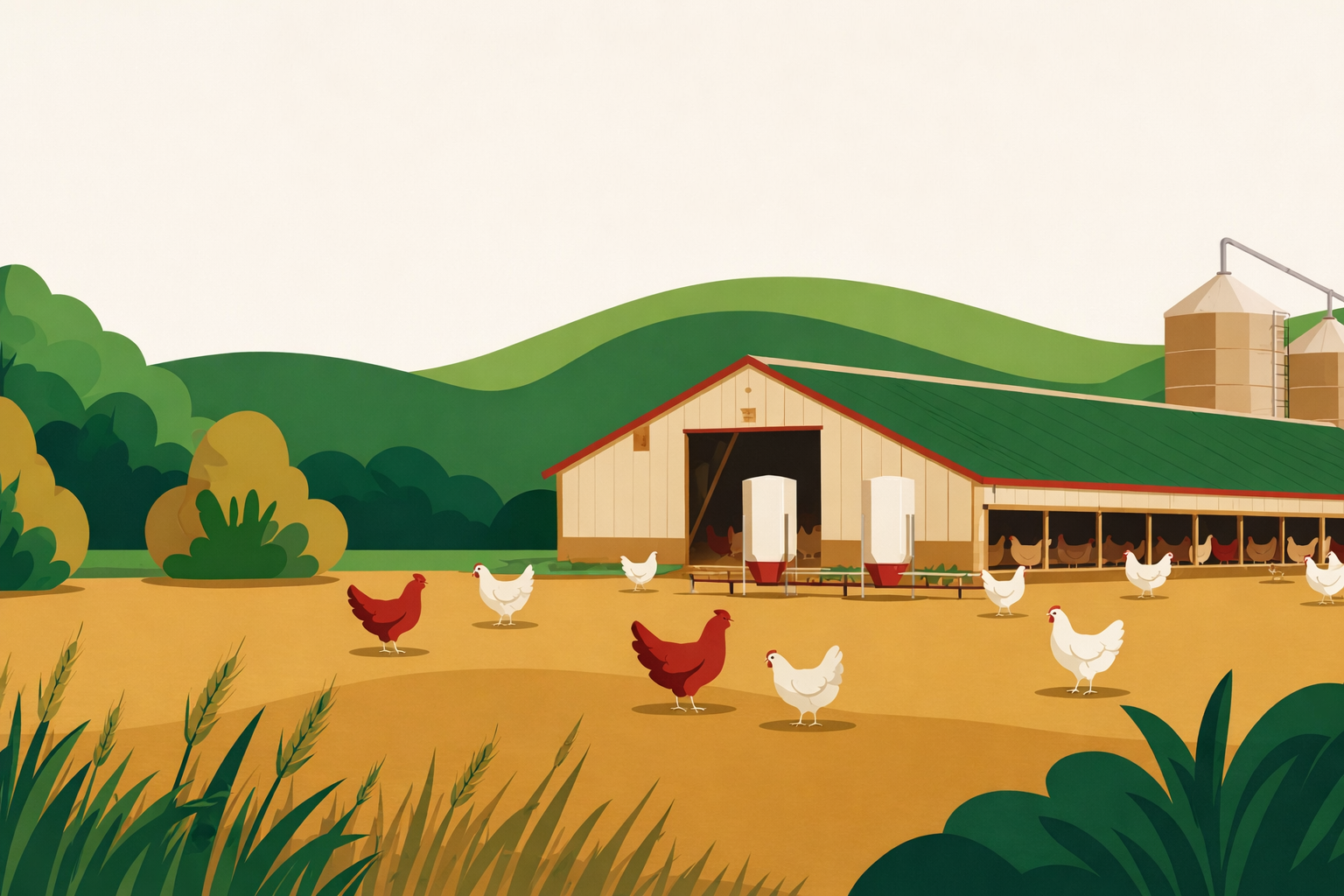
What “for your own needs” means
Keeping poultry for your own needs is raising a few or a dozen birds to have eggs and meat for your family — not for sale. It is the simplest form of keeping poultry: you do not set up a business, you do not need large buildings or specialist equipment. A safe coop, a run and basic knowledge of feeding and bird health are enough. If you are thinking about a larger scale or selling eggs, read the separate guide on poultry farming for sale.
Mostly hens, but not only
For your own needs the most common choice is hens — they lay eggs for most of the year and are easy to handle. For meat, people also keep ducks, geese, turkeys or guinea fowl, though each species has different needs for space, feed and water. If you are just starting, calm, hardy native Polish hen breeds are a good choice. You will find the key terms in the poultry glossary.
Little paperwork, but a few rules apply
Keeping a few hens for yourself does not require setting up a business or keeping records like a large farm. There are limits, though: once you exceed a certain number of birds, or want to sell eggs or meat, a duty to register and to be entered in the records appears. You also have to think about your neighbours’ safety and about rules that protect against bird diseases. We write about the thresholds in the guide on keeping poultry without a permit.
Start calmly, with a few birds
It is best to start with a small flock — a few hens — and learn the rhythm of daily care before you increase the number of birds. It is better to look after five hens well than to struggle with twenty without experience. If you want a full plan from scratch, go through the guide on poultry farming for beginners, and you will avoid typical mistakes with the list of beginner poultry keeper mistakes.
How to start a small family flock
Six steps that lead from an idea to your first eggs — without offices and without big spending.
1. Work out how much you really need
A laying hen produces on average a few eggs a week, so four or five hens usually cover the needs of one family. Start with a small number matched to how many eggs you actually eat. A smaller flock is easier to handle and cheaper to feed. You can always increase the number later.
2. Prepare a safe coop and run
The coop must be dry, sheltered and protected against foxes, martens and birds of prey. You need perches for roosting, nests for laying eggs, and a run where the birds can move around. We describe exactly what to provide in the guide on coop requirements for laying hens.
3. Choose a species and buy healthy birds
The simplest start is with young pullets (reared birds a few weeks old), as they begin laying sooner than chicks. Buy from a trusted seller and look the birds over: they should be lively, clean, with no runny nose or diarrhoea. Calm breeds cope better with the presence of children and nearby buildings.
4. Organise feeding and water
Poultry need constant access to clean water and a balanced feed matched to age and purpose. The most convenient option is to buy ready-made layer feed; kitchen scraps are only an addition, not the basis. For the standards, see the guide on layer feeding standards.
5. Keep them healthy and clean
Clean the coop regularly, change the litter and watch the birds — a change in behaviour or appetite is the first sign of illness. Keep an eye on parasites, especially red mite (a tiny mite that attacks at night). We describe simple farm-protection rules in poultry farm biosecurity.
6. Check you are not crossing the thresholds
As long as you keep poultry only for yourself and in small numbers, there is very little paperwork. Before you enlarge the flock or start selling eggs, though, make sure where the duty to register begins — read poultry registration and the farm veterinary number.
Paperwork, costs and welfare of a small flock
Six things worth thinking through before you bring in your first hens — to avoid trouble with the office and the neighbours.
How many birds without paperwork
A small number of birds kept only for yourself usually does not require setting up a business, but the rules set thresholds above which the flock must be reported and entered in the records. The exact numbers depend on the species and the purpose of keeping and are sometimes changed, so always check the current state with the district veterinary officer. We cover the details in keeping poultry without a permit.
Slaughter for own use
Poultry raised on your own holding may be slaughtered there for your own family’s needs — this is not the same as selling meat. If you want to sell carcasses or eggs, you enter separate rules and often local retail trade. We write about when you may sell from a holding in selling poultry from a holding (local retail).
Neighbours and distances
The coop should stand so that smell, noise and flies do not bother the neighbours — a common source of disputes. It is worth taking care of cleanliness, regular manure removal and a sensible placement of the run from the start. What the rules say about neighbours we gathered in the guide on poultry keeping and neighbours — the rules.
Real costs
At the start you pay for the coop (or its conversion), the netting for the run, drinkers, feeders and the first birds. The ongoing cost is mainly feed, litter and any treatment. A small flock rarely pays for itself in clear money — its value lies in fresh eggs, a known origin of the meat and the pleasure of keeping birds.
Bird welfare
Even a few hens are entitled to dry shelter, movement, daylight and a place to scratch. An overcrowded, dirty coop quickly leads to disease and stress, and from there it is a short step to cannibalism (birds pecking each other). Comfortable, clean conditions mean fewer problems and more eggs.
Protection against bird diseases
Even a small backyard flock is subject to rules protecting against avian influenza — among others, limiting contact with wild birds and feeding under a roof during high-risk periods. Learn to recognise the signs from the guide on avian influenza — signs in poultry and know how to report a suspicion: reporting a suspected case of bird flu.
Frequently asked questions about keeping poultry for your own needs
How many hens can you keep without registration?add
A small number of birds kept only for your own needs usually does not require setting up a business, but the rules set thresholds above which the flock must be reported and entered in the records. The exact numbers depend on the species and purpose of keeping and are sometimes changed, so the safest course is to check the current state with the district veterinary officer. There is more in the guide on keeping poultry without a permit.
Can I slaughter my own hens for the family’s meat?add
Yes — poultry raised on your own holding may be slaughtered there for your own family’s needs, and this is not a sale. It is different when you want to sell carcasses or eggs: separate rules then apply, most often within local retail trade, with additional sanitary requirements.
How many hens do you need for the family’s eggs?add
A laying hen produces on average a few eggs a week, so four or five hens usually cover the needs of one family. It is worth starting with a smaller number and matching it to how many eggs you actually use. You can always enlarge the flock later.
Do I have to ask my neighbours for permission to keep hens?add
The neighbours’ consent is not formally required, but the coop must be placed so that smell, noise and flies do not bother them — the most common source of disputes. Care for cleanliness, regular manure removal and a sensible placement of the run usually suffice to avoid conflicts. You will find details on distances in a separate guide.
How much does it cost to start a small hen flock?add
At the start you pay for the coop or its conversion, netting for the run, drinkers, feeders and the first birds, while the ongoing cost is mainly feed and litter. A small flock rarely pays for itself in clear money — its main value lies in fresh eggs, a known origin of the meat and the joy of keeping birds.
Where is it best to buy the first hens?add
The simplest start is with young, reared pullets from a trusted seller, as they begin laying sooner than chicks. Look the birds over before buying: they should be lively, clean, with no runny nose or diarrhoea. Calm, hardy breeds cope better with the presence of children and nearby buildings.
Run your small flock with order from day one
Even a few hens are worth describing: how many birds, when fed, when treated. Create a free farm account in DlaFerm.pl and keep a simple Flock Card and records so nothing slips your mind. Write to us.
Phone
+48 796 258 151