Broiler farming on a farmstead — meat-chicken fattening at small scale
The broiler is a fast-growing meat chicken that on a farmstead you fatten in under six weeks from a chick to 2–3 kg of live weight. We show how to run such fattening at a small, farmstead scale — from choosing chicks, through phase feeding and a farmstead house, to slaughter for your own use or sale from the farm.
verifiedFrom the team that has organised work on poultry farms for years.
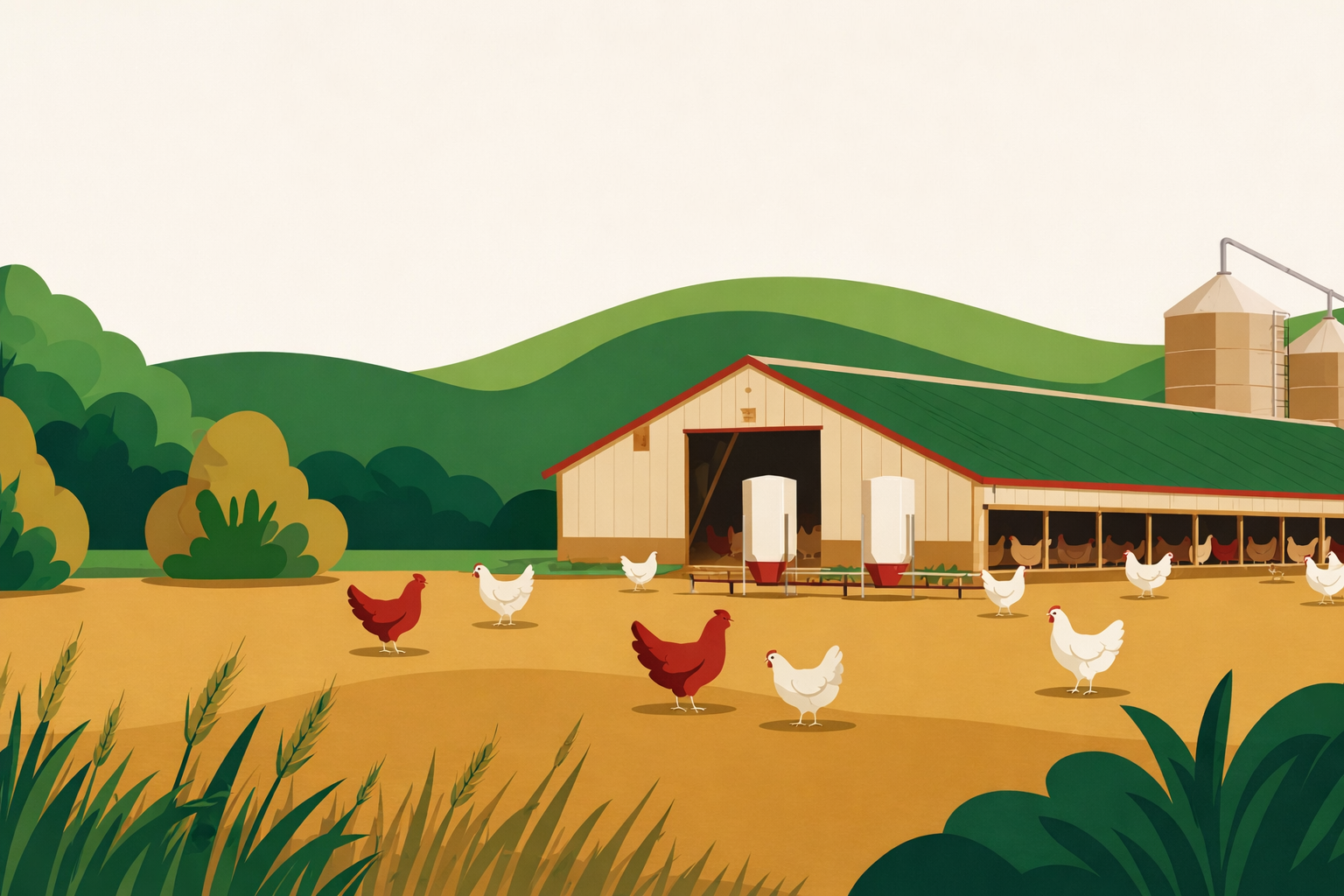
The broiler on a farmstead — fast fattening of a meat chicken
The broiler is a meat chicken — a bird selected for fast body-mass gain. On a farmstead you fatten it at a smaller scale than on a large farm, but the rules are the same: a short cycle, intensive feeding and a warm, dry house. A chick of about 40 g reaches 2–3 kg of live weight in under six weeks. This is a completely different model from keeping layers for eggs — here what counts is growth rate and good feed efficiency. You will find the full production picture in the guide on broiler farming.
Why fatten broilers at small scale
Farmstead broiler fattening has two typical goals: meat for the family’s own use and small-scale sale from the farm to neighbours and local buyers. Small scale gives control — you know what you feed the birds and in what conditions they grow. You do not compete on price with large farms, but you can focus on quality and local sales. Before you place the first chicks, it is worth calculating the cost of feed and chicks and checking whether you have a suitable house and who will buy the live birds or carcasses.
Phase feeding — the key to good fattening
You feed the broiler high-energy, high-protein feed delivered in phases matched to age: starter (the youngest chicks), grower (the growth phase) and finisher (final fattening). Each mix has a different composition, because the bird’s needs change every week. Good feeding directly affects the growth rate and the amount of feed used per kilogram of gain — and feed is the largest cost of the whole fattening. On a farmstead it is most convenient to buy ready-made broiler mixes in the right phases.
A farmstead house and flock welfare
Broilers need a warm, dry and well-ventilated room with even access to feed and water. On a farmstead an ordinary, insulated house is enough, but it must meet the basics: heating for the chicks in the first days, dry litter and air exchange without draughts. We cover conditions, leg quality and litter in the guide on broiler welfare. The better the conditions, the healthier the flock, the fewer losses and the better the fattening result.
Records and order with DlaFerm.pl
Even small broiler fattening comes with duties — reporting the flock, records in IRZplus, and, when treating birds, keeping treatment and withdrawal records before slaughter. DlaFerm.pl brings this together in one place: you keep a digital broiler Flock Card, have the placement dates, feed costs and slaughter dates at hand, and stay ready for a possible inspection. And you can have DlaFerm.pl file your flock-change reports to the often cumbersome IRZplus — we send them to ARiMR for you, if you want, without logging into the portal.
Fattening a broiler on a farmstead — six steps
From deciding on the number of birds to slaughter or sale of live weight — here are the successive stages of farmstead broiler fattening.
1. Plan the scale and sales
Decide how many broilers you want to fatten and why — for your own use or partly for sale. Calculate how much room you have in the house (broilers need space so they do not crowd at the feeders) and to whom and how you will sell any surplus. This is the moment to estimate the cost of feed and chicks even before placement.
2. Prepare the house
Before the chicks arrive, clean and disinfect the room, lay fresh, dry litter and warm it to the right temperature. Check the heating, ventilation and the drinkers and feeders. A warm, dry start is the basis of successful fattening — chilled chicks grow more slowly and fall ill more often.
3. Buy good chicks
Choose healthy broiler chicks from a trusted source — a hatchery or a reliable supplier. A good chick is lively, clean, evenly grown and finds feed and water efficiently. The whole fattening depends on the quality and uniformity of the chicks, so it is not worth saving money at this stage.
4. Brood the chicks
In the first days the chicks need a high temperature under the heat source, easy access to starter feed and clean water, and the right lighting. This is the most sensitive stage — make sure all birds eat, drink and grow evenly. Observe the flock several times a day and react to the first signs of weakness or diarrhoea.
5. Run phase fattening
In the following weeks you move from starter to grower feed, and at the end to finisher. The flock grows intensively, so the demand for air and dry litter rises too. Take care of ventilation and cleanliness, weigh the birds for control and record feed use — this lets you judge whether the fattening is going to plan.
6. Slaughter or sale of live weight
When the broilers reach 2–3 kg, you plan slaughter for your own use or the sale of live birds or carcasses. If the birds were treated, you must wait out the medicine’s withdrawal period before slaughter. Selling carcasses from the farm usually requires registration under agricultural retail trade (RHD) — check the requirements before the first sale.
Costs, profitability and formalities of small-scale fattening
Small scale has its own rules. Here are six things to keep in mind before you place the first broilers.
Fattening costs
The largest cost is feed, followed by buying the chicks and heating the house in the first days. On top of that come litter, water, electricity and labour time. Before placement, calculate the cost per bird — it is then easier to judge whether fattening for sale pays off at all, or whether it should be mainly for your own use.
Profitability of small scale
A small operation does not benefit from economies of scale, so the cost of fattening one broiler can be higher than on a large farm. For your own use, what mainly counts is quality and control over the meat. For sale it is hard to compete on price with a supermarket — focus on local sales, freshness and the trust of buyers.
Sale under RHD
The sale of carcasses and meat from the farm usually takes place under agricultural retail trade (RHD). Quantity limits, hygiene rules and registration apply here. Before you start selling, check the current RHD requirements and any obligation to register with the district veterinary officer — the rules are sometimes updated.
Welfare and conditions
Even at small scale broilers must have enough room, dry litter, fresh air and constant access to feed and water. Crowding and wet litter lead to leg problems and disease. Good conditions are not only a duty — they directly mean fewer losses and a healthier flock. Details in the guide on broiler welfare.
Flock health and biosecurity
The most common threats are coccidiosis and bacterial infections, and nationally — avian influenza. Even a small operation should apply the basics of biosecurity: limit access for outsiders, keep things clean and keep wild birds away from feed and water. An early reaction to symptoms limits losses.
Documentation and records
The flock must be reported and recorded in IRZplus, and when treating birds you must keep treatment and withdrawal records. Even small fattening is worth documenting: placement date, number of birds, feed cost, deaths and slaughter date. The most convenient way is the digital broiler Flock Card.
Frequently asked questions about broiler farming on a farmstead
How long does broiler fattening on a farmstead take?add
Broiler fattening usually takes about 6 weeks — from placing the chick to reaching 2–3 kg of live weight. On a farmstead the cycle is the same as on a farm, only at a smaller scale. The time may differ slightly depending on the chicken line, feeding and house conditions.
What to feed broilers at small scale?add
Broilers are fed high-energy, high-protein feed delivered in phases: starter for the youngest chicks, grower in the growth phase and finisher at the end of fattening. On a farmstead it is most convenient to buy ready-made broiler mixes in the right phases. The feed must be fresh and the water always clean and available.
Can I sell broilers from my farm?add
Yes, but the sale of carcasses and meat usually takes place under agricultural retail trade (RHD), with quantity limits, hygiene rules and registration. Before the first sale, check the current RHD requirements and any obligation to register with the district veterinary officer, because the rules are sometimes updated.
What house is needed for broiler fattening?add
An ordinary, insulated farmstead house is enough, providing warmth for the chicks in the first days, dry litter, air exchange without draughts and even access to feed and water. It is important that the birds are not crowded, because crowding and wet litter lead to leg problems and disease.
Does small-scale broiler fattening pay off?add
A small operation does not benefit from economies of scale, so the cost of fattening one bird can be higher than on a large farm. For your own use, what mainly counts is quality and control over the meat. For sale it is hard to compete on price with a supermarket, so it is worth focusing on local sales, freshness and the trust of buyers.
Do I have to report and record a small broiler flock?add
Yes, a poultry flock must be reported and recorded in IRZplus, and when treating birds you must additionally keep treatment and withdrawal records before slaughter. Even small fattening is worth documenting: placement date, number of birds, feed cost, deaths and slaughter date — most conveniently in a digital Flock Card.
Run farmstead broiler fattening with DlaFerm.pl
Want placement dates, feed costs and flock records in one place? We will show you how DlaFerm.pl makes broiler fattening easier even at small scale. Write to us.
Phone
+48 796 258 151