Breeding broilers for robustness and health
For years broilers were selected mainly for growth rate. Today breeding companies look wider: alongside gain, they select birds for immunity, healthy legs, fitness and lower mortality. This direction is called robustness or balanced breeding. We explain what it means in practice and how to use this knowledge when choosing a line or cross for your farm.
verifiedFrom the team that has organised work on poultry farms for years.
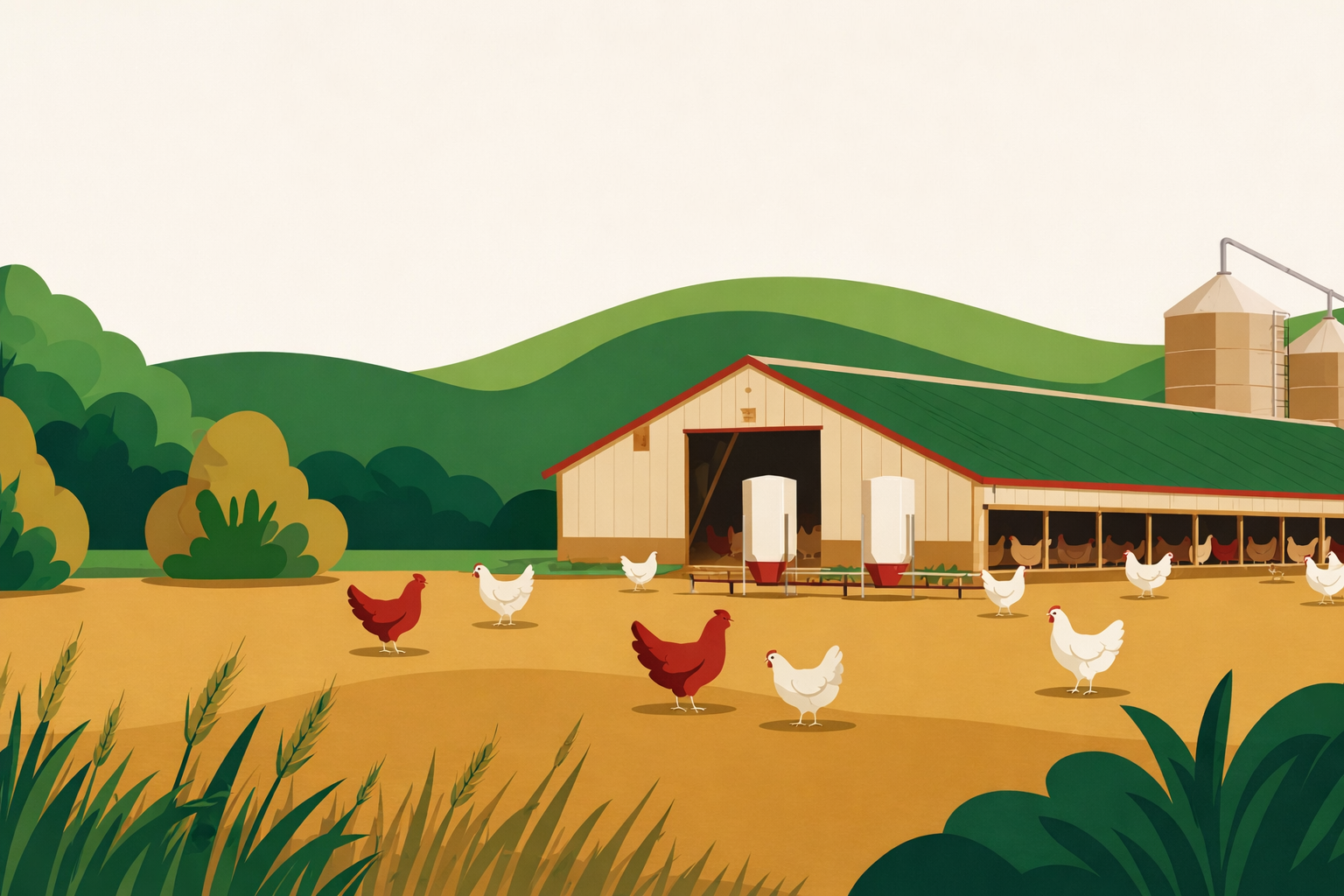
Breeding broilers is the choice of which birds are used for further breeding — that is, which traits a breeding company strengthens from generation to generation. For a long time the strongest emphasis was on growth rate and feed conversion. Over time it became clear that growth speed alone isn’t enough — the bird must also be healthy, fit and robust for the whole flock to turn out well. So modern breeding looks at many traits at once, not just weight at a given age.
What does breeding for robustness and health mean?
It’s the direction called robustness or balanced breeding. Alongside growth rate, breeding companies select birds for leg health, mobility, good condition, lower mortality and better coping with health pressure. The idea is that the bird not only grows fast but also handles rearing conditions well and falls ill less. For the farmer this means lines that are more uniform and less troublesome to manage, even if the gain isn’t the absolute highest.
Traits considered in modern selection
Balanced breeding combines the production result with health and welfare — none of these is chosen at the expense of the rest.
Immunity and general health
Birds are chosen to cope better with germ pressure and fall ill less in typical rearing conditions. Stronger immunity means a calmer flock and a lower risk that a single health problem brings down the whole flock. It is one of the main traits of the robustness direction.
Leg health and fitness
Healthy, strong legs are the basis of welfare and a good result, because a bird that won’t walk eats and drinks worse. Selecting for leg condition and mobility reduces walking problems and lameness. For the farmer that means fewer birds lying idle and better flock uniformity.
Lower mortality
Lines selected for robustness and health usually give lower mortality in the flock. Fewer losses are not only a better financial result but also a sign that the birds handle rearing conditions well. It’s a trait the farmer feels directly with every flock.
Heart and circulation condition
Very fast growth strains the heart and circulation, so selection also pays attention to their capacity. Better circulatory condition reduces the metabolic problems linked to growth rate. It’s an element of the balance between fast gain and the bird’s health.
Meat quality and body conformation
Selection also accounts for body conformation and muscle quality, including reducing breast-muscle defects that appear with very fast growth. The goal is a well-built bird, not just a heavy one. This affects carcass value and the assessment at slaughter.
Flock uniformity and repeatability
A good line is one that gives uniform, repeatable flocks from cycle to cycle. A smaller spread of weights and even growth make management and slaughter planning easier. Repeatability is a practical benefit of balanced breeding that shows only after several flocks.
Choosing genetics step by step
- 1
Define what your market expects
Start with what you sell for: what slaughter weight and age, what carcass quality the buyer expects and whether welfare matters to them. That decides whether you care more about growth rate or about health and uniformity. Choosing genetics starts with the goal, not the catalogue.
- 2
Compare line traits, not just gain
When reading breeding-company material, look not only at growth rate but also at leg health, mortality, immunity and uniformity. Lines in the robustness direction may grow a little slower but give a calmer flock. Compare traits as a whole, because weight at a given age alone doesn’t tell everything.
- 3
Match the line to your conditions
Think about what your conditions look like: stocking, house climate, health pressure, the crew’s experience. More robust and fit lines forgive more in tougher conditions, while the fastest lines demand more refined management. Choose genetics for the reality of your farm, not for ideal conditions.
- 4
Stick to the recommendations for the line
Every line has its management guide: feeding and lighting programme, target weights and densities. These recommendations are matched to the line’s selection, so it’s worth following them to use its potential. Genetics gives its full benefit only with the management it was selected for.
- 5
Watch health, legs and mortality
After placing the flock, watch how the birds walk, what the leg condition looks like and what the mortality is. That’s the real test of whether the line suits your conditions. Note these observations, because they, not the catalogue, will show whether the choice of genetics paid off.
- 6
Compare flocks and draw conclusions
Collect the results of successive flocks: weights, mortality, uniformity, leg problems. After several flocks you’ll see how the line behaves at your farm and whether it’s worth staying with it or changing the cross. The genetics decision should rest on your own data, not just on declarations.
Frequently asked questions about broiler breeding
Does a robust line grow slower than the fastest one?add
Often a little slower, but that’s not the whole story. Lines in the robustness direction aim for balance: a slightly calmer growth in exchange for better leg health, lower mortality and greater immunity. For many farms a uniform, healthy flock gives a better final result than the highest gain paid for with health problems. The choice depends on your market and conditions.
What is balanced breeding?add
It’s an approach where the breeding company selects birds for many traits at once, not just for growth rate. Alongside gain, leg health, immunity, heart condition, meat quality and lower mortality all count. The goal is a bird that grows well but is also healthy and fit, with a flock that is more uniform and repeatable.
Does the choice of line really affect leg health?add
Yes, because leg health and fitness are now among the traits birds are deliberately selected for. Lines in the robustness direction usually have fewer walking problems and less lameness in typical conditions. Genetics won’t replace good management, though — dry litter, movement and the right feeding still decide how the legs look in practice.
How do I choose a cross for my farm?add
Start with your market goal and your conditions, and only then compare lines. Look not only at growth rate but also at leg health, immunity, mortality and uniformity, and match the line to the stocking and health pressure in your house. The best verification is your own data from several flocks, not the catalogue alone.
Record the line and flock results in DlaFerm.pl
In DlaFerm.pl, next to the flock card, you note which line or cross you placed, along with rearing observations — mortality, leg condition, uniformity. That way you can compare genetics across flocks. Create a free account or write to us.
Phone
+48 796 258 151