Slow-growing chicken — slow-grow breeds and the ECC
A slow-growing chicken grows more slowly than a standard broiler — roughly up to about 50 g a day instead of 60 g and more. The slower pace gives stronger legs, fewer joint problems and lower mortality, and welfare programmes such as the European Chicken Commitment require it. We explain which breeds these are, why farmers keep them and what it costs.
verifiedFrom the team that has organised work on poultry farms for years.
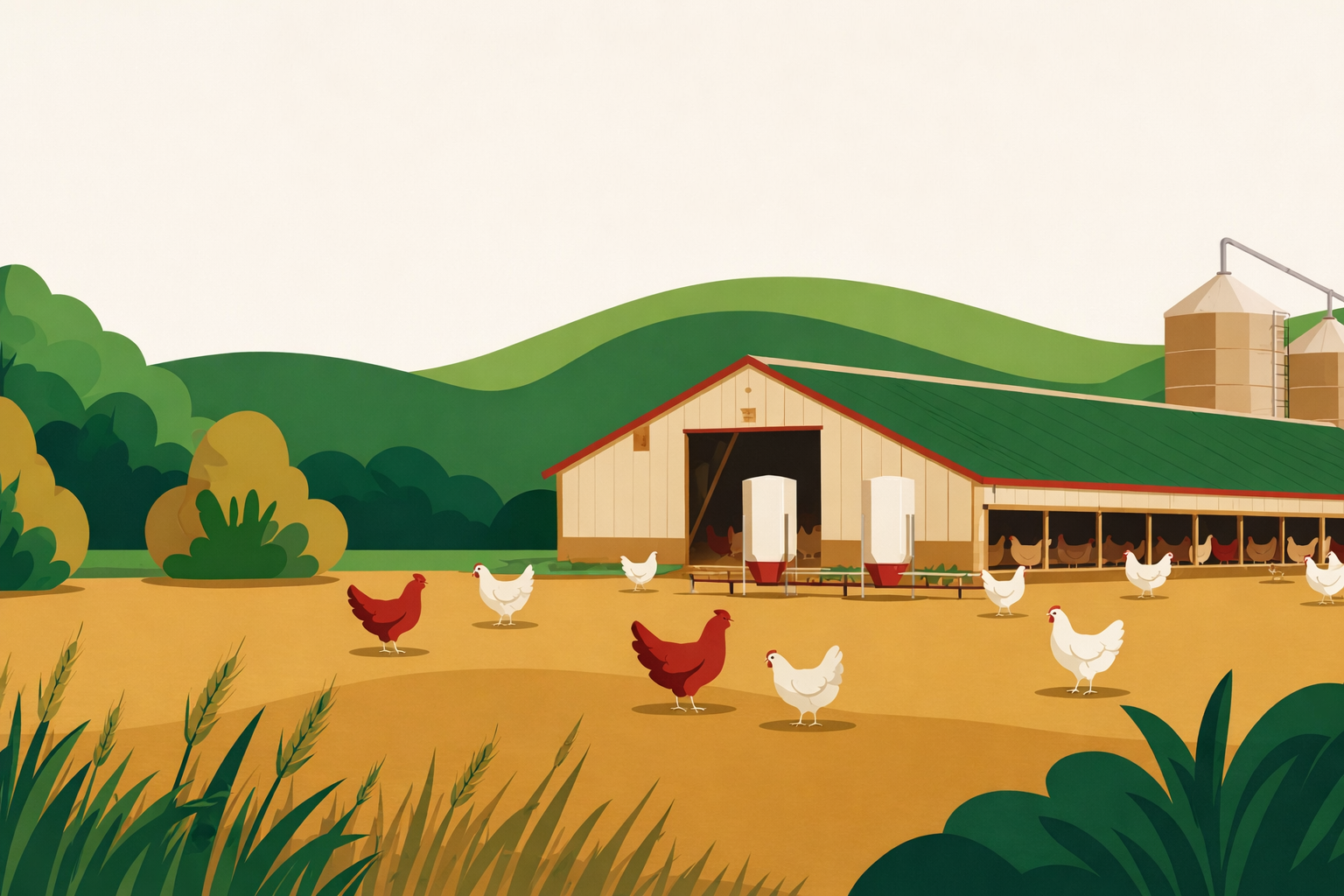
A slow-growing chicken (slow-growing or intermediate-growing) is a broiler from breeds bred to grow more slowly than the fastest commercial lines. Instead of gains of around 60 g a day and more, slow-grow breeds put on roughly up to about 50 g a day and reach slaughter weight later, usually at 56 days or more rather than around 35–42 days. The slower growth is not a flaw — it is a deliberate choice for a healthier bird and better welfare.
Why raise a bird that grows more slowly?
Very fast growth strains the body: the legs and joints can’t keep up with the mass, lameness, bacterial chondronecrosis (BCO) and foot-pad lesions (pododermatitis) appear more often, and the heart and lungs run at their limit. Slow-growing breeds have stronger legs, are more active, cope better with rearing and record lower mortality. That is why they sit at the heart of welfare programmes such as the European Chicken Commitment — pledges by retailers and brands to move away from the fastest lines. We cover the programme itself on the European Chicken Commitment (ECC) page; here we focus on the specific breeds.
What slow-grow actually means
Growth rate is a conventional line, not a hard threshold. Below are the key breeds, crosses and terms you’ll meet when choosing a slow-growing bird.
Hubbard JA (e.g. JA757, JA987)
One of the most popular families of slow-growing and intermediate breeds. The JA lines offer strong legs, good liveability and a calm temperament. They are often chosen for welfare programmes and free-range rearing, because they combine sensible growth with high carcass quality.
Rowan Ranger and the Ranger family (Aviagen)
Ranger, Rowan Ranger and related Aviagen lines are broilers with an intermediate growth rate, made for slower and free-range rearing. They have good leg health and even feathering, and still offer reasonable slaughter yield for a slow-growing bird.
Slow-growing versus intermediate
In practice people talk about two groups: genuinely slow-growing birds (gains clearly below the fast lines) and intermediate ones, which grow more slowly than a commercial broiler but faster than classic free-range breeds. The choice depends on your buyer’s requirements and the programme you want to join.
Growth rate as a criterion
The line is often the average daily weight gain over the whole rearing period. Welfare programmes set it roughly around 50 g a day — a bird that grows more slowly qualifies as slow-growing. It is a conventional threshold, but it captures the difference between a fast line and a slow-grow one well.
Lower stocking and more space
Raising a slow-growing bird goes hand in hand with lower density. Welfare programmes usually cap stocking at around 30 kg per square metre and also require enrichment: perches, pecking materials, natural light. That means fewer birds on the same area, but a calmer and healthier flock.
The European Chicken Commitment requirement
The ECC is a set of welfare criteria that retailers and brands pledge to meet: slow-growing breeds or breeds with a better welfare score, lower stocking, environmental enrichment and better slaughter conditions. Choosing a slow-grow breed is one of the most important points of that commitment.
From the decision to a slow-growing flock
- 1
Check what your buyer requires
Before you pick a breed, work out which programme or buyer you are raising the bird for. Retail chains, premium brands and part of the export market have their own criteria — often based on the European Chicken Commitment. They decide whether you need a slow-growing line, what stocking and what enrichment.
- 2
Match the breed to the goal
Choose between a genuinely slow-growing bird (e.g. Hubbard JA) and an intermediate line (e.g. Rowan Ranger), depending on the required growth rate and carcass quality. Confirm chick availability and feeding guidance with your genetics supplier — each line has its own data sheet and growth curve.
- 3
Recalculate the longer cycle
A slow-growing bird goes to slaughter later — often at 56 days or more instead of around 35–42 days. A longer cycle means more days of heating, watering and feeding per bird, and fewer crops a year. Build this into your flock-turnover plan and costing.
- 4
Plan for higher FCR and feed cost
Slower growth usually means a worse feed conversion ratio (FCR) and a higher feed cost per kilogram of live weight. That is the natural welfare trade-off — the bird lives longer and eats more. Check whether the purchase price or a programme premium makes up the difference.
- 5
Lower the stocking and add enrichment
Adjust the number of birds to the programme’s stocking limit — usually around 30 kg per square metre. Plan perches, pecking materials and access to natural light. Lower density and enrichment mean less cannibalism, better litter quality and healthier legs.
- 6
Monitor legs, litter and mortality
The point of a slow-growing bird is health — so watch leg condition, foot-pad quality, litter dryness and the mortality curve. A regular check shows whether the rearing really delivers the promise of better welfare and lets you react before problems set in.
Frequently asked questions about slow-growing chicken
What actually makes a slow-growing chicken different from an ordinary broiler?add
Mostly the growth rate. A standard commercial broiler gains roughly 60 g a day and more, while slow-grow breeds put on up to about 50 g a day, so they reach slaughter weight later — usually at 56 days or more. The slower growth translates into stronger legs, more activity and lower mortality, at the cost of a longer cycle and higher costs.
Which breeds are slow-growing?add
The ones most often named are the Hubbard JA family (e.g. JA757, JA987) and the Aviagen Ranger group, including Rowan Ranger. Some are genuinely slow-growing, some are intermediate — growing more slowly than a commercial broiler but faster than classic free-range breeds. The specific line and its growth curve are best confirmed with your genetics supplier.
Why switch to a slow-growing bird if it grows more slowly?add
The main reason is welfare and market demand. Slower growth strains the legs, joints, heart and lungs less, so lameness, BCO and pododermatitis fall and mortality is lower. On top of that, many retailers and brands require slow-grow breeds under the European Chicken Commitment, so without them it is harder to reach part of the market.
What do I lose by choosing a slow-grow breed?add
Above all the cycle gets longer and costs rise. The bird goes to slaughter later, usually has a worse FCR and eats more feed per kilogram of live weight, and the lower stocking (roughly up to about 30 kg per square metre) means fewer birds on the same area. These trade-offs are usually offset by a higher purchase price, a welfare-programme premium or access to the premium market.
Run your slow-growing flock in DlaFerm.pl
In DlaFerm.pl you record the breed, stocking, rearing length and flock results of a slow-growing flock in one place — from placement to slaughter. Create a free account or write to us.
Phone
+48 796 258 151