Salmonella in laying hens: egg safety, vaccination and the control programme
In commercial laying hens, salmonella is first and foremost a matter of consumer egg safety. S. Enteritidis can pass into the egg, which is why laying flocks fall under the national Salmonella control programme and pullet vaccination is now standard. Learn how to spot the risk, how to prevent it and how to keep records.
verifiedFrom the team that has organised work on poultry farms for years.
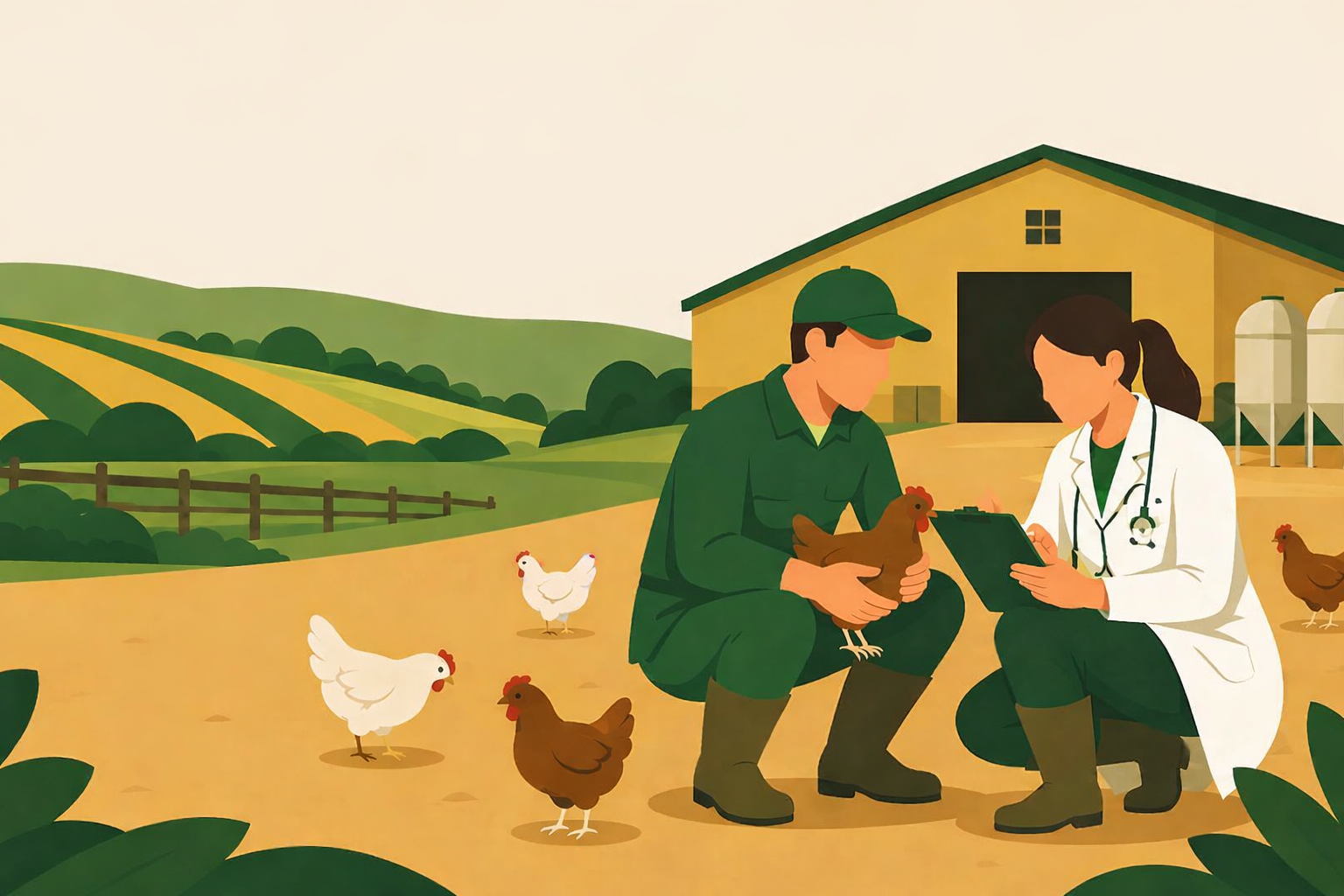
What is salmonellosis in laying hens?
Salmonellosis is an infection caused by bacteria of the genus Salmonella. In commercial laying hens the main concern is not disease in the birds themselves but the safety of consumer eggs. Some serotypes — above all Salmonella Enteritidis — can enter the egg before the shell is formed (so-called in-egg infection) or contaminate the shell from outside. For this reason salmonella in laying flocks is treated as a public-health issue, not merely a veterinary one. More on raising layers: Raising laying hens.
Why are laying flocks covered by a national control programme?
Because hen eggs are one of the main sources of human Salmonella food poisoning, commercial laying flocks in Poland and across the European Union are covered by a mandatory national Salmonella control programme. The programme requires regular testing of flocks for the serotypes targeted for control (chiefly S. Enteritidis and S. Typhimurium). Sampling takes place at set intervals throughout the laying period. Detection of a serotype covered by the programme triggers an obligation to report and to apply restrictions. An overview of the topic: Salmonella on a poultry farm.
How does salmonella present in laying hens?
In adult laying hens the infection often runs without clear signs — birds may be asymptomatic carriers, shedding the bacteria in their droppings and contaminating the environment and eggs. When signs do appear they may include: a drop in egg production, poorer shell quality, sometimes diarrhoea, reduced appetite and dullness. The absence of visible signs does not mean the absence of risk — which is exactly why regular laboratory testing matters, not just flock observation. An overview of other disease signs: Poultry diseases — symptom table.
How does salmonella get into the house?
There are many sources of infection. The most common are rodents (mice and rats are an important reservoir of the bacteria), wild birds and insects, contaminated feed and water, dirty equipment, and the clothing and footwear of people entering the house. A flock can also arrive already infected — through hatching eggs or chicks from an infected parent flock. That is why biosecurity must cover both the birds and everything that enters the farm. See: Vehicle entry and deliveries — biosecurity.
Why is pullet vaccination standard?
In commercial laying flocks, vaccination against Salmonella Enteritidis is standard and is carried out during rearing, before the young hens enter lay. Vaccination is not a hundred-percent guarantee, but it clearly reduces the risk of infection and shedding, and therefore the risk of egg contamination. Vaccination is one of the pillars of protection — alongside biosecurity, rodent control and egg-handling hygiene. The vaccination programme is always set by the veterinarian responsible for the flock: Poultry farm veterinarian.
How salmonella hits the laying flock and egg safety
Most of the danger is invisible to the naked eye — which is why laboratory testing and biosecurity matter, not observation alone.
Asymptomatic carriage
Adult hens often show no signs yet still shed Salmonella in their droppings. A contaminated environment and contaminated eggs are a real risk even in a flock that looks healthy.
Bacteria entering the egg
S. Enteritidis can enter the egg before the shell forms or contaminate the shell from outside. This is the main reason laying flocks are subject to control.
Drop in egg production
With active infection a decline in the number of eggs laid may be seen. This is a signal to consult the veterinarian and arrange testing.
Poorer shell quality
Thinner, misshapen or more easily cracked shells may accompany infection and further ease contamination of the egg contents.
Diarrhoea and dullness
Some birds develop diarrhoea, reduced appetite and lethargy. The signs can be non-specific, so they require confirmation by laboratory testing.
Egg-sale restrictions
Detection of a serotype covered by the programme (e.g. S. Enteritidis) brings restrictions on the trade in consumer eggs and an obligation to carry out actions ordered by the Veterinary Inspection.
How to protect the laying flock and egg safety from Salmonella
Effective protection combines pullet vaccination, strict biosecurity, rodent control, egg hygiene, and testing with documentation.
Pullet vaccination
In commercial laying flocks, vaccination against S. Enteritidis during rearing — before the birds come into lay — is standard. The vaccination programme is set by the veterinarian responsible for the flock.
Farm biosecurity
Tight entry rules (a hygiene barrier, change of clothing and footwear, a disinfection mat), separation of clean and dirty zones, and control of people and equipment limit the introduction of bacteria. Details: Poultry farm biosecurity.
Rodent and pest control
Rodents are one of the most important reservoirs of Salmonella. A continuous rodent-control programme, secured feed stores and sealed buildings are the foundation of protecting a laying flock.
Egg-collection and storage hygiene
Clean nests and egg belts, regular collection, proper cooling and storage, and discarding dirty or cracked eggs reduce the risk of contaminating consumer eggs.
Programme testing and reporting
A laying flock is subject to mandatory Salmonella testing at set intervals. A positive result for a serotype covered by the programme must be reported to the Veterinary Inspection and the ordered actions applied. Legal background: Legal requirements — keeping laying hens.
Records in the Flock Card
Test dates, results, vaccinations, treatments and medication are best kept digitally so they are ready for inspection. DlaFerm.pl lets you keep treatment and withdrawal records: Treatment records and drug withdrawal.
Frequently asked questions about salmonella in laying hens
Why is salmonella in laying hens mainly an egg issue?add
Because S. Enteritidis can pass into the egg or contaminate the shell, and eggs are one of the main sources of human food poisoning. That is why laying flocks fall under the national Salmonella control programme and consumer egg safety is the key concern here.
Does my flock have to be tested for Salmonella?add
Yes. Commercial laying flocks are subject to mandatory testing under the national Salmonella control programme, at set intervals throughout the laying period. The testing and sampling details are set by the veterinarian in line with current regulations.
Is vaccinating laying hens against Salmonella compulsory?add
In commercial laying flocks, vaccination against S. Enteritidis is standard and may be required by regulation depending on flock size. It is carried out during rearing. The scope and programme of vaccination are set by the veterinarian responsible for the flock.
What happens when S. Enteritidis is detected in a flock?add
Detection of a serotype covered by the programme must be reported to the Veterinary Inspection. This brings restrictions on the trade in consumer eggs and an order to carry out specific actions. The further course is conducted under the supervision of the district veterinary officer.
Can a hen with no signs spread Salmonella?add
Yes. Many infected laying hens are asymptomatic carriers — they look healthy but shed the bacteria in their droppings and can contaminate eggs and the environment. That is why observing the flock alone is not enough and laboratory testing is required.
How does DlaFerm.pl help with salmonella?add
DlaFerm.pl lets you keep digital flock records: testing dates and results, vaccinations, treatments and the record of medication and withdrawal periods. This keeps the data organised and ready for a Veterinary Inspection visit and for the needs of the control programme.
Keep your laying-flock records with DlaFerm.pl
Want to see how the Flock Card and treatment records organise tests, vaccinations and results? Write to us or create an account.
Phone
+48 796 258 151