Goose stocking density — indoors and on the range
A goose is a grazing bird, so stocking density is calculated differently than for a broiler: you have to give both how many birds fit per square metre indoors and how much range or pasture area there is per bird. We explain in plain language the indicative birds/m² and kilograms of live weight per square metre (kg/m²) in the house, the range area per bird, and how density affects litter, air quality and flock welfare.
verifiedFrom the team that has organised work on poultry farms for years.
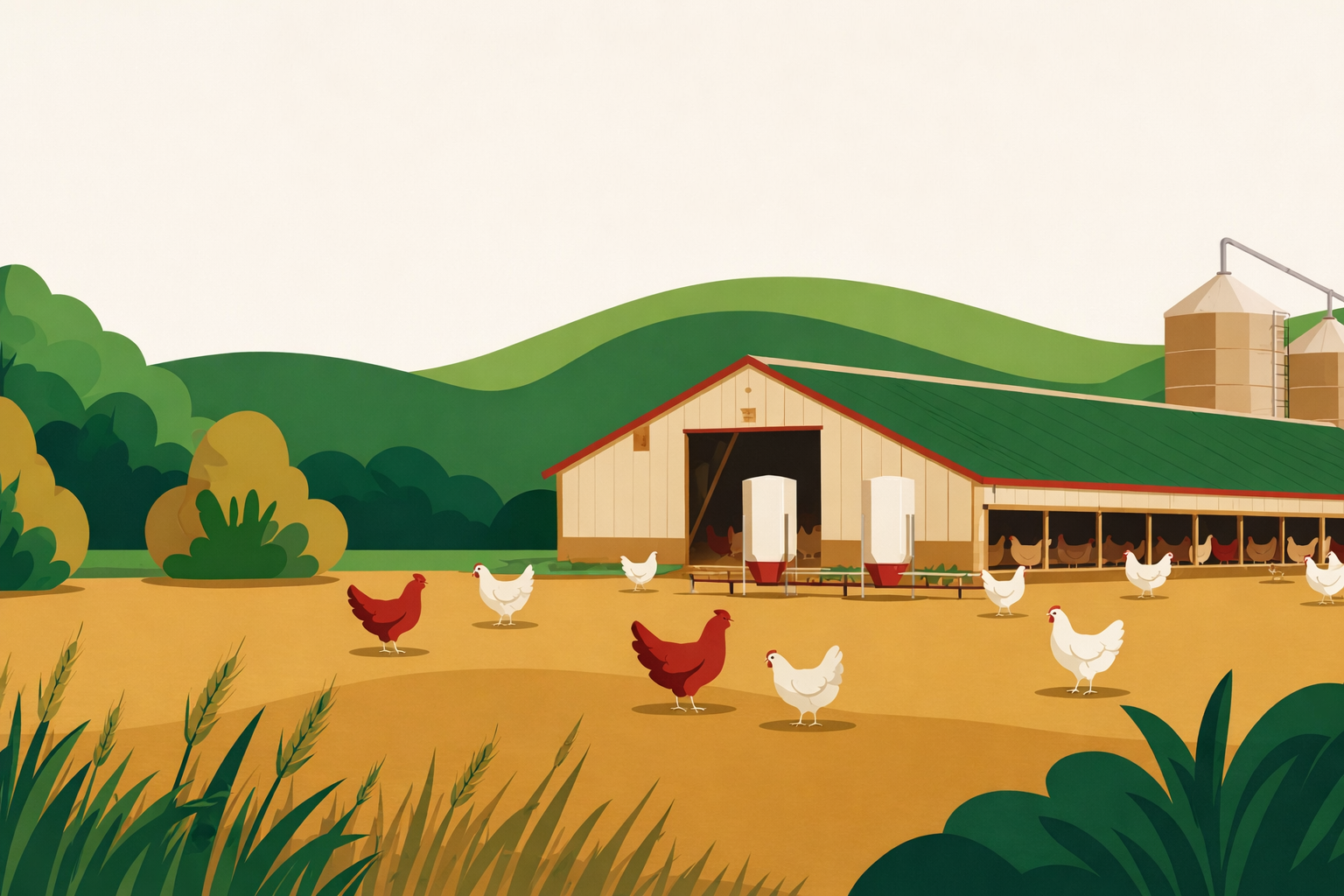
Stocking density is the number of birds per area on which they are kept. For geese we talk about two areas at once: the area indoors (where the birds sleep and shelter from the weather) and the area of the range or pasture outdoors. A goose is a grazing bird — in natural husbandry it spends a lot of time on grass, so the indoor area cannot be considered separately from the range. The broader picture of the whole husbandry is in the guide on goose farming.
Why is goose stocking density not the same as broiler density?
A broiler is kept exclusively indoors, and its density is calculated mainly in kilograms of live weight per square metre (kg/m²) — we cover this in the guide on broiler stocking density. A goose is larger, grows more slowly and naturally uses a range. That is why for geese three things matter at once: how many birds per m² indoors, how many kg of live weight per m² (because a goose weighs several kilograms before slaughter) and how many m² of range or pasture per bird. Too high a density indoors means wet litter and worse air; too small a range means a trampled, muddy sward and a higher parasite risk.
Where do the numbers in this guide come from?
The indicative values* are based on Council of Europe recommendations on keeping domestic geese, on national poultry welfare guidance and on husbandry guides. The exact figures depend on the age and weight of the birds, the breed, the season and the production system (deep litter, with a range, extensive on pasture). Treat the values given as a starting point, not a fixed norm — always check the birds’ response and the condition of the litter and the sward. Welfare indicators are covered in more detail in the guide on poultry welfare indicators.
Goose stocking density — from the house to the range, step by step
- 1
Determine the stage — rearing or finishing
You plan a different density for young goslings in rearing than for geese being finished before slaughter. Goslings are small at the start and need warmth and less space, but they grow fast, so density has to be reduced as they age — otherwise it becomes crowded before you notice. In finishing the birds are large and heavy, so fewer of them fit per square metre. The rearing stages are covered in detail in the guide on goose rearing.
- 2
Calculate indoor density in birds and in kg/m²
Indoors, density is given both in birds per m² and in kilograms of live weight per m². Indicatively* for goslings in the first weeks this is a few to a dozen or so birds per m² (the older they are, the fewer), and for geese in finishing usually about 2–3 birds per m². Because a goose weighs several kilograms before slaughter, it is worth checking kg/m² as well: too much live weight per metre quickly means wet litter and worse air. The requirements of the house itself (area, ventilation, litter) are covered in the guide on housing requirements for geese.
- 3
Plan the range or pasture area per bird
A goose is a grazing bird, so the range is just as important as the house. Indicatively* in a range system you plan a few to a dozen or so square metres of range per bird, and in an extensive system on pasture — much more, because the sward has to have time to regrow and not turn into mud. The more area per bird, the longer a green, healthy sward lasts and the lower the risk of parasites and excessive mud. Welfare on the range is covered in more detail in the guide on goose welfare.
- 4
Check the effect of density on litter and air
Geese drink a lot of water and produce loose, wet droppings, so their litter gets damp faster than that of hens. Too high a density indoors means litter that cannot keep up with drying, a rising ammonia level and worse air — and that hits the legs, feathers and overall welfare of the birds. The first sign of too high a density is precisely wet, caked litter. How to manage it is covered in the guide on litter management in the house.
- 5
Match density to the welfare programme and regulations
If you use welfare subsidies or meet a buyer’s requirements, density may be lower than the maximum you could technically fit in the house — programmes usually reward more space per bird. Before the next batch, check the terms of your programme and the applicable regulations. The legal requirements for keeping geese are gathered in the guide on legal standards for keeping geese, and the rules for subsidies in the guide on poultry welfare — subsidies.
Table: goose stocking density indoors and on the range
Indicative birds/m² and kg/m² indoors and range area per bird, by husbandry stage. Indicative figures* — always adjust to the age, weight of the birds and the flock’s response.
Goslings in rearing (house)
In the first weeks goslings are small and can be kept more densely — indicatively* a few to a dozen or so birds per m². The key, however, is to reduce density as they grow: what is comfortable at the start becomes crowded after a few weeks. Wet litter under goslings is the first sign that density is too high.
Geese in finishing (house)
Growing and finishing geese are large and heavy, so fewer of them fit per m² — indicatively* about 2–3 birds per m². It is worth also watching kilograms of live weight per metre (kg/m²), because several kilograms of weight per bird quickly raises the load on the litter and worsens the air if density is too high.
Range by the house
In a range system you plan indicatively* a few to a dozen or so m² of range per bird. A smaller range gets trampled and muddy faster, a larger one keeps a green sward longer. The range should have access to shade and clean water and adequate drainage so that puddles and mud do not form.
Pasture (extensive system)
In an extensive system, where the geese graze, the area per bird is much larger than by the house — the sward has to have time to regrow between grazings and not be eaten down “to bare ground”. The larger the area and the better the paddock rotation, the healthier the sward, the fewer parasites and the better the grazing results.
The most common mistakes with goose stocking density
A few mistakes come up repeatedly — worth knowing before you plan your next batch.
Not reducing density as goslings grow
A density that was comfortable at the start becomes too high after a few weeks because the birds grow fast. Keeping the same number of goslings on the same area throughout rearing means wet litter, worse air and slower growth. Plan density with the target bird weight in mind, and thin out the flock during rearing if necessary.
Overlooking the range area
Focusing only on indoor density and treating the range “any old how” is a common mistake with a grazing bird like the goose. Too small a range quickly turns into a muddy, trampled surface — that means worse welfare, muddier birds and a higher parasite risk. Plan the range area just as carefully as the indoor area.
Ignoring wet litter as a signal
Geese naturally wet the litter more than hens do. If the litter is constantly wet and caked, it usually means too high a density or too weak ventilation — adding fresh litter is not enough, you have to reduce the load. Wet litter means worse feathers, leg problems and rising ammonia. How to manage it: litter management in the house.
No paddock rotation on pasture
Keeping geese on the same pasture paddock all season leads to the sward being eaten and trampled down and parasites building up in the soil. Without paddock rotation and rest for the sward, even a large area stops doing its job over time. Plan dividing the pasture into paddocks and give the sward time to regrow.
Frequently asked questions about goose stocking density
How many geese can be kept per square metre indoors?add
It depends on the age and weight of the birds. Indicatively* goslings in the first weeks can be kept more densely (a few to a dozen or so birds per m²), but density has to be reduced as they grow. Adult finishing geese are large and heavy, so usually about 2–3 birds fit per m². Always also watch kilograms of live weight per metre (kg/m²) and the condition of the litter — wet, caked litter is a sign that density is too high.
How much range area does one goose need?add
A goose is a grazing bird, so the range is just as important as the house. Indicatively* in a range system you plan a few to a dozen or so m² per bird, and in an extensive system on pasture much more, because the sward has to have time to regrow. The more area per bird and the better the paddock rotation, the longer a green, healthy sward lasts and the lower the risk of mud and parasites.
Why does goose stocking density differ from broiler density?add
A broiler is kept exclusively indoors and its density is calculated mainly in kg of live weight per m² — covered in the guide on broiler stocking density. A goose is larger, grows more slowly and naturally uses a range. That is why for geese both the indoor density (birds/m² and kg/m²) and the range or pasture area per bird matter. Overlooking the range is a common mistake when planning goose husbandry.
How does density affect litter and air in a goose house?add
Geese drink a lot of water and produce loose, wet droppings, so their litter gets damp faster than that of hens. Too high a density indoors means litter that cannot keep up with drying, rising ammonia and worse air — which hits the legs, feathers and welfare of the birds. The first sign of too high a density is wet, caked litter. How to manage it is covered in the guide on litter management in the house.
Does density differ between rearing and finishing?add
Yes. In rearing goslings are small and can be kept more densely, but they grow fast, so density has to be reduced gradually. In finishing the birds are large and heavy, so far fewer fit per square metre. Planning density “for the start” without adjusting during rearing is a common mistake. The rearing stages are covered in the guide on goose rearing.
Do welfare programmes require a lower goose density?add
Often yes — welfare programmes and buyer requirements usually reward more space per bird, so density tends to be lower than the maximum you could technically fit in the house. The exact requirements depend on the specific programme and the regulations. The legal requirements for keeping geese are gathered in the guide on legal standards for keeping geese, and the rules for subsidies in the guide on poultry welfare — subsidies.
Sources & resources
- linkCouncil of Europe — Standing Committee Recommendation concerning domestic geese (Anser anser, Anser cygnoides) — European Convention for the Protection of Animals kept for Farming Purposes (coe.int)
- linkEFSA — scientific opinions on poultry welfare (efsa.europa.eu)
- linkNational Research Institute of Animal Production (IZ-PIB) — guidance and materials on waterfowl husbandry (izoo.krakow.pl)
Track flock density in DlaFerm.pl
Want a digital flock record and batch history in one place? Create a free farm account or write to us.
Phone
+48 796 258 151