Coccidiosis in laying hens: symptoms, prevention and treatment records
Coccidiosis caused by Eimeria protozoa is most dangerous to layers during rearing — to chicks and pullets. Learn how to recognise it, how to protect young birds, and how to keep treatment records with egg withdrawal periods.
verifiedFrom the team that has organised work on poultry farms for years.
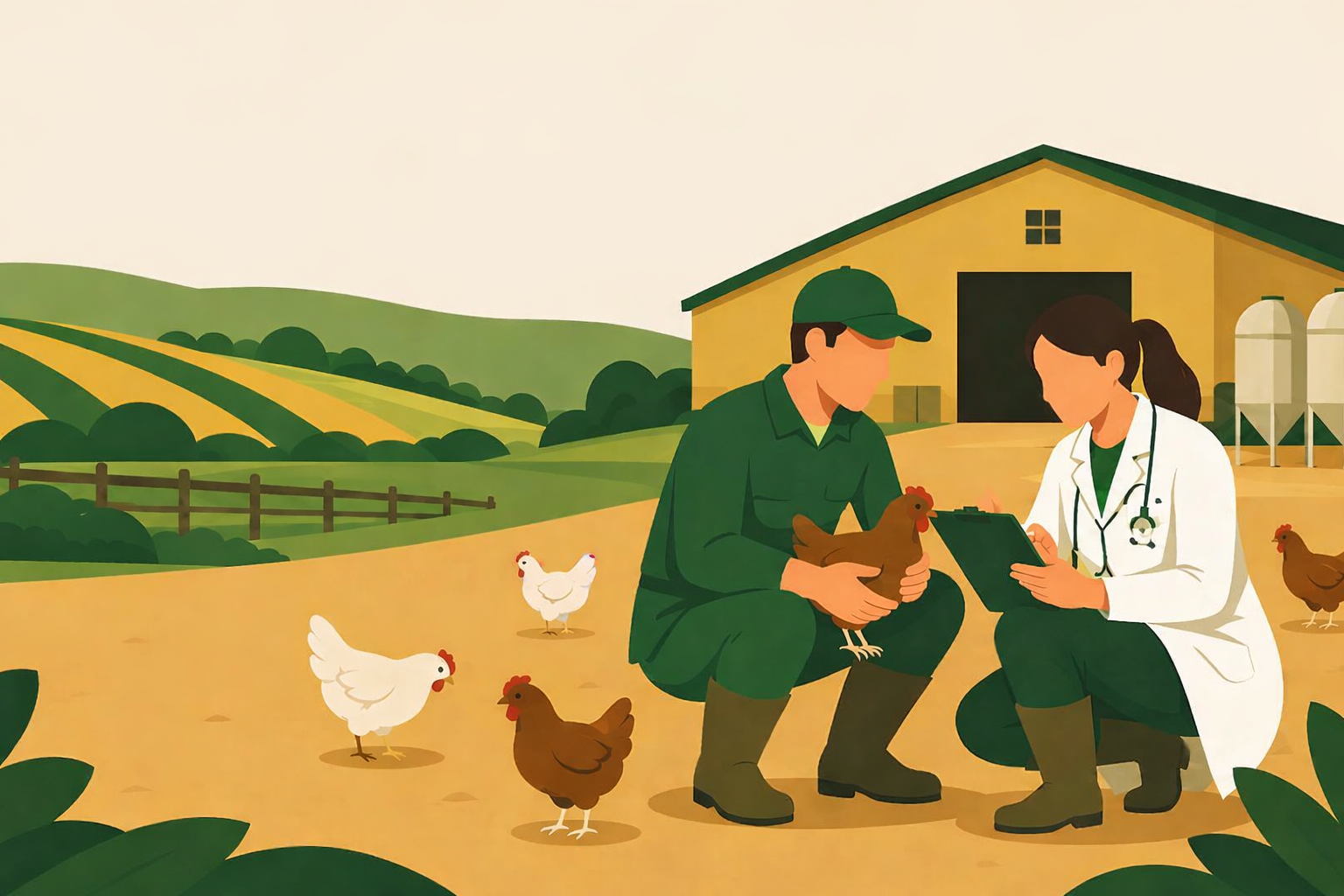
What is coccidiosis in laying hens?
Coccidiosis is a parasitic disease caused by protozoa of the genus Eimeria. These parasites destroy the intestinal epithelium, so the bird cannot properly absorb feed or water. In laying hens the problem mainly concerns the rearing period — chicks and pullets (young hens before lay). Adult layers usually acquire immunity after a mild early-life contact with the parasite. The disease spreads via the faecal-oral route: oocysts shed in faeces reach the litter and then the beaks of healthy birds. More on keeping layers: Raising laying hens.
Why is coccidiosis mainly a rearing problem?
Young birds have not yet developed immunity to Eimeria, so they fall ill most often and most severely. During rearing the pullet’s body gradually “learns” the parasite — provided contact is controlled, for example through vaccination or low, safe doses in the litter. Uncontrolled mass exposure to large numbers of oocysts results in clinical disease. In broilers, which live briefly, the course is similar — see the comparison here: Coccidiosis in broilers. In layers, at stake is not only chick health but also the uniform development of the future laying flock.
What are the symptoms in hens and pullets?
The most common symptoms include: watery or bloody diarrhoea (blood in faeces points to Eimeria tenella, which damages the caeca), ruffled feathers, listlessness and birds huddling under heaters, poorer feed and water intake, and weaker, uneven pullet development. In already-laying birds, a drop in egg production and pallor of the comb and wattles caused by anaemia are also seen. In mild cases the disease is subclinical: the only signal is poorer weight gain and a less uniform flock, with no obvious diarrhoea.
How does litter affect coccidiosis risk?
Litter moisture is a key risk factor. Eimeria oocysts sporulate (become infective) within 1–3 days in warm, wet conditions. Leaking drinkers, poor ventilation or diarrhoea of another cause raise litter moisture and accelerate parasite multiplication. Dry, friable litter and clean drinkers are the first line of defence, especially in the rearing house. More on litter management: Poultry house litter — management.
Coccidiosis, other diseases and flock welfare
Intestine damaged by Eimeria opens the door to bacterial infections, including Clostridium perfringens responsible for necrotic enteritis. Weakened, undernourished pullets cope worse with stress and handling, which affects the later welfare of the laying flock — see Laying hen welfare. When coccidiosis is suspected, always consult a veterinarian and run diagnostics. Overview of other diseases: Poultry diseases — symptom table.
How coccidiosis hits hens and pullets
Each of these signals should prompt the farmer to consult a veterinarian.
Bloody or watery diarrhoea
Blood in faeces — especially dark red — indicates caecal damage by Eimeria tenella. This is an alarm signal requiring immediate veterinary intervention.
Ruffled feathers and listlessness
Sick birds stand fluffed up, avoid feeders and huddle under heaters. Regular observation of pullet behaviour allows early detection of the problem.
Weaker pullet development
Slower growth and large weight differences between birds in the flock are a common sign of subclinical coccidiosis, which reduces the uniformity of the future laying flock.
Drop in egg production
In already-productive birds, coccidiosis lowers feed and water intake, and as a result the number and quality of eggs laid falls.
Pale comb and wattles
Anaemia after haemorrhagic coccidiosis shows as a pale comb and wattles — a sign of severe disease visible to the naked eye.
Deaths in the rearing house
In severe cases, especially when coccidiosis co-exists with bacterial infection, mortality of chicks and pullets can rise sharply.
How to protect pullets from coccidiosis and how to act when disease is suspected
Effective prevention combines an anti-Eimeria programme, a dry environment and accurate records — always agreed with a veterinarian.
Coccidiostats in rearing feed
Coccidiostats (ionophores and non-ionophores) added to rearing feed inhibit Eimeria development in the intestine of young birds. Their use is legal in the EU and regulated by animal nutrition law — always on veterinary advice and observing the withdrawal period. The programme is decided by a veterinarian.
Pullet vaccination
Vaccines contain live attenuated Eimeria oocysts given to chicks in early life (usually via water or spray). They let layers acquire lasting immunity for their whole productive life. In vaccinated flocks, vaccination is not combined with ionophores, which would destroy the vaccine strain.
Dry litter and clean drinkers
Keeping litter dry and friable limits oocyst sporulation, while clean, leak-free drinkers prevent dampness and parasite spread. This is the basis of prevention in the rearing house. Details: Poultry house litter.
Diagnostics and a programme with the vet
Diagnosis is based on symptoms, post-mortem of dead birds and faecal examination for oocysts (flotation or McMaster). Drug selection, dose and treatment duration, as well as the choice between a coccidiostat and vaccination, are set by a veterinarian as part of farm biosecurity.
Treatment records and egg withdrawal
Every administration of a veterinary medicine must be recorded: date, drug, dose, route and withdrawal period. For layers the egg withdrawal period is especially important — during it eggs must not be placed on the market. DlaFerm.pl keeps these records digitally. More: Treatment records and drug withdrawal.
Development monitoring in the Flock Card
Tracking body weight, flock uniformity and pullet feed intake in the Flock Card helps detect subclinical coccidiosis before clear signs appear. Planning laying hen stocking density also helps, as density affects parasite pressure.
Frequently asked questions about coccidiosis in laying hens
What is coccidiosis in laying hens?add
It is a parasitic disease caused by Eimeria protozoa that destroy the intestinal epithelium. In layers it mainly concerns rearing — chicks and pullets — because adult birds usually acquire immunity. It causes diarrhoea, ruffled feathers, poorer development, and in laying birds a drop in egg production and pallor.
Why do mainly young hens fall ill, not adult layers?add
Chicks and pullets have no immunity to Eimeria yet, so they fall ill most severely. Adult layers had earlier controlled contact with the parasite (naturally or by vaccination) and acquired immunity. That is why prevention focuses on the rearing period.
Can I sell eggs during coccidiosis treatment?add
Not always — many drugs have an egg withdrawal period during which eggs must not be placed on the market. The withdrawal period is always given on the drug leaflet and by the veterinarian. Every treatment must therefore be recorded together with the withdrawal end date.
Is pullet vaccination or coccidiostats better?add
It depends on the production system and the vet’s decision. Vaccination gives layers lasting lifelong immunity and is common in organic and coccidiostat-free production. Coccidiostats in feed are simpler logistically. Important: in vaccinated flocks, vaccination is not combined with ionophores.
What should I do if I suspect coccidiosis in my flock?add
Contact a veterinarian and do not administer drugs without a diagnosis and prescription. The vet will order faecal examination and post-mortem, choose treatment and indicate the withdrawal period. Self-treatment risks the wrong dose and a breach of the egg withdrawal period.
How does DlaFerm.pl help with coccidiosis in layers?add
DlaFerm.pl enables digital treatment and withdrawal records — including the egg withdrawal period required for layers. The Flock Card lets you track pullet development, flock uniformity and egg production, making early detection of subclinical coccidiosis easier. Data are always at hand during veterinary inspections.
Sources & resources
Keep treatment and egg withdrawal records with DlaFerm.pl
Want to see how the Flock Card and egg withdrawal records work? Write to us or create an account.
Phone
+48 796 258 151